


ERP Software Malaysia: Essential Modules Every Business Needs
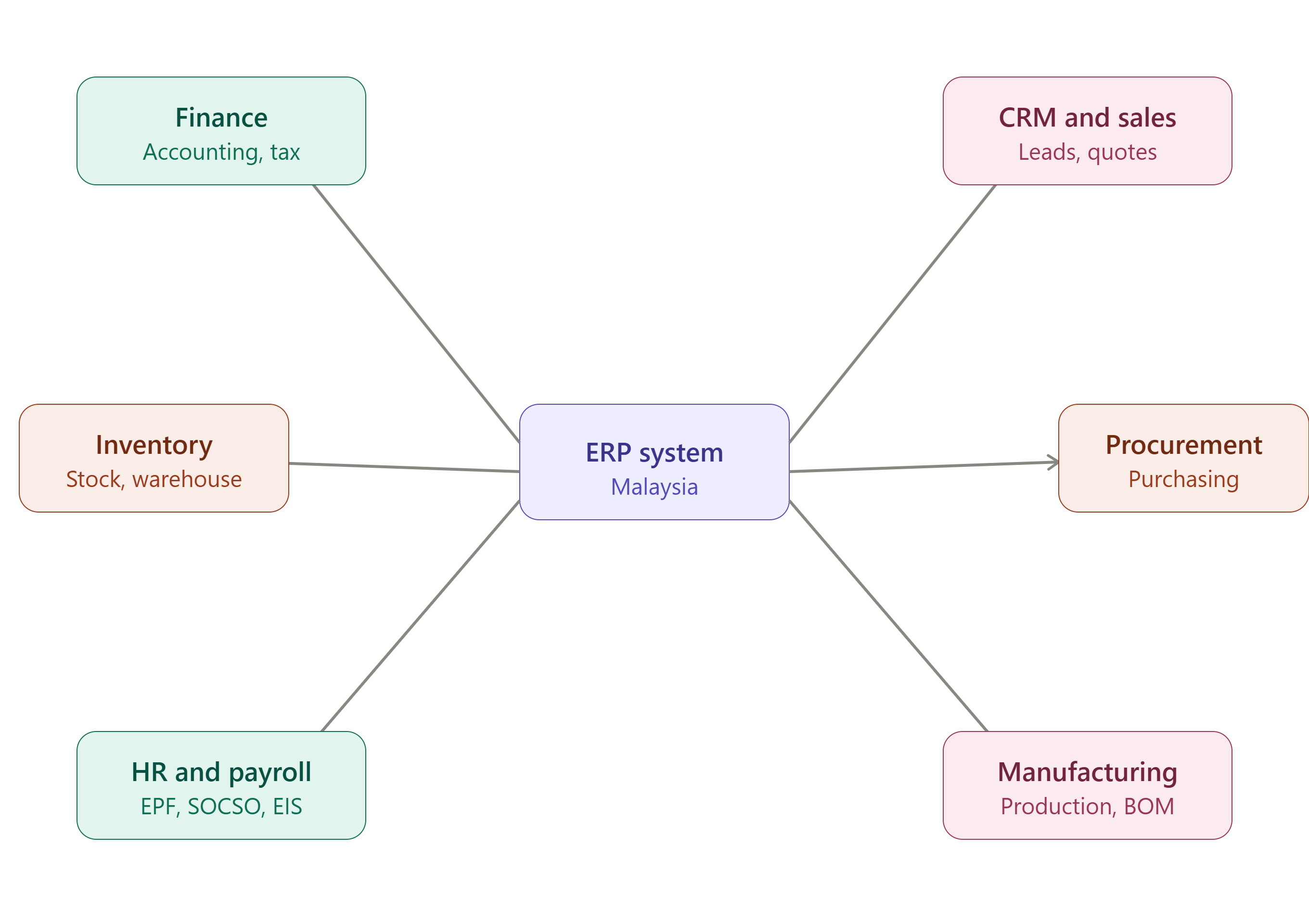
Running a business in Malaysia today means juggling finance, inventory, HR, sales, and compliance all at once. When these functions live in separate spreadsheets or disconnected tools, mistakes creep in, reporting slows down, and growth stalls. This is exactly why more companies, from Klang Valley SMEs to manufacturing plants in Penang, are investing in ERP software Malaysia to bring every department onto a single platform.
An Enterprise Resource Planning (ERP) system isn't just another piece of software. It's the operational backbone that connects your finance team, warehouse staff, sales reps, and management under one shared source of truth. But not every ERP system Malaysia businesses adopt delivers real value. The difference usually comes down to which modules are included and how well they're implemented.
In this guide, we'll break down the essential ERP modules every Malaysian business should look for, why each one matters, and how to choose a system that fits your industry and growth stage.
Why ERP Software Matters for Malaysian Businesses
Malaysia's business landscape is diverse, spanning manufacturing, retail, logistics, construction, and services. Each of these industries has its own operational complexity, but they share common pain points: manual data entry, disconnected departments, delayed reporting, and difficulty staying compliant with local regulations like SST (Sales and Service Tax) and LHDN's e-invoicing requirements.
A well-implemented ERP system Malaysia companies use addresses these challenges by centralizing data, automating repetitive tasks, and giving decision-makers real-time visibility into operations. Instead of waiting days for a consolidated report, management can pull up live dashboards showing cash flow, stock levels, and sales performance in seconds.
Beyond efficiency, ERP adoption is increasingly tied to competitiveness. Businesses that can respond faster to market changes, fulfil orders more accurately, and forecast demand more reliably tend to outperform those still relying on fragmented systems.
Essential ERP Modules Every Business Needs
Not all ERP platforms are built the same, and not every business needs every module from day one. However, there are core modules that form the foundation of a functional, scalable ERP system Malaysia companies should prioritize.
1. Finance and Accounting
This is the heart of any ERP software Malaysia deployment. The finance module handles general ledger, accounts payable and receivable, budgeting, and financial reporting. For Malaysian businesses, it should also support local compliance requirements such as SST filing, withholding tax calculations, and increasingly, LHDN's e-invoicing framework.
A strong finance module eliminates the need for separate accounting software, reduces reconciliation errors, and gives finance teams real-time visibility into cash flow and profitability across departments or branches.
2. Inventory and Warehouse Management
For businesses dealing with physical goods, whether retail, distribution, or manufacturing, inventory visibility is critical. This module tracks stock levels, movements, and valuations across multiple warehouses or outlets.
Good inventory management within an ERP system Malaysia businesses use can prevent stockouts and overstocking, automate reorder points, and support barcode or RFID scanning for faster, more accurate stock counts. It also integrates directly with sales and procurement, so stock figures update automatically as orders come in and out.
3. Human Resources and Payroll
Managing a workforce in Malaysia comes with specific statutory obligations, including EPF, SOCSO, EIS, and PCB (monthly tax deduction) calculations. An HR and payroll module built for the local market automates these calculations, reduces compliance risk, and simplifies leave management, attendance tracking, and performance appraisals.
This module also helps HR teams manage onboarding, employee records, and claims processing without relying on manual spreadsheets, which is especially valuable as headcount grows across multiple locations.
4. Customer Relationship Management (CRM) and Sales
Sales teams need quick access to customer history, quotations, and order status to close deals efficiently. A CRM module within your ERP software Malaysia setup keeps leads, opportunities, and customer interactions organized in one place, while syncing directly with inventory and finance to confirm stock availability and generate invoices without duplicate data entry.
This tight integration between sales and other departments shortens the order-to-cash cycle and improves the overall customer experience.
5. Procurement and Supply Chain Management
Procurement modules streamline purchase requisitions, vendor management, and purchase order approvals. For businesses with multiple suppliers or complex sourcing needs, this module helps track vendor performance, negotiate better terms, and maintain a clear audit trail for every purchase.
When connected to inventory and finance, procurement data flows automatically into stock records and accounts payable, reducing manual reconciliation and improving supplier relationship management.
6. Manufacturing and Production Planning
For Malaysia's manufacturing sector, a production module is indispensable. It manages bills of materials (BOM), production scheduling, work orders, and shop floor tracking. This helps manufacturers plan capacity accurately, reduce material waste, and maintain quality control throughout the production cycle.
Manufacturers using an integrated ERP system Malaysia-wide can also better forecast raw material needs based on sales trends, avoiding costly production delays.
7. Business Intelligence and Reporting
Data is only useful if it can be turned into insight. A business intelligence module aggregates data from finance, sales, inventory, and HR into customizable dashboards and reports. This allows management to spot trends, monitor KPIs, and make informed decisions without waiting for manual report compilation.
For growing businesses, this module is often what separates reactive decision-making from proactive, data-driven strategy.
8. Point of Sale (POS) for Retail
Retail and F&B businesses benefit from a POS module tightly integrated with inventory and finance. This ensures every transaction automatically updates stock levels and financial records in real time, eliminating the need to manually reconcile sales data at the end of each day.
9. Project Management
Service-based businesses, contractors, and consultancies often need to track project timelines, budgets, and resource allocation. A project management module within the ERP allows teams to monitor project profitability alongside overall company finances, rather than managing projects in isolation.
10. Compliance and Localization
Given Malaysia's evolving regulatory environment, particularly around e-invoicing mandates being rolled out in phases by LHDN, compliance features are no longer optional. The right ERP software Malaysia businesses choose should be regularly updated to reflect changes in tax regulations, reporting formats, and statutory requirements, reducing the risk of penalties or last-minute scrambles.
How to Choose the Right ERP System for Your Business
With so many modules available, it's tempting to look for the platform with the longest feature list. But the right ERP system Malaysia businesses should choose isn't necessarily the one with the most modules, it's the one that fits your industry, size, and growth plans.
A few practical considerations:
- Start with your core pain points. If cash flow visibility is your biggest challenge, prioritize a strong finance module before adding manufacturing or project management features.
- Check for local compliance support. Ensure the system is updated regularly for SST, PCB, and e-invoicing requirements specific to Malaysia.
- Evaluate scalability. Choose a system that can add modules as your business grows, rather than requiring a full platform switch later.
- Consider integration capabilities. Your ERP should connect with existing tools like e-commerce platforms, banking systems, or third-party logistics providers.
- Look at vendor support and implementation experience. A system is only as good as the team helping you deploy and customize it for your specific workflows.
Final Thoughts
Choosing the right combination of modules is what turns ERP software Malaysia companies invest in from a simple accounting tool into a genuine growth enabler. Whether you're a manufacturer needing tight production control, a retailer managing multiple outlets, or a services firm tracking project profitability, the modules you prioritize should reflect where your business actually needs the most support.
If you're evaluating providers, it's worth working with a team that understands both the technical side of ERP implementation and the practical realities of running a business in Malaysia. GO-Globe has experience building and customizing business software solutions tailored to local compliance requirements and industry-specific workflows, making it a solid starting point for businesses ready to move beyond spreadsheets and disconnected tools.
 Portuguese
 English
 Arabic
 French
 Spanish
 Deutsch
 Turkish
 Dutch
 Italiano
 Russian
 Romaian
 Portuguese (Brazil)
 Greek