


What Is Vedic Astrology and How Does It Work?
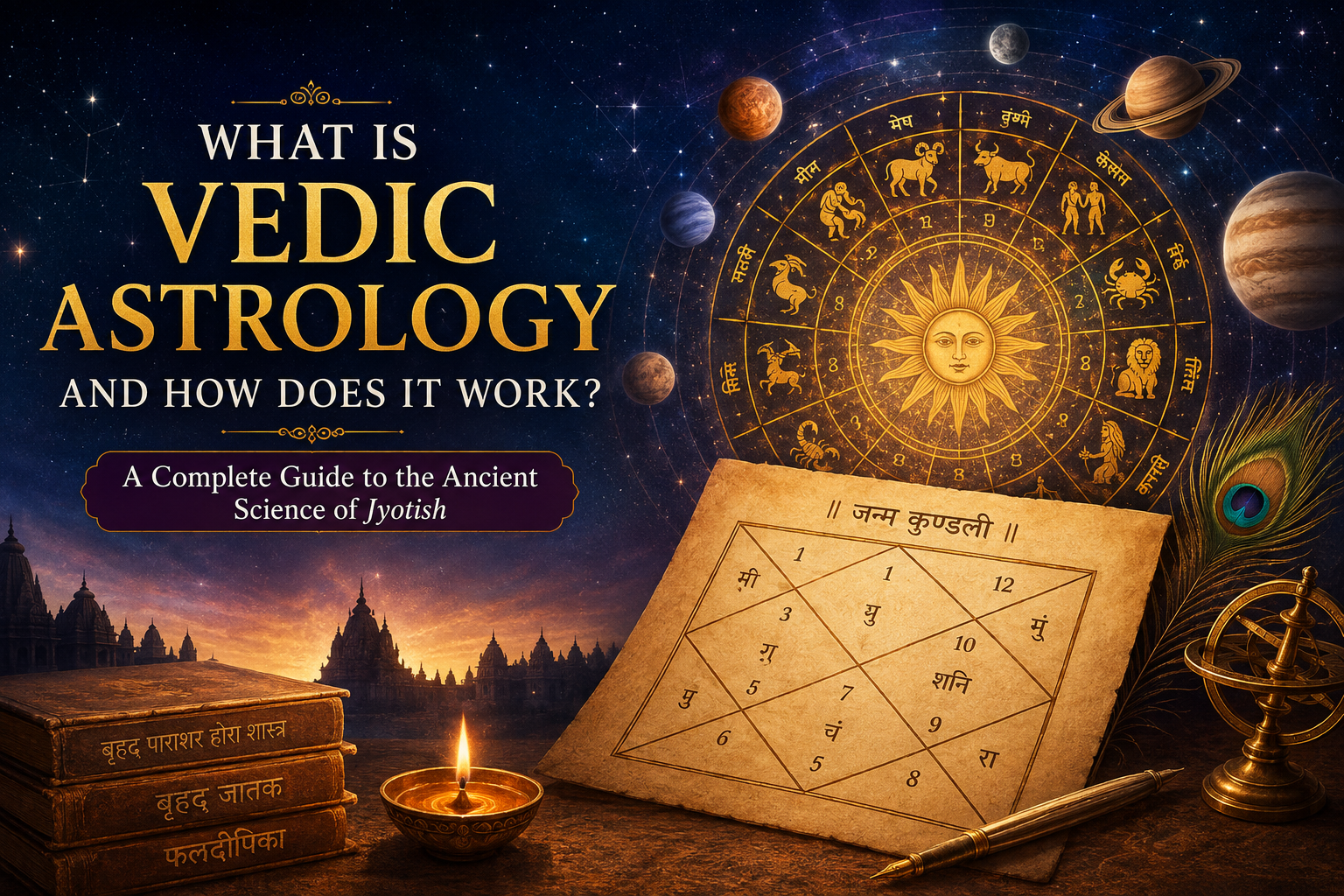
Vedic astrology is one of the oldest systems of astrology in the world. Rooted in the ancient Indian tradition, it is traditionally known as Jyotish, a Sanskrit term associated with light, illumination, and the study of celestial influences. For thousands of years, Vedic astrology has been used to understand personality, life patterns, important periods, relationships, career choices, and other areas of life through the positions of celestial bodies.
Unlike modern Western astrology, Vedic astrology follows the sidereal zodiac, which takes the actual positions of the stars into account. It also places strong importance on the Moon, planetary periods, houses, lunar constellations called Nakshatras, and the concept of karma.
Today, people consult Vedic astrologers both traditionally and online to gain a different perspective on their life circumstances and future possibilities.
What Is Vedic Astrology?
Vedic astrology is an astrological system that originated in the Indian subcontinent and developed through ancient Indian astronomical and philosophical traditions. Its classical literature includes important works such as the Brihat Parashara Hora Shastra, Brihat Jataka, and other Jyotish texts.
At its core, Vedic astrology attempts to interpret the relationship between the positions of celestial bodies at a person's birth and different areas of life.
A Vedic astrologer generally studies a person's:
- Date of birth
- Exact time of birth
- Place of birth
These details are used to calculate a Janam Kundli, or birth chart. The chart represents the positions of the Sun, Moon, planets, zodiac signs, houses, and Nakshatras at the moment of birth.
The astrologer then interprets these placements to provide insights into personality, relationships, career, finances, family life, and significant periods of change.
How Does Vedic Astrology Work?
The foundation of Vedic astrology is the birth chart. When a person is born, the sky has a particular arrangement of planets and other astronomical points. Vedic astrology interprets this arrangement symbolically.
A typical Vedic astrology consultation involves several major elements.
1. Birth Details
Accurate birth information is extremely important because even a small difference in birth time can affect the Ascendant and the placement of planets in houses.
The three primary details are:
Date of birth: Determines the astronomical positions of planets on that day.
Time of birth: Helps determine the Ascendant and house placements.
Place of birth: Establishes the geographical coordinates required to calculate the chart accurately.
Together, these details are used to construct the Janam Kundli.
2. The Ascendant or Lagna
The Lagna, or Ascendant, is the zodiac sign rising on the eastern horizon at the time of birth.
It is one of the most important factors in Vedic astrology because it forms the foundation of the birth chart and determines the arrangement of the twelve houses.
The Lagna is traditionally associated with areas such as:
- Physical appearance
- Personality
- General behavior
- Individual identity
- Approach to life
- Overall life direction
Two people born on the same day can have very different birth charts because their birth times and locations may differ.
3. The Twelve Houses
The Vedic birth chart is divided into twelve houses, with each house representing particular areas of life.
First House – Self and Personality
The first house represents the individual, personality, appearance, vitality, and general approach to life.
Second House – Wealth and Family
The second house is associated with accumulated wealth, speech, family values, food, and possessions.
Third House – Communication and Courage
This house relates to communication, skills, courage, siblings, short journeys, and personal initiative.
Fourth House – Home and Emotional Foundations
The fourth house is traditionally connected with home, mother, property, education, comfort, and emotional foundations.
Fifth House – Creativity and Intelligence
The fifth house is associated with creativity, learning, children, intelligence, romance, and self-expression.
Sixth House – Work, Challenges, and Service
This house relates to daily work, service, competition, debts, obstacles, and health-related themes.
Seventh House – Marriage and Partnerships
The seventh house is particularly important for marriage, partnerships, business relationships, and one-to-one connections.
Eighth House – Transformation and Hidden Matters
The eighth house is traditionally associated with transformation, sudden changes, inheritance, shared resources, and subjects that are less visible.
Ninth House – Dharma, Higher Learning, and Fortune
The ninth house represents higher education, spirituality, philosophy, long-distance journeys, teachers, and traditional concepts of fortune or dharma.
Tenth House – Career and Public Life
The tenth house is one of the most important houses for career and professional life. It is associated with occupation, reputation, achievements, authority, and public responsibilities.
Eleventh House – Gains and Aspirations
The eleventh house relates to income from professional activities, gains, networks, friendships, ambitions, and fulfillment of desires.
Twelfth House – Expenses and Spirituality
The twelfth house is associated with expenses, foreign connections, isolation, retreat, sleep, and spiritual themes.
The interpretation of a house depends not only on the house itself but also on its ruling planet, the planets placed within it, aspects received, and the broader structure of the chart.
The Role of the Nine Grahas
Vedic astrology traditionally works with nine major Grahas, often called the Navagraha.
These include:
- Sun — Surya
- Moon — Chandra
- Mars — Mangala
- Mercury — Budha
- Jupiter — Guru
- Venus — Shukra
- Saturn — Shani
- Rahu
- Ketu
Rahu and Ketu are not physical planets. They are the lunar nodes—the points where the Moon's orbit intersects the apparent path of the Sun.
Each Graha is traditionally associated with particular qualities and areas of life.
For example, the Sun is associated with authority, confidence, identity, and leadership. The Moon is associated with emotions, mental tendencies, and sensitivity. Jupiter is traditionally connected with wisdom, learning, expansion, and guidance, while Saturn is associated with discipline, responsibility, patience, and long-term effort.
However, a planet is not interpreted in isolation. Its sign, house, dignity, relationships with other planets, and planetary periods all influence the interpretation.
What Are Nakshatras?
One of the distinctive features of Vedic astrology is the use of 27 Nakshatras, or lunar constellations.
The zodiac is divided into 27 sections, each covering 13 degrees and 20 minutes. The Moon's position at birth determines a person's Janma Nakshatra, or birth star.
Each Nakshatra has its own traditional symbolism, qualities, planetary ruler, and mythological associations.
Nakshatras are particularly important for understanding:
- Emotional tendencies
- Personality characteristics
- Compatibility
- Timing techniques
- Planetary periods
- Traditional naming practices
Because the Moon moves relatively quickly through the zodiac, the Nakshatra can provide a more specific layer of interpretation within a birth chart.
What Is a Kundli?
A Kundli, also called a Janam Kundli or birth chart, is a graphical representation of the planetary positions at the time and place of birth.
A Vedic astrologer may examine several components of the Kundli, including:
- Ascendant
- Moon sign
- Sun sign
- Planetary placements
- Houses
- Nakshatras
- Planetary aspects
- Planetary strengths
- Yogas
- Dashas
- Divisional charts
The objective is not simply to identify a person's zodiac sign. Instead, Vedic astrology considers the entire chart as an interconnected system.
What Are Dashas in Vedic Astrology?
One of the most important predictive techniques in Vedic astrology is the Dasha system.
Dashas are planetary periods used to analyze the timing of different experiences and developments in life.
The most widely used system is Vimshottari Dasha, which divides a 120-year cycle among the nine Grahas.
Different planetary periods are traditionally associated with different themes. For example, a Jupiter period may emphasize education, growth, guidance, or opportunities, while a Saturn period may emphasize responsibility, discipline, patience, or restructuring.
The actual interpretation depends on the planet's position and condition in the individual's birth chart.
This is why two people experiencing the same planetary period may not experience it in exactly the same way.
What Are Yogas?
In Vedic astrology, Yogas are specific combinations of planetary placements that are traditionally believed to produce particular results.
There are many types of Yogas described in classical Jyotish literature.
Some are associated with:
- Wealth
- Career success
- Leadership
- Education
- Relationships
- Spiritual development
- Challenges and obstacles
However, identifying a Yoga does not automatically mean that a particular event will occur. A professional interpretation considers the strength of the planets, relevant houses, Dashas, transits, and the overall chart.
The Importance of Planetary Transits
Another important part of Vedic astrology is Gochar, or planetary transit.
Transits examine the current movement of planets and compare their positions with the birth chart.
For example, astrologers may study the movements of Saturn, Jupiter, Rahu, and Ketu when analyzing longer-term trends.
Transit analysis is often combined with Dashas rather than being interpreted independently.
This combination can help an astrologer identify periods that may traditionally be considered more significant for career changes, relationships, education, financial developments, or personal transformation.
Vedic Astrology and Career
Career is one of the most common reasons people seek an astrology consultation.
A Vedic astrologer may examine the:
- Tenth house
- Tenth-house lord
- Sixth house
- Second house
- Eleventh house
- Sun
- Saturn
- Mercury
- Jupiter
- Relevant Dashas and transits
The goal is generally to understand professional tendencies, strengths, opportunities, challenges, and periods of change.
For example, a chart may be interpreted for indications related to leadership, business, communication, technology, education, creative work, administration, or other professional fields.
Astrology should not replace practical career planning, education, professional advice, or personal decision-making. Instead, many people use it as a reflective tool alongside practical considerations.
Vedic Astrology and Marriage
Marriage and relationships are another major area of Vedic astrology.
Astrologers traditionally examine the seventh house, its ruling planet, Venus, Jupiter, the Moon, relevant Dashas, and other factors.
Kundli matching, commonly known as Guna Milan, may also be used in traditional marriage consultations.
Compatibility analysis can consider factors such as:
- Emotional compatibility
- Communication
- Temperament
- Family considerations
- Long-term relationship tendencies
- Traditional compatibility scores
However, compatibility should not be reduced to a single score. A thoughtful consultation considers the broader charts and, importantly, the values, communication, expectations, and choices of the individuals involved.
Vedic Astrology and Finance
Financial analysis in Vedic astrology traditionally considers houses associated with wealth, income, work, assets, and expenses.
Astrologers may examine the second, fifth, ninth, tenth, and eleventh houses along with their ruling planets and relevant Dashas.
Rather than treating astrology as a guarantee of financial outcomes, it can be used to explore traditional interpretations of financial tendencies and potentially significant periods.
Financial decisions should always consider real-world factors such as income, savings, risk tolerance, market conditions, and professional financial advice.
Vedic Astrology and Spirituality
Vedic astrology is closely connected with India's broader philosophical traditions.
Certain houses and planetary combinations are traditionally associated with spirituality, meditation, higher knowledge, pilgrimage, detachment, and self-discovery.
The ninth and twelfth houses, Jupiter, Ketu, and other factors may receive attention when an astrologer explores these themes.
For many people, this is one of the more meaningful aspects of Jyotish because it shifts the focus from simply predicting events toward understanding personal growth and life purpose.
Vedic Astrology vs. Western Astrology
Although both Vedic and Western astrology use planets, zodiac signs, houses, and birth charts, there are important differences.
The most widely recognized distinction is the zodiac system.
Vedic astrology primarily uses the sidereal zodiac, which accounts for the gradual shift in the relationship between the zodiac and the observable stars.
Western astrology generally uses the tropical zodiac, which is anchored to the seasonal cycle.
Because of this difference, a person's Vedic Moon sign or Ascendant may differ from the sign shown by a Western astrology chart.
Vedic astrology also places considerable emphasis on Nakshatras, Dashas, planetary strength, and specific predictive techniques.
Is Vedic Astrology Accurate?
The question of accuracy is often more complicated than a simple yes or no.
Astrology is traditionally practiced as a system of symbolic interpretation rather than a scientifically established method for predicting future events. There is no scientific consensus that planetary positions at birth causally determine personality or future events.
People nevertheless consult Vedic astrologers for different reasons. Some are interested in tradition and spirituality, while others use astrology as a framework for reflection, planning, or exploring different possibilities.
The quality of an astrology consultation can also depend heavily on the astrologer's knowledge, experience, interpretation, and the accuracy of the birth information provided.
A responsible astrologer should avoid presenting uncertain predictions as guaranteed facts.
Why Do People Consult a Vedic Astrologer?
People seek Vedic astrology consultations for a wide variety of reasons.
Common topics include:
- Career and professional direction
- Marriage and relationships
- Education
- Business
- Financial planning
- Family matters
- Personal development
- Important life transitions
- Spiritual questions
- Understanding a birth chart
An astrology consultation can provide a structured opportunity to reflect on these questions from a traditional Jyotish perspective.
How to Get the Most From a Vedic Astrology Consultation
If you are planning to consult a Vedic astrologer, preparing beforehand can make the session more useful.
Provide Accurate Birth Information
Try to provide the most accurate birth date, time, and location available. Birth-time accuracy can be particularly important for Ascendant and house calculations.
Identify Your Main Questions
Instead of asking only, "What will happen in my future?", consider preparing specific questions about the areas you want to understand.
For example:
- What career paths may suit my strengths?
- What does my Kundli indicate about professional changes?
- What factors should I consider regarding marriage?
- Which periods may be important for education or career?
- What traditional practices are associated with my chart?
Keep an Open but Practical Mindset
Astrology can provide a traditional perspective, but important life decisions should also be based on evidence, circumstances, professional guidance, and personal judgment.
Can Vedic Astrology Predict the Future?
Vedic astrology contains several traditional techniques for forecasting periods and potential developments. Dashas and transits are commonly used for this purpose.
However, predictions should generally be understood as interpretations of tendencies and possibilities rather than guaranteed events.
Human decisions, circumstances, opportunities, and changing environments can all influence the way life unfolds.
A responsible approach to astrology focuses not only on what might happen but also on how a person can respond thoughtfully to different circumstances.
Final Thoughts
Vedic astrology is a sophisticated traditional system that combines the birth chart, planets, houses, Nakshatras, Dashas, Yogas, and transits to create a detailed interpretation of an individual's life patterns.
At the center of the practice is the Kundli, which provides the foundation for understanding planetary placements at the time of birth. Rather than relying on a person's Sun sign alone, Vedic astrology considers multiple interconnected factors.
For those interested in Indian astrological traditions, a personalized Vedic astrology consultation can offer an opportunity to explore questions about career, relationships, personal development, and life direction.
Whether you approach Jyotish as a spiritual tradition, a cultural practice, or a tool for personal reflection, it is best used thoughtfully and responsibly. Astrology can offer perspectives and possibilities, while the choices you make ultimately remain an important part of shaping your life.
 Romaian
 English
 Arabic
 French
 Spanish
 Portuguese
 Deutsch
 Turkish
 Dutch
 Italiano
 Russian
 Portuguese (Brazil)
 Greek