


What Does 99% Peptide Purity Actually Mean?
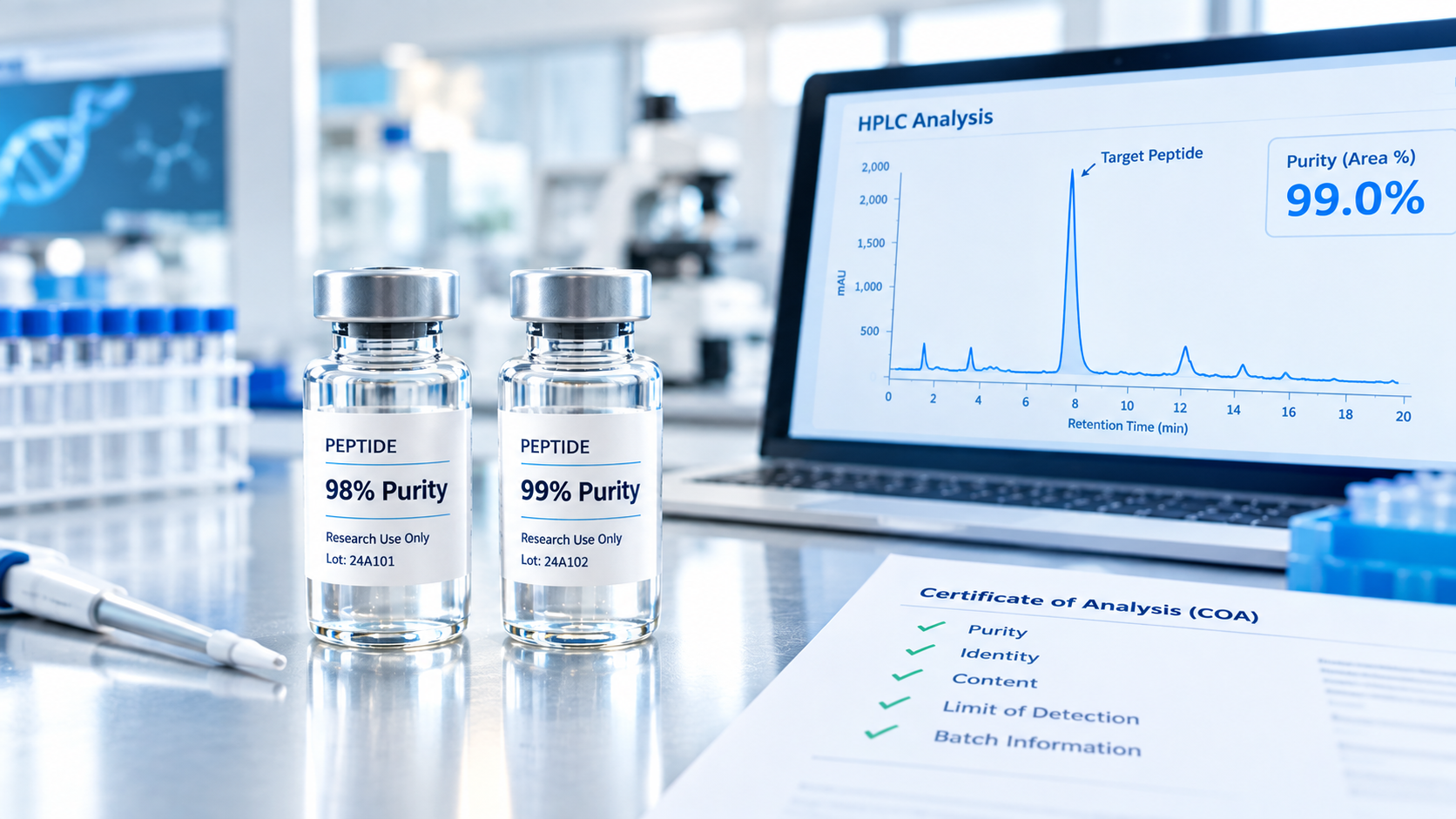
You're comparing two vials. One says 98% peptide purity, while the other claims 99% and costs noticeably more. Is that one percentage point worth paying for? More importantly, what does the number actually tell you?
Peptide purity is one of the most frequently discussed quality indicators in Peptide Products for Research. However, understanding what the percentage represents requires looking beyond the product label. A purity result can provide valuable information about a sample, but it does not tell the entire story.
This guide explains what 99% peptide purity means, how laboratories measure it, how it differs from peptide content, and what to look for when reviewing a Certificate of Analysis (COA). The information is intended for educational purposes and laboratory research contexts.
The Simple Definition of Peptide Purity
When a laboratory reports that a peptide is 99% pure, it often refers to the percentage of the total integrated chromatographic peak area attributed to the target peptide in a high-performance liquid chromatography (HPLC) analysis.
In simple terms, the target peptide accounts for approximately 99% of the detected peak area under the specific testing conditions. The remaining signal may come from other detectable compounds, including incomplete synthesis products, deletion sequences, degradation products, or other impurities.
However, there is an important distinction: 99% HPLC purity does not necessarily mean that 99% of the powder's total weight consists of the target peptide.
The result depends on the analytical method, detector response, sample preparation, and how effectively the method separates the target peptide from other compounds. Some impurities may not be detected or may overlap with the target peak.
Therefore, peptide purity is a useful analytical measurement, but it should not be treated as a complete guarantee of composition, identity, or overall quality.
How Is Peptide Purity Measured?
One commonly used method is reversed-phase high-performance liquid chromatography, also known as RP-HPLC.
During this process, a prepared sample passes through a chromatography column. Different compounds interact with the column material differently, causing them to separate as they travel through the system.
A detector, often measuring ultraviolet (UV) absorbance, records the compounds as peaks on a chromatogram. Analysts then evaluate the peaks to estimate the relative proportion associated with the target peptide.
In a typical area-percentage calculation, the integrated area of the target peak is divided by the total integrated area of the relevant detected peaks and multiplied by 100.
For example, if the target peak accounts for 99% of the integrated peak area, the reported HPLC area purity may be 99%.
However, this calculation has limitations. Different compounds can produce different detector responses, and some impurities may not be adequately separated or detected. Consequently, area percentage is not automatically equivalent to the actual percentage by mass.
What Role Does Mass Spectrometry Play?
Mass spectrometry (MS) provides complementary information by measuring the mass-to-charge ratios of ions produced from molecules in a sample.
For peptide analysis, the measured molecular mass can be compared with the expected mass of the target peptide. This helps support the identification of the intended compound and can reveal certain unexpected products or modifications.
However, a matching molecular mass alone does not necessarily confirm the complete amino acid sequence or rule out every possible structural difference. Additional analytical techniques may be necessary when more comprehensive identity confirmation is required.
HPLC and mass spectrometry serve different purposes: HPLC helps evaluate chromatographic purity, while MS provides evidence about molecular mass and identity. Used together, they can offer a more informative assessment than either result alone.
Peptide Purity vs. Peptide Content: What's the Difference?
One of the most important distinctions in peptide analysis is the difference between chromatographic purity and peptide content.
HPLC purity generally describes the relative chromatographic signal attributed to the target peptide. Peptide content, by contrast, concerns how much peptide is present in a given quantity of material, depending on the measurement method and reporting convention.
Freeze-dried, or lyophilized, peptide powders may contain residual water, counterions, salts, and other non-peptide material. These components can contribute to the powder's total weight without appearing as separate impurity peaks in a typical HPLC purity calculation.
For example, a sample could show 99% HPLC area purity while containing a lower proportion of the target peptide by total weight. The actual peptide content depends on the compound, its chemical form, preparation, and analytical results.
Why does this matter? In quantitative laboratory work, calculations based only on the total powder weight may not accurately reflect the amount of peptide present if the content has not been established.
When precise concentration is important, researchers should consult the relevant analytical documentation and use an appropriate content or assay measurement rather than assuming that HPLC purity represents weight percentage.
Does 99% Peptide Purity Really Beat 98%?
The answer depends on the experiment, the impurities present, and the reliability of the analytical methods used.
In some applications, even small amounts of impurity can affect the interpretation of results. This may be particularly relevant when an impurity interacts with the same biological target, interferes with an assay, or changes the behavior of the sample.
In other applications, a one-percentage-point difference in reported HPLC purity may have little practical significance.
It is also important to recognize that two laboratories can report different purity values for the same material if they use different columns, gradients, detectors, integration settings, or sample preparation procedures.
A reported 99% result is therefore not automatically superior to a 98% result obtained using a more suitable or better-characterized analytical method.
When comparing peptide products, consider the following:
• The analytical method is used to determine purity.
• Whether the chromatogram is available for review.
• Whether the target peptide's identity has been independently supported.
• Whether relevant impurities have been investigated.
• Whether peptide content or assay information is available when needed.
• Whether the test results correspond to the specific batch being evaluated.
Rather than focusing exclusively on the highest percentage, evaluate the evidence supporting the result and its relevance to the intended research application.
What About Peptide Blends?
Peptide blends require additional consideration because they contain more than one intended component.
Unlike a single-peptide sample, a blend may contain several target peptides, each with its own identity, concentration, and impurity profile. A single overall purity figure may not adequately describe the composition of the mixture.
For a meaningful assessment, researchers should look for documentation that identifies the individual components and explains how their identities, quantities, and relevant impurities were evaluated.
Analytical methods must also be suitable for separating or distinguishing the components. If two peptides produce overlapping chromatographic peaks, a simple area-percentage calculation may not reliably establish the purity of each individual component.
When reviewing a Peptide Blend, look for clear information about its composition, the analytical methods used, and any available component-specific results.
Transparent documentation makes it easier to understand what has actually been measured rather than relying on a single headline number.
Actionable Tips for Reading a Peptide Certificate of Analysis
A Certificate of Analysis, or COA, summarizes analytical results associated with a particular material or batch. Its usefulness depends on the quality, completeness, and traceability of the information it contains.
Here are several points to review when examining a peptide COA.
1. Check the batch or lot number.
The COA should identify the same batch as the material being evaluated. A generic certificate that cannot be linked to a specific batch provides less assurance about the sample in question.
2. Look for the HPLC chromatogram.
A reported purity percentage is more informative when supported by the chromatogram and relevant analytical details. Review the separation of peaks, the labeling of the target peak, and any available method information.
3. Review the identity data.
Check whether mass spectrometry or another suitable analytical method supports the identity of the target peptide. A matching molecular mass is useful evidence, although it may not independently establish the complete sequence or rule out every structural alternative.
4. Ask about peptide content when relevant.
If the research requires accurate quantitative measurements, determine whether peptide content or assay results are available. Do not assume that chromatographic purity is equivalent to peptide mass fraction.
5. Check the counter-ion and chemical form.
Peptides may be supplied in different salt forms, including acetate or trifluoroacetate (TFA). These forms can affect the material's composition and may be relevant to certain analytical or biological experiments. Their significance depends on the specific application.
6. Review the testing laboratory and date.
A COA should identify the testing organization and provide enough information to establish the relevance of the results. Independent testing can add confidence when the laboratory's methods and qualifications are appropriate, but the word “independent” alone does not establish analytical quality.
7. Consider storage and stability information.
Peptide stability varies with sequence, chemical form, formulation, moisture exposure, temperature, and other environmental conditions. Follow compound-specific storage instructions and available stability data. A high initial purity result does not guarantee that the material will retain the same quality indefinitely.
Red Flags to Watch For
When reviewing peptide quality documentation, several warning signs deserve closer attention.
• Unsupported purity claims: A supplier reports an unusually high purity percentage but provides no meaningful analytical evidence.
• Missing batch information: The certificate cannot be matched to the specific material being evaluated.
• Unclear identity testing: Purity is reported, but there is no supporting evidence that the main component is the intended peptide.
• Insufficient method details: The documentation does not explain how purity was measured or what the reported percentage represents.
• Unexplained blend composition: A mixture is advertised with one purity figure, but the individual components and their evaluation are not documented.
• No relevant content information: A quantitative application requires peptide content, yet the documentation provides only an HPLC area percentage.
These issues do not automatically prove that a material is unsuitable. They indicate that more information may be needed before drawing conclusions about its composition or analytical quality.
Frequently Asked Questions
Does 99% peptide purity mean the peptide is 99% pure by weight?
Not necessarily. A 99% HPLC area-purity result usually refers to the proportion of the detected chromatographic peak area attributed to the target peptide. It does not automatically establish the percentage of the powder's total weight that consists of that peptide.
Is 99% peptide purity always better than 98%?
Not automatically. The difference may matter in some experiments, but analytical methods, impurity identities, and the requirements of the research application also matter. A higher reported percentage alone does not establish overall quality.
Can HPLC confirm peptide identity?
HPLC can help separate and characterize components, but retention time and peak area alone generally do not provide definitive molecular identification. Additional evidence, such as mass spectrometry, can help support the identity assessment.
What should a peptide COA include?
Useful information may include the peptide name or identifier, batch number, analytical methods, purity results, identity data, testing laboratory, and date. Peptide content or assay information may also be relevant, depending on the material and intended analytical use.
The Takeaway
A 99% peptide purity result is a useful starting point, but it is not a complete measure of peptide quality.
The figure commonly represents the proportion of detected chromatographic peak area attributed to the target peptide under a particular analytical method. It does not necessarily establish the sample's weight-based peptide content, prove every aspect of molecular identity, or guarantee the absence of undetected impurities.
To assess a peptide more thoroughly, consider the HPLC results alongside identity testing, relevant peptide content measurements, batch-specific documentation, and appropriate storage and stability information.
When comparing Premium Research Compounds, focus on the transparency and quality of the supporting analytical evidence rather than the purity percentage alone. Understanding what a measurement can and cannot tell you makes it easier to evaluate claims accurately and interpret laboratory documentation with confidence.
 Russian
 English
 Arabic
 French
 Spanish
 Portuguese
 Deutsch
 Turkish
 Dutch
 Italiano
 Romaian
 Portuguese (Brazil)
 Greek