


What Should You Know Before Practicing C_CPE Questions for the SAP CAP Certification?
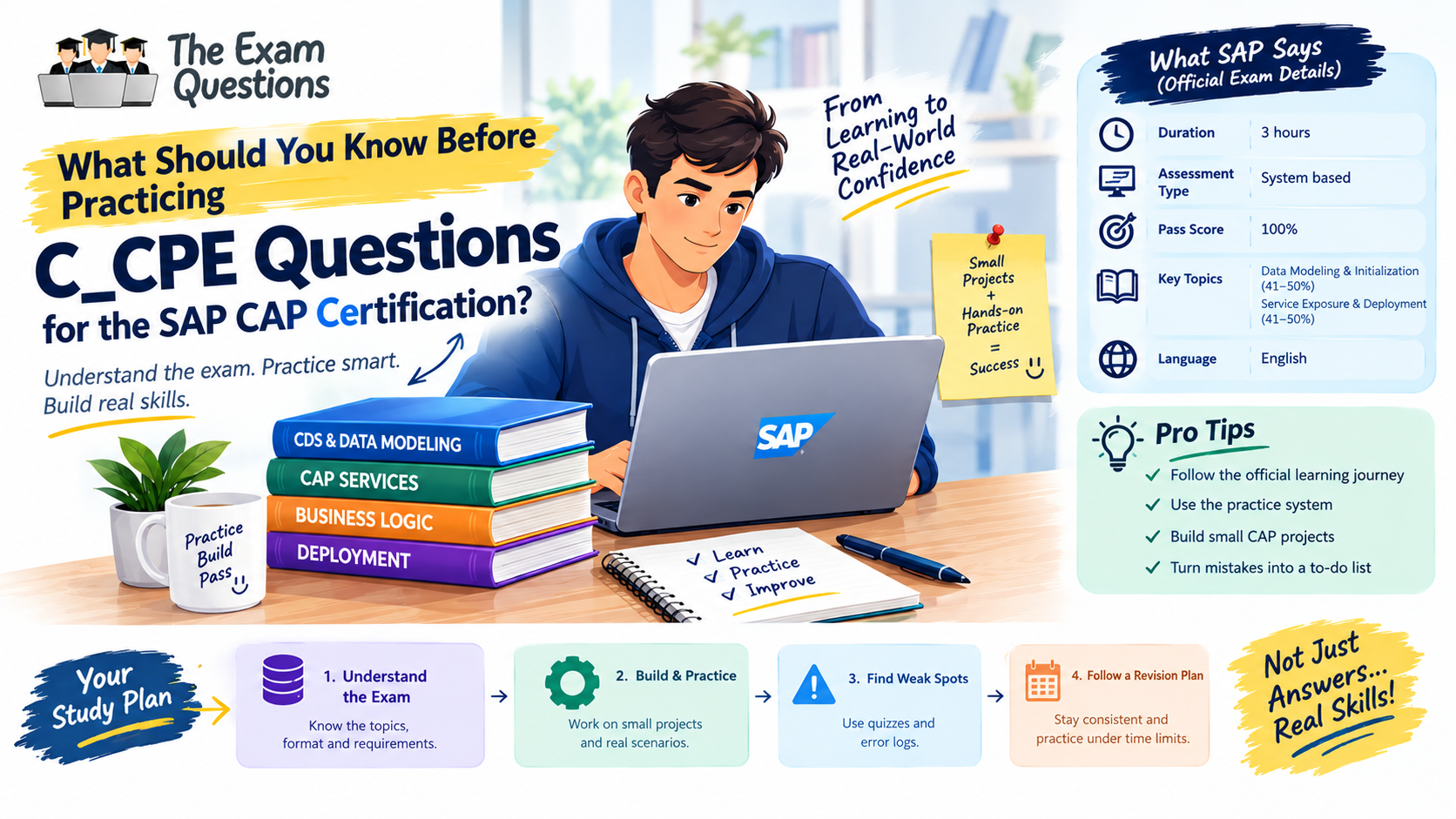
You have watched the tutorials, read the documentation, and maybe even built a bookshop demo. So why does the thought of a three hour assessment still feel uncertain? Searching for C_CPE Questions is a natural step, but practice only helps if you know what you are practicing for. This guide separates what SAP states officially from what is simply good study advice, then gives you a short original quiz, a list of common mistakes, and a revision plan you can actually follow.
TL;DR
SAP describes this certification as a three hour, system based assessment focused on two big areas: data modeling with data initialization, and service exposure with deployment. Prepare by building small CAP projects, use the practice system that SAP provides, and treat mistakes as a to do list. The quiz below is original practice material, and nothing here guarantees a result.
What does SAP officially say about this exam?
This section is the factual part, taken from SAP's own certification page when this article was prepared. Details can change, so always recheck the page before you book.
- Certification: SAP Certified - Backend Developer - SAP Cloud Application Programming Model, exam code C_CPE.
- Duration: 3 hours.
- Assessment type: system based, meaning you work in a live system rather than only choosing from listed options.
- Pass score: listed as 100%.
- Exam topics: Data Modeling and Data Initialization (41 to 50%) and Service Exposure and Deployment (41 to 50%).
- Language:
- Preparation: SAP recommends the learning journey Building Side-by-Side Extensions on SAP BTP, and the page mentions a practice system within it.
- Access: an SAP Learning Hub subscription that includes certification attempts, plus a valid SAP Universal ID.
You can confirm every one of these points on the official SAP certification page, which is also where you will find the technical readiness checklist for your computer and connection.
One piece of study advice, clearly labeled as such: because the pass score is listed as 100% and the assessment is system based, it makes sense to practice finishing complete, working tasks, not just getting most of an answer right. That is our interpretation, not an SAP statement.
Why does the two topic split matter for your study plan?
The page lists only two exam topics, and each carries a large share. That tells you where your hours should go. Roughly speaking, half of your effort belongs on how you model and initialize data, and half on how you expose and deploy services. A candidate who loves writing handlers but skips deployment is leaving a big area uncovered.
What does "data modeling and data initialization" cover in practice?
Think about everything that happens before a user sends a single request: entities and their elements, types, keys, associations and compositions, reusable aspects, and the way sample or initial data is loaded into the database. Practice writing a model from scratch, then loading data from CSV files and checking that the rows really arrive.
What does "service exposure and deployment" cover in practice?
This is about turning your model into something others can use: defining services, shaping what they expose, adding logic and protection where needed, and getting the application running beyond your own laptop. Practice defining a service, testing it with real requests, and then walking through what a deployment needs, such as a database service, bindings, and security configuration. Which pieces are required for your exact assessment is something to verify in SAP's materials.
Can you answer these original practice questions?
This quiz is original practice material written for learning. These are not actual, leaked, or predicted exam questions, and the real assessment is system based, so it will not look like this multiple choice format. Answer each one before you scroll to the explanations.
Question 1. You add the managed aspect to an entity. Which fields does it provide?
A) ID and name
B) createdAt, createdBy, modifiedAt, modifiedBy
C) locale and texts
D) status and version
Question 2. A CAP project has an entity Books in the namespace my.shop. Which initial data file name will be matched to it?
A) csv
B) Books-my.shop.csv
C) shop-Books.csv
D) csv
Question 3. An Orders entity has a composition of Items. What happens to the items when an order is deleted?
A) They stay in the database untouched.
B) They are deleted together with the order.
C) They are moved to an archive table.
D) The delete request is always rejected.
Question 4. You want clients to read an entity through a service but never change it. What is the simplest, most direct approach?
A) Delete the entity from the model.
B) Annotate the exposed entity as read only.
C) Rename the entity.
D) Add a before handler that logs each request.
Question 5. Your app uses a local SQLite database during development. What should you plan for when deploying to SAP BTP?
A) Nothing changes, SQLite is used in production too.
B) Remove all entities from the model.
C) A production grade database service, with the project configured and bound to it.
D) Convert the model to JSON files.
What are the answers, and why?
Answer 1: B. The managed aspect adds created and modified timestamps and user fields, which saves you from modeling auditing columns by hand. Option C relates to localized texts, a different feature.
Answer 2: C. CAP matches CSV files to entities by name, with the namespace and entity name joined by a hyphen, and the files normally live in the db/data folder. A file with a close but wrong name is simply ignored, which is one of the most common reasons for an empty table.
Answer 3: B. A composition models a parent and child that belong together, so child records are deleted with the parent. An association, by contrast, is only a reference. If your answer differed, revisit that distinction first.
Answer 4: B. CAP offers an annotation that marks an exposed entity as read only. Deleting or renaming the entity changes your model, and a logging handler observes requests without preventing writes.
Answer 5: C. SQLite is a development convenience. Deployed applications normally rely on a managed database service, so your project needs the matching configuration and a binding. Check SAP's documentation for the exact steps for your target environment.
How did you score? More important than the number is the reason behind each miss. Which topic did it come from?
What mistakes do CAP learners make most often?
•
- Reading solutions instead of building them. A walkthrough feels clear until you face a blank project.
- Ignoring data initialization. Many people jump straight to services and forget that CSV naming, location, and loading are part of the exam topic list.
- Mixing up associations and compositions. The choice changes deletion and lifecycle behavior.
- Changing code before reading the error. Read the full message, then check the model, service definition, configuration, and data in that order.
- Skipping deployment. It is half of the listed topic area, so it deserves real practice time.
- Not using the practice system. If SAP provides one for your learning journey, use it, because working in the same kind of environment lowers surprises.
- Relying on memorized answers. A system based assessment rewards doing, not recalling a list.
What does a realistic revision plan look like?
This is study advice, not an SAP schedule. Adjust it to your own pace, and expect to spend about an hour on weekdays and a longer block on weekends.
Week 1: Data modeling. Build a small domain with three entities. Practice keys, types, aspects, associations, and compositions. Load initial data from CSV and confirm it arrives.
Week 2: Services. Expose your entities through a service with projections, a read only entity, and one custom handler. Test with real requests, including $filter and $expand.
Week 3: Security and deployment. Add basic role based protection, then study what a deployment needs, including the database, bindings, and configuration. Walk through the official steps without skipping any.
Week 4: Practice and gaps. Work through the SAP practice system, then run one timed rehearsal of a full small build. Review your error log and rebuild your two weakest topics from scratch.
In the last two days, stop learning new material. Recheck the technical readiness checklist, confirm your attempts and login, and rest.
What is the main takeaway?
Passing is never guaranteed by any article or question set, but steady, hands on practice gives you a real advantage. Treat every error as information, spend your time where the exam topics are heavy, and keep checking SAP's official page for changes. When you want extra practice material to sit beside your own projects and the official SAP resources, you can look at what is available at The Exam Questions. Keep building, keep breaking things, and trust the process one small project at a time.
 Russian
 English
 Arabic
 French
 Spanish
 Portuguese
 Deutsch
 Turkish
 Dutch
 Italiano
 Romaian
 Portuguese (Brazil)
 Greek