


Best CAT Test 2026: Mock Tests, Practice and Performance Analysis
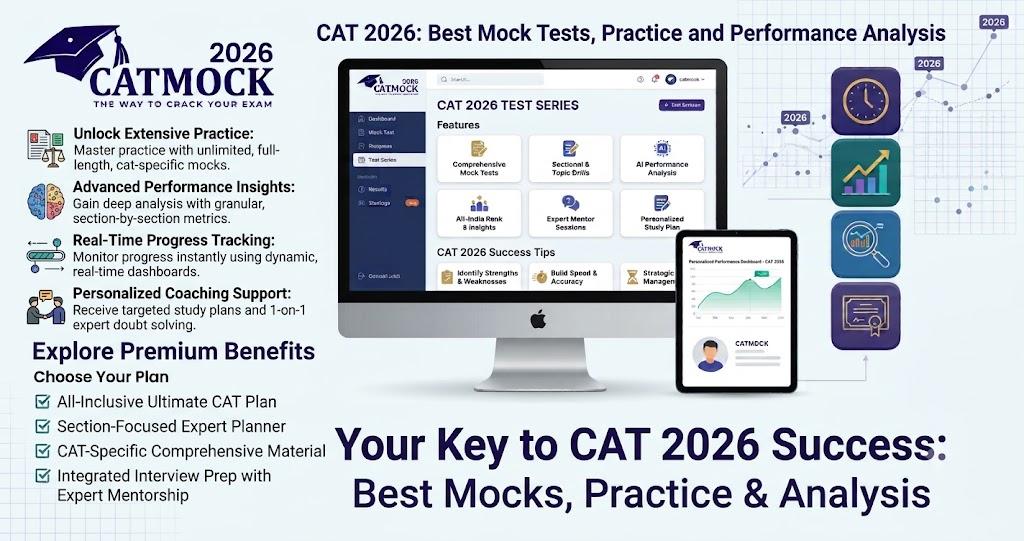
Preparing for the Common Admission Test (CAT) requires consistent practice, strong conceptual understanding, and effective time management. Choosing the best CAT test can help you evaluate your preparation, identify weak areas, and develop a strategy for tackling the examination confidently.
CAT tests your skills across three sections: Verbal Ability and Reading Comprehension (VARC), Data Interpretation and Logical Reasoning (DILR), and Quantitative Ability (QA). Regular practice across these sections helps you understand the exam pattern and improve your ability to solve questions under time pressure.
Whether you are starting your preparation or refining your exam strategy, selecting the right practice resources can make your preparation more organised.
Why Are CAT Tests Important?
CAT practice tests help you assess your performance before the actual examination. They provide opportunities to practise timed questions, evaluate your accuracy, and understand how effectively you manage different sections.
Here are some key benefits:
-
Better time management: Learn to allocate time wisely and avoid spending too long on difficult questions.
-
Improved accuracy: Identify common mistakes and work on reducing incorrect attempts.
-
Stronger question selection: Learn to recognise questions you can solve efficiently.
-
Performance tracking: Compare your results across multiple tests to monitor progress.
-
Greater confidence: Become familiar with the examination format through regular practice.
Remember that taking tests alone is not enough. Reviewing your answers and correcting mistakes are essential parts of preparation.
What to Look for in the Best CAT Test
Before choosing a CAT test platform, consider the features that support your preparation goals.
1. Full-Length Mock Tests
Full-length CAT mocks help you practise all three sections under timed conditions. They allow you to evaluate your overall strategy, concentration, and ability to manage the examination duration.
Choose tests that follow the latest available CAT examination pattern.
2. Sectional Tests
Sectional tests help you focus on VARC, DILR, or QA individually. If you struggle with reading comprehension or solving DILR sets, targeted practice can help you improve those skills.
Use sectional tests alongside full-length mocks to maintain a balanced preparation strategy.
3. Detailed Solutions and Analytics
A good CAT test should help you understand not only your score but also the reasons behind your performance.
Look for solutions and performance reports that help you evaluate accuracy, time spent on questions, and section-wise strengths and weaknesses.
4. Previous Year Questions
Previous year CAT questions provide valuable practice and help you understand the styles of questions asked in earlier examinations. Combine them with mock tests to strengthen your understanding of question patterns.
5. Affordable Preparation Options
Choose a test series that fits your budget and preparation requirements. Consider the number of tests, quality of solutions, sectional practice options, and performance analysis available before selecting a package.
Prepare for CAT with CatMock
CatMock is an online self-preparation platform that provides resources for CAT and other MBA entrance examinations.
Aspirants can explore full-length mock tests, sectional tests, previous year questions, daily practice, concept videos, and performance analytics to support their preparation.
These resources can help you practise exam-style questions, revise important concepts, and identify areas that require additional attention. Free practice options also allow you to explore available resources before choosing a suitable package.
Select the resources that match your preparation level, available time, and budget. Focus on consistent practice and meaningful performance analysis rather than simply attempting more tests.
How to Use CAT Tests Effectively
Follow these steps to get more value from your practice sessions:
-
Attempt tests under timed conditions without distractions.
-
Review incorrect answers and understand the concepts behind your mistakes.
-
Analyse unanswered questions to identify missed opportunities.
-
Revise weak topics before attempting similar questions again.
-
Track your scores, accuracy, and recurring errors.
-
Apply the lessons from each test to your next attempt.
Do not judge your preparation based on a single mock score. Look for patterns across multiple tests and use your findings to improve your strategy.
Frequently Asked Questions
1. Which is the best CAT test for preparation?
Choose a CAT test that follows the current exam pattern and offers realistic questions, detailed solutions, sectional practice, and performance analysis.
2. Are free CAT tests useful?
Yes. Free CAT tests can help you understand the exam format, practise questions, and assess your preparation before purchasing a test series.
3. How often should I take CAT mock tests?
Your frequency should depend on your preparation level and available time. Allow sufficient time to analyse each test and revise the concepts behind your mistakes.
4. Can CAT tests improve my percentile?
Regular tests can help you improve your strategy, accuracy, and time management. However, percentile improvement depends on your overall preparation, consistency, and performance relative to other candidates.
Conclusion
The best CAT test is one that helps you practise consistently, understand your mistakes, and measure your progress. Consider full-length mocks, sectional tests, previous year questions, and performance analytics when selecting your preparation resources.
With regular practice, targeted revision, and careful analysis, you can build a more effective CAT preparation strategy and approach the examination with greater confidence.

 Arabic
 French
 Spanish
 Portuguese
 Deutsch
 Turkish
 Dutch
 Italiano
 Russian
 Romaian
 Portuguese (Brazil)
 Greek