


RAG vs Fine-Tuning vs AI Agents: Which AI Approach Should Malaysian Businesses Choose?
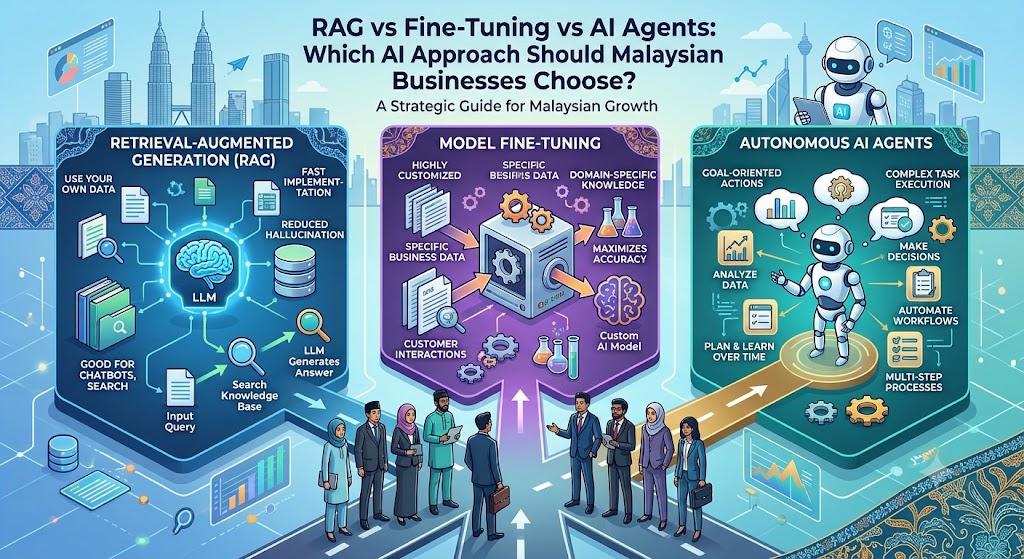
Artificial intelligence is transforming how Malaysian businesses manage customer interactions, automate operations, analyse data, and make strategic decisions. However, selecting the right AI technology can be challenging. Retrieval-Augmented Generation (RAG), fine-tuning, and AI agents offer different capabilities, and choosing the wrong approach can increase development costs, introduce operational risks, and delay business outcomes.
For organisations planning AI adoption in Malaysia, understanding these three approaches is essential to building reliable, scalable, and business-focused applications. Whether a company wants to create an intelligent customer support system, customise an existing language model, or automate complex workflows, the right approach depends on its business objectives, data requirements, and level of automation.
Partnering with an experienced AI Software Development Company in Malaysia can help businesses evaluate these options and implement an architecture that aligns with their long-term digital transformation goals.
Understanding RAG, Fine-Tuning, and AI Agents
Although RAG, fine-tuning, and AI agents can work with large language models (LLMs), they solve different problems.
What Is Retrieval-Augmented Generation (RAG)?
Retrieval-Augmented Generation connects an AI model to an external knowledge source. Instead of relying exclusively on information learned during training, the system retrieves relevant information from documents, databases, knowledge bases, or enterprise systems before generating a response.
For example, a Malaysian financial services company could use RAG to help employees find information across internal policies, product documentation, and compliance guidelines. When an employee asks a question, the system retrieves relevant passages and uses them to formulate an answer.
Key benefits of RAG:
-
Access to current business information without retraining the model.
-
Better grounding of responses in approved organisational knowledge.
-
Support for citations and source references.
-
Easier updates when documents, policies, or product information change.
-
Greater control over which information is available to the AI system.
However, RAG depends on document quality, retrieval accuracy, access controls, and effective evaluation. It cannot guarantee that every response will be correct.
What Is Fine-Tuning?
Fine-tuning involves further training a pretrained AI model using carefully selected examples to improve its performance on a particular task, style, or domain.
Businesses may use fine-tuning when they need consistent response formats, specialised classification, domain-specific language patterns, or outputs that follow particular business conventions.
For example, a Malaysian insurance company might fine-tune a model to classify customer enquiries into predefined categories or generate structured summaries using an approved format.
Key benefits of fine-tuning:
-
More consistent output styles and formats.
-
Improved performance on targeted tasks when suitable training data is available.
-
Better adaptation to specialised terminology and recurring patterns.
-
Potentially reduced dependence on lengthy instructions in every prompt.
Fine-tuning is not the same as updating a knowledge base. It does not reliably teach a model every new fact, nor does it guarantee that the model will remember precise details. Training data preparation, evaluation, deployment, and ongoing monitoring also require investment.
What Are AI Agents?
AI agents are systems that use AI models to pursue goals, make decisions, and perform actions through connected tools, APIs, and business applications. Depending on their design, they may plan multiple steps, maintain task context, check results, and request human approval when necessary.
For example, an e-commerce business in Malaysia could deploy an AI agent to check an order, retrieve delivery information, identify a potential delay, draft a customer notification, and update a support ticket through authorised integrations.
Key benefits of AI agents:
-
Automation of multi-step business workflows.
-
Integration with enterprise applications and external services.
-
Ability to respond dynamically to changing task conditions.
-
Reduced manual effort for repetitive operational activities.
-
Support for human-in-the-loop review and escalation.
AI agents introduce additional complexity because their actions depend on permissions, tool reliability, planning quality, and appropriate safeguards. Businesses should define clear limits on what an agent can access or change.
RAG vs Fine-Tuning vs AI Agents: Key Differences
Each approach addresses a different business requirement. The following comparison helps Malaysian organisations identify where each technology fits.
| Evaluation Criteria | RAG | Fine-Tuning | AI Agents |
|---|---|---|---|
| Primary purpose | Retrieve relevant knowledge | Adapt model behaviour | Execute multi-step tasks |
| Best suited for | Knowledge-based answers | Specialised tasks and output patterns | Workflow automation |
| Uses external data | Yes, during retrieval | Only when separately connected or supplied | Often through tools and integrations |
| Updating information | Update the knowledge source and index | May require additional training | Depends on connected systems and workflow design |
| Typical use cases | Document assistants, internal search | Classification, structured generation | Customer support workflows, operations automation |
| Main challenge | Retrieval quality and data permissions | Training data and evaluation | Reliability, permissions, and action control |
The approaches are not mutually exclusive. A business application can combine all three when the use case justifies the additional complexity.
When Should Malaysian Businesses Choose RAG?
RAG is a strong starting point when an organisation needs AI to answer questions using information that changes frequently or must come from approved internal sources.
Suitable use cases include:
-
Enterprise knowledge management: Search policies, reports, manuals, and operational documents.
-
Customer support: Retrieve current product information, service policies, and troubleshooting guidance.
-
Financial services: Help authorised employees locate relevant internal procedures and documentation.
-
Human resources: Answer employee questions using approved HR policies and company guidelines.
-
Healthcare administration: Retrieve information from authorised administrative documents, subject to applicable privacy and access requirements.
For businesses with substantial document collections, RAG can reduce the need to retrain models whenever information changes. Nevertheless, sensitive information must be protected through document-level permissions, secure retrieval, and appropriate logging.
When Is Fine-Tuning the Better Choice?
Fine-tuning is more appropriate when a business needs a model to perform a specific task consistently rather than simply access more information.
Consider fine-tuning when:
-
Outputs must follow a strict, repeatable structure.
-
A model needs to recognise specialised terminology or recurring industry patterns.
-
Classification accuracy needs improvement on a well-defined task.
-
Prompt-based approaches do not deliver sufficiently consistent results.
-
Suitable, high-quality examples are available for training and evaluation.
For instance, a Malaysian manufacturing company could evaluate fine-tuning for categorising maintenance reports or converting unstructured operational notes into a standard format.
Before investing in training, businesses should establish a baseline using prompting and other simpler methods. Fine-tuning should be selected when measurable improvements justify its cost and operational requirements.
When Should Businesses Invest in AI Agents?
AI agents are most useful when the objective extends beyond answering questions to completing tasks across business systems.
Potential applications include:
-
Logistics: Coordinate shipment checks, flag exceptions, and prepare operational updates.
-
E-commerce: Support order enquiries, returns processing, and customer service workflows.
-
Software development: Assist with issue triage, test preparation, and development documentation.
-
Enterprise operations: Route requests, collect information, and coordinate approval workflows.
-
Sales operations: Summarise customer interactions and prepare follow-up tasks using authorised CRM access.
Not every workflow needs an autonomous agent. A conventional automation script may be more suitable for deterministic, rule-based tasks. AI agents offer greater flexibility where the workflow involves variable inputs, interpretation, or decisions.
Businesses should begin with limited permissions, measurable objectives, human approval for consequential actions, and clear escalation paths.
Can RAG, Fine-Tuning, and AI Agents Work Together?
Yes. Combining these technologies can create a more capable AI application when each component has a clearly defined purpose.
Consider a Malaysian enterprise building an AI-powered customer service platform.
-
RAG retrieves information: The system finds current product documentation, order policies, and support articles.
-
Fine-tuning improves specialised behaviour: Where justified by evaluation, a customised model produces consistent classifications or structured responses.
-
An AI agent coordinates actions: The agent checks authorised systems, creates support tickets, and initiates approved workflows.
This architecture separates knowledge retrieval, model behaviour, and task execution. It can also make the system easier to test and maintain.
However, combining all three is not automatically the best option. Additional components increase development effort, infrastructure requirements, monitoring needs, and potential failure points. Businesses should introduce each component only when it addresses a demonstrated requirement.
How to Choose the Right AI Approach for Your Business
Malaysian businesses can use the following decision framework to shortlist an appropriate solution.
Choose RAG if: Your AI needs reliable access to frequently updated company information, policies, or documents.
Choose fine-tuning if: Your model needs to follow specialised patterns, classifications, or output formats that simpler methods cannot deliver consistently.
Choose AI agents if: Your application must perform multiple steps, interact with business tools, and complete tasks under defined permissions.
Choose a hybrid approach if: Your business requires current knowledge, specialised model behaviour, and controlled workflow execution.
Before implementation, assess data readiness, integration requirements, security, regulatory obligations, operating costs, and measurable business outcomes. Malaysian organisations should also consider applicable personal data protection requirements, particularly when AI systems process customer or employee information.
Define success metrics such as response accuracy, task completion rates, processing time, cost per interaction, and human intervention rates. Test the proposed system against real business scenarios before expanding it into production.
How Hidden Brains Helps Malaysian Businesses Build AI Solutions
Selecting an AI architecture requires more than choosing a popular technology. Businesses need to understand their existing systems, data quality, operational challenges, and desired outcomes before deciding how RAG, fine-tuning, or AI agents should be implemented.
Hidden Brains helps organisations explore AI-driven digital transformation through application development, system integration, and tailored technology solutions. Businesses can evaluate their requirements, identify suitable AI capabilities, and plan an implementation strategy that supports scalability, security, and operational efficiency.
With the right technical approach, organisations can move from experimentation to practical AI applications that address measurable business needs. The priority should be to solve a clearly defined problem first, validate the results, and expand capabilities as business requirements evolve.
Conclusion
RAG, fine-tuning, and AI agents are complementary technologies rather than competing alternatives. RAG connects AI to relevant knowledge, fine-tuning adapts model behaviour, and AI agents coordinate actions across workflows.
For Malaysian businesses, the right choice depends on the problem being solved, available data, desired level of automation, and acceptable operational risk. Starting with a focused use case, evaluating performance, and introducing additional capabilities when needed can help organisations achieve sustainable value from AI.
Working with an experienced AI Software Development Company in Malaysia can help businesses make informed architectural decisions, build practical AI applications, and develop a roadmap for responsible AI adoption.
 Spanish
 English
 Arabic
 French
 Portuguese
 Deutsch
 Turkish
 Dutch
 Italiano
 Russian
 Romaian
 Portuguese (Brazil)
 Greek