


What Makes a Good Finisher? Role, Numbers and Pressure Explained
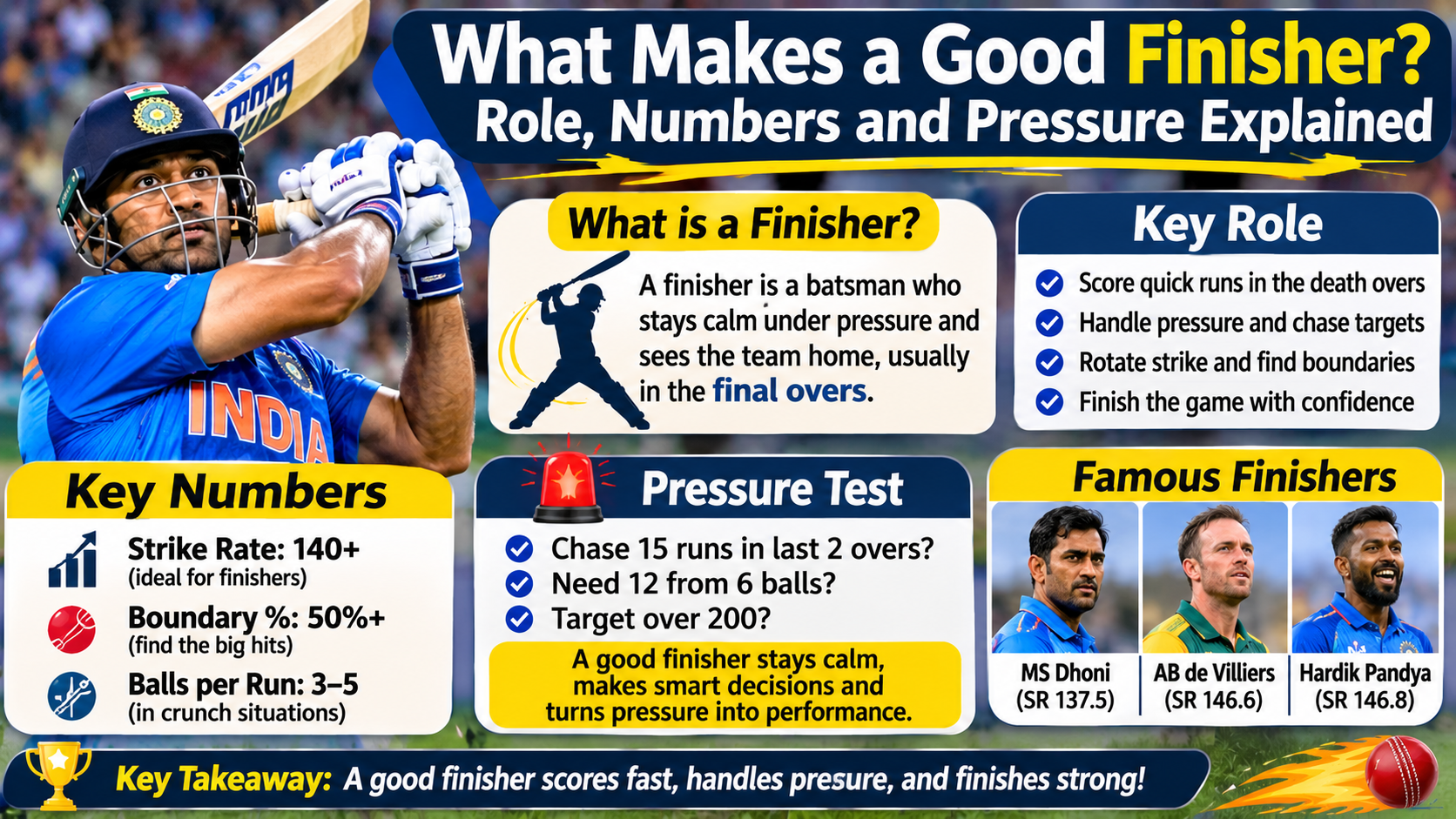
A finisher is not just a big hitter. Anyone can smash sixes on a flat pitch against tired bowlers, when the match is already won.
A finisher is the player who walks in when the match is still in the balance, with the required run rate climbing, the field spread out, and the bowlers bowling their best yorkers and slower balls, and still finds a way to win.
In T20 cricket, that player usually bats at No. 5, 6, or 7. He may only face 15 or 20 balls. Those 15 or 20 balls decide the match.
Tilak Varma's 51 not out off 26 balls in Christchurch on 24 October 2026 is the perfect recent example. India were 70/5, then 112/6, chasing 181 against New Zealand. Tilak and Nitish Kumar Reddy added an unbeaten 69 off 30 balls to win with one ball to spare. That was not a cameo. That was finishing.
What is a finisher?
A finisher is the batter responsible for taking the game home in the final overs, especially in white-ball cricket.
In a chase, that means being there at the end, not out, when the winning runs are scored. In a first innings, that means turning a good total into a great one, by scoring quickly in the last five overs without getting out and wasting the platform the top order built.
The role was perfected in 50-over cricket by Michael Bevan in the 1990s. Bevan understood that staying not out while scoring quickly was more valuable than hitting big and then getting out. He calculated required run rates, played percentage cricket, and rarely took unnecessary risks.
MS Dhoni took that template and made it his own in T20 and ODI cricket. Dhoni built his reputation not on strike rate alone, but on staying calm, rotating the strike, and exploding only when it truly mattered. He finished unbeaten in 49% of his T20I innings, a third of his IPL innings, and more than a fifth of his ODI innings. A high not-out rate is the fingerprint of a true finisher.
Modern T20 has changed the role, but not the core. In the 1980s, scoring at five runs per over was fast. Today, T20 demands 12 or more runs per over in the death overs, against better death bowling, strategic field placements, yorker specialists, and slower-ball variations. The finisher still has to do what Bevan and Dhoni did: read the game, stay calm, and finish it.
The two jobs of a finisher
A finisher has two different jobs, and they require different skills.
1. Chasing a target
This is the classic finisher's job. He comes in with a target in front of him, a required run rate, and a number of wickets left. He has to work out how to pace his innings: when to push on and when to consolidate.
He may come in with plenty of time left, or with 20 needed off two overs. He has to bat in more than one mode. He must have the power to clear the boundary when required, and the delicacy of touch to find the gaps and keep picking up ones and twos.
He may also have to shield his less talented partner from the strike, a further complication that tests a batter's mental resources. If the tailender is at the other end, the finisher has to take most of the strike, without taking unnecessary risks himself.
2. Setting a total
When batting first, the finisher's job is different. He comes in with wickets in hand and overs left, and he has to maximise the total. He does not have a target to chase, so he has to judge what a good total is on that pitch, against that bowling attack, and then attack accordingly.
A good finisher in a first innings will not just swing at everything. He will target the bowler who is struggling, protect himself against the bowler who is bowling well, and make sure he is still there in the last over, when the field is up and the bowlers are tired.
The skills that matter
Power helps, but it is not enough. The best finishers share five skills that do not show up in a highlights package.
Game awareness. A finisher knows how many runs are needed, how many wickets are left, and which bowlers still have overs. He knows when to hit, when to take singles, and when to block. A batter who understands these moments can win games even without flashy numbers.
Strike rotation. Singles are the lifeblood of a finish. A finisher who can turn a dot ball into a single, and a single into two runs, keeps the scoreboard ticking and keeps the pressure off himself. Tilak Varma's Christchurch innings is a good example: he started slowly, 10 off 9 balls, then accelerated, because he was rotating the strike while Naman Dhir was hitting.
Boundary hitting against good bowling. A finisher has to score boundaries even when yorkers come at 145 km/h, and when the field is spread out. That means having more than one boundary shot: a pull, a cut, a scoop, a lofted drive, and the ability to hit to different parts of the ground.
Calm under pressure. This is the skill statistics do not show. Many players hit big shots when the team is already ahead. Very few can do it when the required run rate is climbing and the crowd is tense. Dhoni's calmness was not an accident. It was a skill he practised: he saw patterns where others saw chaos, and he took matches to the final over because he backed his ability to control the outcome.
Taking the game deep. A good finisher does not try to finish the match in the 16th over. He takes it deep, to the 19th or 20th over, because the longer he stays, the more the bowlers tire, the more the fielders make mistakes, and the more the pressure shifts to the bowling side.
Tilak put it simply after Christchurch: “I already had the power game; I have scored runs at number 3 as well. Now, especially batting at number 5 or 6, I think about going for a boundary off the very first ball only if it’s there to be hit. Otherwise, I focus on taking the game deep. I take a bit more time. Initially, I focus on singles and doubles, finding gaps for fours or two runs.”
The numbers that matter
Strike rate alone does not tell you if someone is a good finisher. You need to look at four numbers together.
1. Death-overs strike rate. This is strike rate in overs 16-20, not overall strike rate. A modern finisher should be striking at 150 or more in the death overs. Andre Russell and Kieron Pollard strike at 170-180 in that phase in the IPL. Tilak Varma, at No. 6 in T20Is, strikes at 195.27.
2. Average in chases. A finisher's average in chases matters more than his overall average, because his job is to win chases. Tilak averages 51.62 in chases in T20Is, compared with 39.70 when batting first. That gap tells you he is better under pressure than he is when setting a total.
3. Not-out rate and win rate when not out. How often is the finisher still there at the end? And how often does his team win when he is? India have won all 12 T20Is in which Tilak has remained not out. In all T20 cricket, he has been not out in 26 chases, and his team has won every time.
4. Balls per boundary and dot-ball percentage. A finisher who hits a boundary every six balls but dots the other five is less useful than a finisher who hits a boundary every eight balls but rotates the strike on the other balls. The second player keeps the scoreboard moving and does not let the required rate climb.
A high strike rate is useful in the powerplay, but the real pressure moments usually come in the last five overs. Bowlers know their plan, fielders are perfectly placed, and one mistake can cost the match. A finisher's job is not to score fast from ball one, but to read the situation and win the game.
The Christchurch case study: Tilak Varma, 24 October 2026
The second T20I in Christchurch is the best recent lesson in finishing, because it was not a run-fest. It was a tricky chase on a two-paced pitch, against a wily New Zealand attack.
New Zealand made 180/5, with Glenn Phillips making 70 and Bevon Jacobs making 58. Mitchell Santner then took 4/21 with his left-arm spin, and India slipped to 70/5, then 112/6.
Tilak came in during the 11th over, with the scoreboard reading 69/4. He crafted an unbeaten 51 off 26 balls, with six fours and one six, to guide India to 181 with four wickets and a ball to spare.
The partnership with Nitish Kumar Reddy was 69 off 30 balls, the highest seventh-wicket stand for India in men's T20Is. Nitish made 26 not out off 13 balls, at a strike rate of 200.
The key was how Tilak structured the chase. Against spin, the emphasis was on finding gaps and running hard. He told Naman Dhir they would push hard when the spinners were bowling. After Dhir was out for 31 off 17 balls, Tilak and Nitish resisted the temptation to clear the ropes on a large ground. They worked the gaps, turned ones into twos, and waited for the pace bowlers at the death.
They took the game deep, and even with 46 required off the last three overs, they backed themselves. Seventeen runs came off the 18th over, and 18 off the 19th, bringing the equation down to 11 off six balls. Nitish's winning two off the penultimate ball completed the escape.
India needed 68 runs from the final five overs to win. That was India's highest successful chase during that phase of a T20I, surpassing their previous best of 60 runs against Pakistan at the Melbourne Cricket Ground during the 2022 T20 World Cup.
Tilak credited head coach Gautam Gambhir and batting coach Sitanshu Kotak for giving him the confidence to finish. They had told him the whole country believed in him, and that if he batted till the end, India could win. He promised them he would take the game deep from next time onwards, and in Christchurch, he did.
The other India finishers in New Zealand
Tilak is not India's only finisher in this series. He is the main one, but the series has shown India have depth.
Naman Dhir, in the first T20I on 22 October, made 42 not out off 15 balls as India chased 230, their highest successful T20I chase. In the second match, he made 31 off 17 balls, including three sixes, to keep India in contention before Tilak and Nitish finished it. Dhir is a different type of finisher: he attacks from ball one, while Tilak absorbs pressure and then accelerates.
Nitish Kumar Reddy, in the second match, made 26 not out off 13 balls. He rotated the strike while Dhir was hitting, then accelerated when Tilak needed support. His role was to be proactive, to run hard, and to put pressure back on New Zealand.
That is the modern finisher's group: not one player, but two or three players who can finish in different ways, depending on the match situation.
Three types of finisher
Not all finishers are the same. They fall into three broad types, and good teams have at least two of them.
The calculator. Dhoni and Bevan are the classic examples. They take the game deep, calculate the required rate, and finish with surgical precision. They do not panic, they do not swing at every ball, and they are at their best in the last over.
The power hitter. Kieron Pollard and Andre Russell are the classic examples. Pollard has played more than 600 T20 matches, hit six sixes in one over against Sri Lanka in 2021, and hits a six every 17 balls. Russell attacks from ball one, targets boundaries immediately, and can chase 50 runs in three overs. Their strike rates are higher, but their averages are lower, because they take more risks.
The flexible finisher. Tilak Varma and Hardik Pandya are the modern examples. They can bat at No. 3 and score a hundred, or bat at No. 6 and finish a chase. They can absorb pressure, rotate the strike, and then explode. Tilak's numbers show the split: at No. 3 in T20Is, he has 651 runs in 21 innings at an average of 43.40 and a strike rate of 150.69. At No. 6, he has 248 runs in 10 innings at an average of 82.66 and a strike rate of 195.27. The average is higher at No. 6 because he is often not out, and the strike rate is higher because he is batting in the death overs.
For fans following a chase, the finisher is often the player to watch when the game gets tight. The top order sets it up, but the finisher decides it. Cricbet99 is one of the platforms fans use to follow live scores, chase equations and player form in one place during a match. Cricbet99 is a gaming and betting-related platform, not an official broadcaster, and any betting-related features are for adults only, where legally permitted. Use responsibly and check local rules, as betting law in India varies by state.
What a finisher is not
A finisher is not an opener with a high strike rate. An opener faces the new ball, with fielding restrictions, and has time to build an innings. A finisher faces the old ball, with the field spread out, and has no time to build.
A finisher is not a cameo hitter who scores 20 off 8 balls and then gets out. That player may have a high strike rate, but he does not finish matches. He leaves the job to someone else.
A finisher is not just a power hitter who can hit sixes. Power helps, but if a player cannot rotate the strike, cannot read the game, and cannot stay calm under pressure, he will not finish matches consistently.
And a finisher is not defined by one innings. One innings does not decide who is a great finisher. It is about doing it again and again, across formats, conditions, and pressure situations, over an entire career.
Frequently asked questions
What batting position is a finisher?
Usually No. 5, 6, or 7 in T20 cricket. In ODIs, the finisher often bats at No. 5 or 6. The exact position depends on the team's balance, but the finisher is always in the lower-middle order.
Is strike rate the most important number for a finisher?
No. Death-overs strike rate matters, but so do average in chases, not-out rate, and win rate when not out. A finisher who strikes at 160 but gets out too often is less valuable than a finisher who strikes at 145 but is not out at the end.
Who is the best finisher in cricket history?
MS Dhoni is the most widely cited answer, for his calmness, his calculation, and his record of finishing matches in the last over. Michael Bevan is the ODI original, and AB de Villiers, Kieron Pollard, and Andre Russell are the modern power finishers.
Is Tilak Varma India's finisher now?
He is India's first-choice finisher in T20Is after Christchurch, but not the only finisher. Naman Dhir and Nitish Kumar Reddy also finished matches in New Zealand, and Hardik Pandya has been India's finisher in the past. Tilak's role is to take the game deep and be not out at the end.
Can a finisher bat higher up the order?
Yes. Tilak has scored runs at No. 3 as well as at No. 5 and 6. The best finishers are flexible. They can bat higher if the team needs them to, but their main value is in the final overs.
What is the difference between a finisher and an anchor?
An anchor bats at a par or below-par strike rate for most of the innings, then bashes the death overs when set. A finisher chops off the initial period and comes in late, so you see less of the slow period. Dhoni was both: a finishing anchor.
The verdict
A good finisher is not defined by how hard he hits the ball. He is defined by how often he is still there when the match is won.
He reads the game, rotates the strike, hits boundaries against good bowling, and stays calm when everyone else panics. He takes the game deep, because he knows the longer he stays, the more the pressure shifts to the bowling side.
Tilak Varma's Christchurch innings showed all of that in 26 balls: a slow start, a partnership, a plan against spin, and an acceleration against pace at the death. It was not the biggest innings of the series. Abhishek Sharma's 113 off 38 balls in Wellington was bigger. But it was the innings that won a match India should have lost, from 70/5 and 112/6.
That is what a finisher does. He does not just score runs. He wins matches that look lost.

 Arabic
 French
 Spanish
 Portuguese
 Deutsch
 Turkish
 Dutch
 Italiano
 Russian
 Romaian
 Portuguese (Brazil)
 Greek