


U.S. Procurement Software Market Size, Growth & Forecast 2034
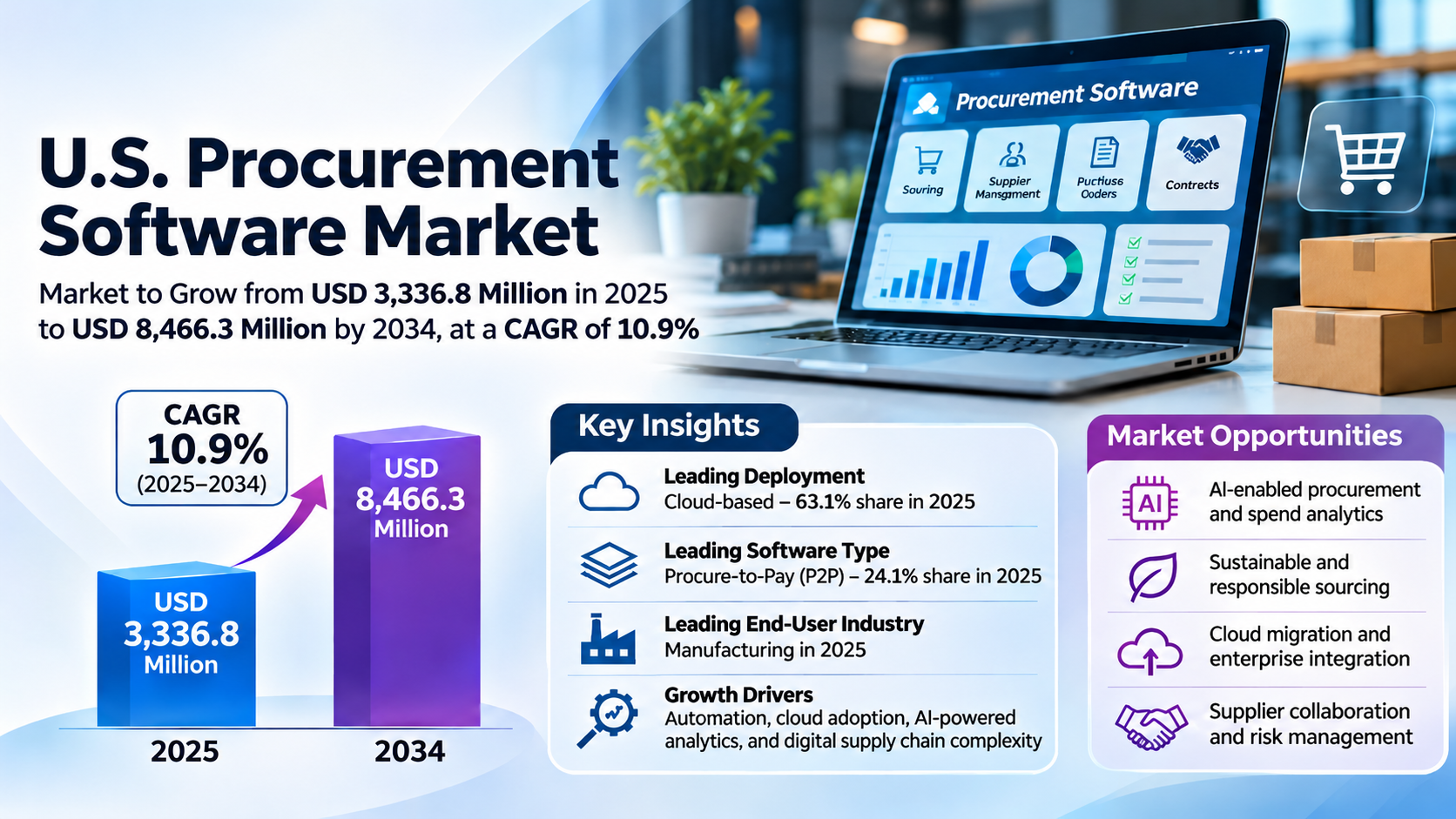
The U.S. Procurement Software Market is undergoing significant transformation as American businesses adopt automated purchasing systems, artificial intelligence, and cloud-based procurement platforms to improve operational efficiency and supplier management.
According to Dimension Market Research, the market is predicted to reach USD 3,336.8 million in 2025 and expand to USD 8,466.3 million by 2034, registering a CAGR of 10.9% from 2025 to 2034.
Increasing demand for cost optimization, procurement transparency, and supply chain resilience is encouraging organizations to replace fragmented purchasing systems with integrated digital solutions. AI-powered analytics, automated workflows, and centralized supplier information are becoming important capabilities for procurement teams managing complex business operations.
What Is the U.S. Procurement Software Market?
The U.S. Procurement Software Market covers digital platforms that help organizations manage purchasing activities, supplier relationships, sourcing, contracts, expenditure analysis, and procurement-related financial workflows.
These applications enable businesses to automate purchase orders, monitor supplier performance, evaluate spending patterns, and standardize procurement procedures across departments.
The market includes procure-to-pay software, spend analysis platforms, electronic sourcing tools, supplier management systems, and strategic sourcing applications.
Procurement technology increasingly connects purchasing departments with finance, operations, and supply chain management, supporting more coordinated business decisions.
Why Is the U.S. Procurement Software Market Growing?
Automation and operational cost management are central factors supporting market expansion.
Traditional procurement processes often involve manual approvals, disconnected supplier records, repetitive documentation, and limited purchasing visibility. Digital platforms address these challenges by automating routine activities and strengthening control over organizational expenditure.
The expansion of e-commerce and increasingly complex supply chains is also creating demand for more sophisticated procurement management systems.
Businesses require technology capable of supporting supplier collaboration, purchase order processing, contract administration, and expenditure monitoring across multiple operational locations.
Artificial intelligence adds another dimension to procurement modernization. Machine learning applications help organizations analyze historical purchasing patterns, identify supplier risks, and improve procurement planning.
These capabilities are contributing to the transition from transaction-focused purchasing toward more strategic, data-driven procurement management.
Get a Free Sample of the U.S. Procurement Software Market Report
Organizations evaluating procurement technology investments, software partnerships, or market expansion opportunities can request a sample to review the research scope and determine its relevance to their strategic requirements.
https://dimensionmarketresearch.com/request-sample/us-procurement-software-market/
Cloud-Based Procurement Software Leads Deployment
Cloud-based deployment is projected to account for 63.1% of U.S. procurement software market revenue in 2025, making it the leading deployment category.
Cloud procurement platforms offer centralized access to purchasing information, support collaboration between distributed teams, and facilitate integration with enterprise resource planning systems.
Their scalability makes them particularly relevant for businesses seeking to modernize procurement operations without maintaining extensive on-premise infrastructure.
Cloud solutions also support automated software updates, analytics integration, and remote procurement administration.
For technology providers, this suggests opportunities to differentiate through implementation flexibility, interoperability, cybersecurity, and industry-specific procurement functionality.
Procure-to-Pay Software Holds the Largest Software Type Share
Procure-to-Pay (P2P) software is anticipated to represent 24.1% of the market in 2025, establishing it as the leading software type.
P2P platforms connect purchasing requests, approvals, purchase orders, invoicing, and payment-related activities within coordinated workflows.
This integration helps companies reduce manual processing, strengthen expenditure controls, and improve transaction visibility.
Other important software categories include spend analysis, electronic sourcing, supplier management, and strategic sourcing solutions.
Together, these applications enable procurement departments to manage both routine transactions and longer-term supplier relationships.
Large enterprises are expected to dominate procurement software adoption by organization size, reflecting their complex supplier networks, substantial purchasing volumes, and requirements for integrated business systems.
Manufacturing Emerges as the Leading End-User Industry
Manufacturing is anticipated to represent the largest end-user industry in the U.S. Procurement Software Market in 2025.
Manufacturers depend on reliable purchasing systems to coordinate raw material sourcing, supplier selection, inventory requirements, and production schedules.
Procurement disruptions can affect manufacturing continuity, making supplier monitoring and purchasing visibility especially important.
Advanced procurement platforms support supplier evaluation, expenditure tracking, contract administration, and sourcing decisions.
Healthcare, retail, financial services, information technology, and government organizations also represent important application areas.
Their procurement requirements differ, creating opportunities for software providers to develop specialized functionality addressing compliance, purchasing complexity, and supplier governance.
How AI and Sustainability Are Reshaping Procurement
Artificial intelligence and machine learning are becoming increasingly important in procurement technology.
AI-supported platforms can assist with predictive spend analysis, supplier performance monitoring, contract evaluation, and purchase approval workflows.
These applications help procurement professionals identify potential inefficiencies and make more informed sourcing decisions.
Sustainability is another developing area of procurement technology adoption.
Organizations are paying greater attention to ethical sourcing, supplier compliance, and environmental performance. Procurement systems with sustainability-monitoring capabilities can help businesses evaluate supplier information and improve sourcing transparency.
Blockchain-based transaction records and smart contracts also represent potential opportunities for greater traceability and automated contract execution.
However, high implementation expenses, legacy system integration, cybersecurity risks, and organizational resistance remain barriers to broader adoption.
Competitive Landscape and Business Opportunities
Competition in the U.S. procurement software industry focuses on automation, cloud capabilities, supplier management, and enterprise software integration.
Companies identified in the market include Coupa Software, SAP Ariba, GEP SMART, JAGGAER, Ivalua, Procurify, Precoro, Zycus, Oracle Procurement Cloud, and Workday Procurement.
Established enterprise technology providers compete through integrated procurement functionality, while specialized vendors address purchasing automation and supplier management requirements across different organization sizes.
For software developers, implementation partners, and investors, market opportunities are closely associated with cloud migration, AI-enabled procurement, industry-specific solutions, and procurement process standardization.
The ability to demonstrate measurable operational value while maintaining security and integration compatibility will remain important to customer purchasing decisions.
Future Outlook: Procurement Becomes a Strategic Business Function
Through 2034, the U.S. Procurement Software Market is expected to benefit from continuing enterprise digitalization and demand for intelligent purchasing systems.
Organizations increasingly require procurement platforms that combine expenditure management, supplier visibility, compliance monitoring, and analytics.
For technology suppliers, this creates opportunities to develop integrated solutions addressing both operational requirements and broader supply chain risks.
For enterprise buyers, procurement software selection will increasingly involve evaluating automation capabilities, deployment flexibility, integration requirements, and long-term operational costs.
Explore the Complete U.S. Procurement Software Market Analysis
Businesses assessing software investments, competitive positioning, customer opportunities, or procurement technology adoption can explore the complete report for market forecasts, segmentation analysis, growth factors, and competitive insights.
View the U.S. Procurement Software Market Report and Purchase Options:
https://dimensionmarketresearch.com/checkout/us-procurement-software-market/
Frequently Asked Questions
1. What is the size of the U.S. Procurement Software Market?
The U.S. Procurement Software Market is estimated at USD 3,336.8 million in 2025 and is forecast to reach USD 8,466.3 million by 2034.
2. What is the projected CAGR of the U.S. Procurement Software Market?
The market is projected to register a CAGR of 10.9% from 2025 to 2034.
3. Which software type dominates the U.S. Procurement Software Market?
Procure-to-Pay (P2P) software is anticipated to lead with a 24.1% market share in 2025.
4. Which deployment model leads the U.S. Procurement Software Market?
Cloud-based procurement software is projected to account for 63.1% of market revenue in 2025.
5. What factors are driving U.S. procurement software market growth?
Major growth factors include procurement automation, cloud adoption, AI-powered analytics, increasing digital supply chain complexity, and demand for improved supplier management and cost control.
Conclusion
The U.S. Procurement Software Market is moving toward more automated, connected, and analytics-driven purchasing operations.
The projected expansion through 2034 reflects growing demand for procurement efficiency, better supplier visibility, and enterprise-wide spending control.
Cloud-based platforms, AI applications, and integrated procure-to-pay solutions are expected to remain important elements of market development.
Companies that combine effective automation with reliable integration, strong security, and adaptable procurement capabilities will be better positioned to address changing enterprise requirements.
Related Procurement Technology Market Insights
The global Procurement Software Market Size is projected to increase from USD 9.7 billion in 2025 to USD 28.7 billion by 2034, expanding at a CAGR of 12.8%. Growing demand for enterprise automation, cloud procurement solutions, and AI-powered sourcing is supporting adoption across industries. The report also identifies North America as the leading regional market, accounting for 36.9% of global revenue in 2025.
The global Procurement as a Service Market Share outlook reflects increasing demand for outsourced procurement expertise and technology-enabled sourcing services. This market is projected to rise from USD 8.3 billion in 2025 to USD 20.0 billion by 2034, at a CAGR of 10.3%. Strategic sourcing is anticipated to lead the component category with a 31.7% share in 2025, while Europe is projected to hold the largest regional share at 41.9%.

 Arabic
 French
 Spanish
 Portuguese
 Deutsch
 Turkish
 Dutch
 Italiano
 Russian
 Romaian
 Portuguese (Brazil)
 Greek