


Sociology Optional for UPSC Mains – How to Connect Sociological Theory with Real-World Examples
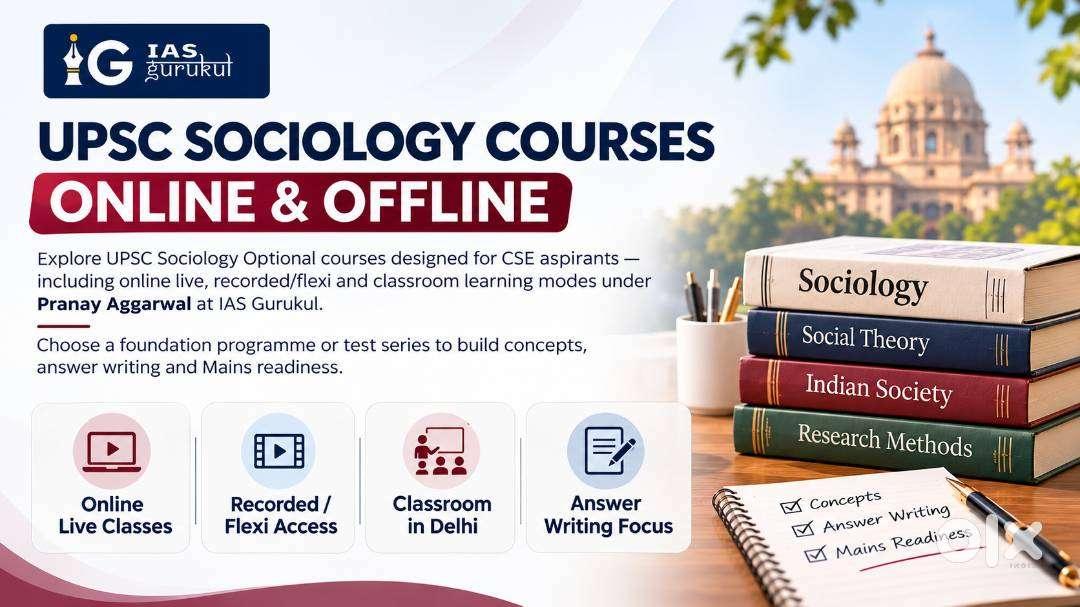
Sociology Optional requires more than remembering definitions, thinkers and theories. A strong answer demonstrates how sociological concepts help explain the society around us. For UPSC Civil Services Examination aspirants, the ability to connect theoretical knowledge with contemporary examples can make answers more analytical, relevant and meaningful.
The subject provides a framework for understanding social institutions, inequality, cultural change, development, family, caste, religion and political processes. When aspirants combine these concepts with suitable examples from Indian society, they can demonstrate a deeper understanding of the syllabus.
Why Connecting Theory with Examples Matters
Sociological theories explain patterns of human behaviour and social relationships. However, UPSC answers become more effective when candidates demonstrate how these ideas apply to actual social conditions.
For example, a question on social stratification can be approached through concepts such as class, status and power. Aspirants can then connect these concepts with inequalities in education, employment, income and access to resources in India.
This approach helps candidates:
-
Demonstrate conceptual clarity.
-
Explain abstract theories through familiar situations.
-
Develop analytical rather than descriptive answers.
-
Connect Paper I concepts with Indian society in Paper II.
-
Present balanced and relevant arguments.
How to Apply Sociological Thinkers in Answer Writing
Sociological thinkers should not be included merely to increase the number of names in an answer. Their ideas should support the argument being developed.
1. Karl Marx and Class Inequality
Karl Marx's ideas about class conflict, ownership and economic relations can help explain inequalities in modern society.
For instance, while discussing economic inequality, candidates can examine differences in access to productive resources, employment opportunities and wealth.
2. Max Weber and Social Stratification
Max Weber explained stratification through class, status and party. This framework can help analyse how economic position, social prestige and political influence shape opportunities in society.
3. Émile Durkheim and Social Solidarity
Durkheim's concepts of mechanical and organic solidarity can be used to understand changes in social relationships as societies become more specialised and interconnected.
4. M. N. Srinivas and Indian Society
M. N. Srinivas's concepts of Sanskritisation and dominant caste are particularly useful for analysing social mobility, caste relations and changes in rural India.
Connecting Paper I with Paper II
One effective preparation strategy is to identify concepts in Paper I and explore their application to Indian society in Paper II.
| Paper I concept | Possible Paper II application |
|---|---|
| Social stratification | Caste and class inequalities |
| Social mobility | Changes in caste and occupational structures |
| Family and kinship | Changing family patterns in India |
| Religion | Secularism and religious diversity |
| Social change | Urbanisation and modernisation |
| Gender and society | Gender inequality and women's participation |
This approach creates continuity between the two papers and helps aspirants develop a broader sociological perspective.
Using Contemporary Examples Effectively
Contemporary examples can strengthen an answer when they are directly relevant to the question. Aspirants should avoid adding news references simply to make an answer appear updated.
Useful areas to observe include:
-
Migration and urbanisation.
-
Digital technology and social interaction.
-
Women's participation in education and employment.
-
Changing family structures.
-
Rural development and agrarian transformation.
-
Caste relations and social mobility.
-
Education and unequal opportunities.
For example, a question on urbanisation can be connected with rural-to-urban migration, informal employment, housing challenges and changing community relationships.
The objective is not to write a newspaper summary. It is to interpret social developments through sociological concepts.
A Practical Framework for Writing Analytical Answers
Aspirants can follow a simple structure while preparing and writing answers.
Step 1 – Identify the central concept
Understand what the question is asking. Identify its main sociological theme, such as inequality, social change, power or social institutions.
Step 2 – Introduce a relevant thinker or theory
Use a suitable concept or sociologist to establish the theoretical foundation.
Step 3 – Explain the Indian context
Connect the theory with relevant examples from Indian society.
Step 4 – Present different dimensions
Consider economic, political, cultural, regional and gender-related aspects wherever relevant.
Step 5 – Conclude analytically
End with a balanced conclusion that directly addresses the question.
How IAS Gurukul Supports Sociology Optional Preparation
A structured approach to Sociology Optional preparation can help aspirants develop conceptual understanding and improve answer-writing skills.
At IAS Gurukul, aspirants can explore learning resources and programmes designed for Sociology Optional preparation.
The Sociology Optional Classroom Course provides a structured learning option for candidates seeking conceptual clarity, comprehensive syllabus coverage and regular doubt-clearing support.
Candidates can also explore the Sociology Optional Test Series for 70 Days to understand the available assessment and practice programme. Confirm the current schedule and course details directly with the institute.
For additional preparation, the UPSC Sociology Optional Previous Year Question Papers resource provides access to an archive covering 13 examination years and more than 706 questions from Paper I and Paper II.
Aspirants interested in the faculty's background can also visit the Pranay Aggarwal profile.
Common Mistakes to Avoid
Even well-prepared candidates can lose clarity when they do not apply sociological concepts appropriately.
Avoid these common mistakes:
-
Mentioning thinkers without explaining their relevance.
-
Using examples that do not directly address the question.
-
Writing lengthy introductions without defining the central issue.
-
Repeating the same examples across multiple answers.
-
Treating Paper I and Paper II as completely separate subjects.
-
Describing current events without sociological analysis.
Frequently Asked Questions
1. How can I connect sociological theory with examples in UPSC answers?
Identify the central concept, introduce a relevant theory and explain its application through examples from Indian society.
2. Should I mention sociologists in every Sociology Optional answer?
No. Include thinkers when their concepts directly support the argument. Relevance and clarity are more important than the number of names.
3. How can I prepare Paper I and Paper II together?
Connect theoretical concepts from Paper I with their applications in Indian society under Paper II. This helps develop conceptual continuity.
4. Are current affairs important for Sociology Optional?
Yes. Contemporary developments can provide useful examples, particularly when they illustrate social change, inequality, migration, gender relations or changing institutions.
5. How can previous year questions improve answer writing?
PYQs help aspirants understand question patterns, recurring themes and the depth of analysis expected in the examination.
Conclusion
The strength of a Sociology Optional answer lies in the ability to explain society through sociological reasoning. Theories provide the foundation, while relevant examples demonstrate their practical application. Aspirants who consistently connect concepts, thinkers and developments in Indian society can build more coherent and analytical answers.
Explore Sociology Optional preparation resources and courses at IAS Gurukul and develop a systematic approach to UPSC Mains preparation.
 Dutch
 English
 Arabic
 French
 Spanish
 Portuguese
 Deutsch
 Turkish
 Italiano
 Russian
 Romaian
 Portuguese (Brazil)
 Greek