


Middle East Oil & Gas Pipeline Infrastructure Market to 2035
The Middle East Oil & Gas Pipeline Infrastructure Market is entering an important phase of infrastructure development as regional energy producers expand natural gas transportation, modernize crude oil networks, and strengthen connections between production facilities and industrial demand centers.
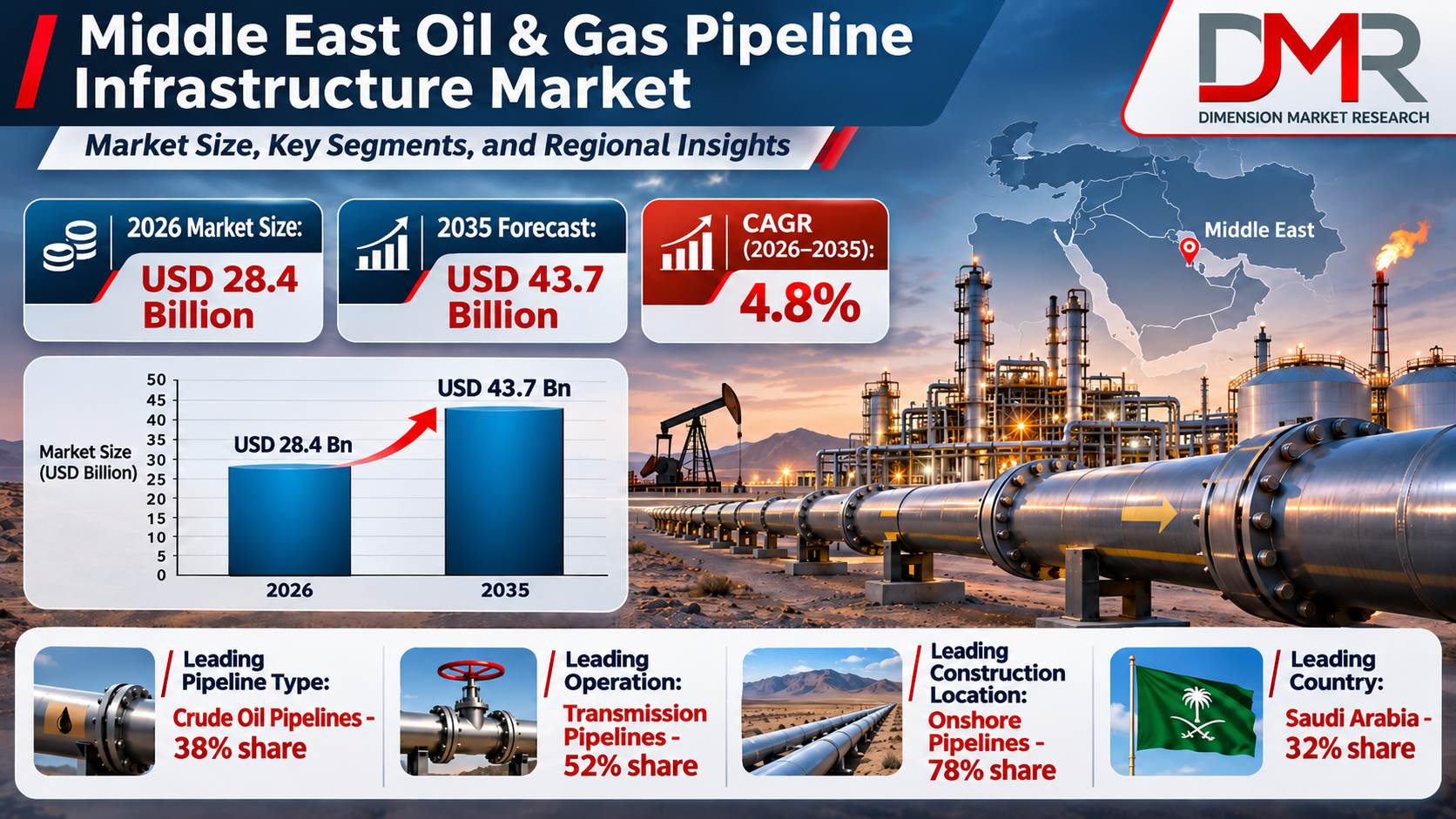
According to Dimension Market Research, the market is projected to reach USD 28.4 billion in 2026 and increase to USD 43.7 billion by 2035, expanding at a CAGR of 4.8% during 2026-2035.
Saudi Arabia, the United Arab Emirates, and Kuwait are important contributors to regional infrastructure spending. Investment in transmission networks, offshore pipeline connectivity, compressor stations, and digital monitoring technologies is creating opportunities for engineering contractors, equipment manufacturers, and pipeline service providers.
What Is the Middle East Oil & Gas Pipeline Infrastructure Market?
The Middle East Oil & Gas Pipeline Infrastructure Market encompasses the physical and digital systems used to transport crude oil, natural gas, natural gas liquids, and refined petroleum products between production sites, processing plants, refineries, industrial facilities, storage terminals, and distribution networks.
Infrastructure includes gathering pipelines, transmission pipelines, distribution systems, pumping stations, compressor stations, metering facilities, and associated control technologies.
These assets play an essential role in energy transportation, supporting reliable hydrocarbon movement while connecting upstream production with downstream processing and industrial consumption.
Why Is the Middle East Oil & Gas Pipeline Infrastructure Market Growing?
One of the principal growth drivers is the expansion of natural gas transportation infrastructure across major producing countries.
Saudi Arabia's Master Gas System expansion illustrates the scale of infrastructure investment required to connect gas production facilities with power generation, petrochemical manufacturing, and industrial demand centers. Saudi Aramco has awarded approximately USD 8.8 billion in contracts associated with the third expansion phase.
The UAE is similarly strengthening gas transmission infrastructure. ADNOC Gas operates a pipeline network extending approximately 3,260 kilometers, supplying around 60% of the country's gas requirements.
Offshore oilfield development also supports demand for subsea pipelines, risers, pipeline installation services, and high-pressure transportation equipment.
At the same time, existing networks require inspection, corrosion prevention, equipment replacement, and integrity management, creating recurring expenditure beyond new pipeline construction.
Get a Free Sample of the Middle East Oil & Gas Pipeline Infrastructure Market Report
Evaluate the regional investment outlook, infrastructure requirements, market segmentation, and competitive environment through the available report sample.
Get a Free Sample:
Middle East Oil & Gas Pipeline Infrastructure Market Statistics
● 2026 Market Size: USD 28.4 Billion
● 2035 Forecast Value: USD 43.7 Billion
● Forecast CAGR: 4.8%
● Leading Pipeline Type: Crude Oil Pipelines, 38% share in 2026
● Leading Pipeline Operation: Transmission Pipelines, 52% share in 2026
● Leading Construction Location: Onshore Pipelines, 78% share in 2026
● Leading Country: Saudi Arabia, 32% share in 2026
Which Pipeline Infrastructure Segments Dominate the Market?
Crude Oil Pipelines accounted for approximately 38% of regional revenue in 2026, supported by extensive crude production and transportation requirements. These networks connect producing fields with refineries, gathering facilities, storage terminals, and export infrastructure.
Transmission Pipelines represented around 52% of the market in 2026. Their importance reflects the need to move substantial hydrocarbon volumes between production regions, processing facilities, industrial centers, and export terminals.
By construction location, Onshore Pipelines held a 78% market share in 2026. Their leading position reflects extensive land-based transportation networks serving inland production facilities, refineries, gas processing plants, and industrial developments.
For pipeline manufacturers and engineering contractors, these findings indicate continuing demand for large-diameter steel pipes, pumping systems, compressors, valves, and associated infrastructure services.
Country-Level Growth Opportunities Across the Middle East
Saudi Arabia represents the largest national market, with revenue projected to increase from USD 9.1 billion in 2026 to USD 14.0 billion by 2035, reflecting a CAGR of 4.8%.
The country's infrastructure spending is closely connected to gas transmission expansion, offshore production projects, and localization initiatives.
The United Arab Emirates market is projected to grow from USD 6.8 billion in 2026 to USD 10.5 billion by 2035, at a CAGR of 4.9%. ADNOC's investments in gas processing, offshore development, and industrial supply networks support infrastructure requirements.
Meanwhile, Kuwait is expected to expand from USD 2.8 billion in 2026 to USD 4.4 billion by 2035, recording a CAGR of 4.7%.
Oman and Iraq also present opportunities associated with upstream field development, pipeline connectivity, and transportation capacity expansion.
How Are AI and Digital Technologies Changing Pipeline Operations?
Digitalization is becoming increasingly relevant to pipeline performance, safety, and maintenance planning.
Operators are integrating SCADA platforms, intelligent inspection technologies, remote sensors, and predictive analytics to monitor infrastructure conditions and identify potential operational problems.
Artificial intelligence can support corrosion assessment, anomaly detection, leakage monitoring, and maintenance scheduling by analyzing pressure, flow, temperature, and inspection information.
Digital twins and fiber-optic sensing technologies also provide opportunities to improve asset visibility across geographically dispersed pipeline networks.
For infrastructure operators, these technologies can support more informed maintenance decisions and better coordination between field assets and centralized control facilities.
Market Challenges and Competitive Landscape
Despite the growth outlook, pipeline projects face substantial capital requirements, complex engineering conditions, and lengthy approval procedures.
Corrosion, environmental exposure, equipment reliability, construction costs, and technical compliance can influence project economics throughout infrastructure operating lifecycles.
The competitive landscape includes national energy companies and international engineering, procurement, and construction providers.
Prominent participants covered by the report include Saudi Aramco, ADNOC Gas Pipeline Assets, NMDC Energy, Saipem, McDermott International, Larsen & Toubro Energy Hydrocarbon, Petrofac, Technip Energies, and Técnicas Reunidas.
Competition increasingly reflects engineering capabilities, project delivery experience, safety performance, local participation requirements, and the ability to provide long-term infrastructure services.
Future Opportunities Through 2035
Investment opportunities extend beyond greenfield construction into pipeline rehabilitation, compressor modernization, inspection services, automated control infrastructure, and existing network upgrades.
Integrated EPC contracting and lifecycle asset management are becoming important considerations for infrastructure owners.
For suppliers, opportunities increasingly depend on meeting technical specifications, supporting regional localization requirements, and delivering reliable performance across demanding operating environments.
View the Middle East Oil & Gas Pipeline Infrastructure Market Report and Purchase Options
Explore the complete market study to evaluate country-level opportunities, infrastructure segments, investment patterns, and the competitive environment.
View Report and Purchase Options:
https://dimensionmarketresearch.com/checkout/middle-east-oil-gas-pipeline-infrastructure-market/
Frequently Asked Questions
1. What is the Middle East Oil & Gas Pipeline Infrastructure Market size in 2026?
The market is projected to reach USD 28.4 billion in 2026, with continued growth expected through 2035.
2. What is the projected CAGR of the market?
The market is forecast to expand at a compound annual growth rate of 4.8% during 2026-2035.
3. Which pipeline type holds the largest market share?
Crude Oil Pipelines lead the pipeline type segment, accounting for approximately 38% of market revenue in 2026.
4. Which country leads the Middle East Oil & Gas Pipeline Infrastructure Market?
Saudi Arabia leads the regional market with an estimated 32% revenue share in 2026.
5. What factors are driving pipeline infrastructure market growth?
Natural gas transmission expansion, offshore field development, pipeline modernization, and increasing infrastructure integrity requirements are major growth factors.
Conclusion
The Middle East Oil & Gas Pipeline Infrastructure Market is projected to expand steadily through 2035 as regional producers invest in transportation capacity, energy connectivity, and network modernization.
Natural gas infrastructure, offshore development, and digital asset management are expected to remain important investment areas.
For manufacturers, engineering contractors, infrastructure investors, and technology providers, understanding country-level priorities and infrastructure requirements will be essential for identifying commercially relevant opportunities.
Related Oil & Gas Infrastructure Market Insights
The Middle East Oil & Gas Monitoring System Market Size is projected to increase from USD 4.82 billion in 2026 to USD 11.35 billion by 2035, registering a CAGR of 9.9%. The market includes monitoring hardware, software, sensors, pipeline integrity systems, and remote operating technologies supporting infrastructure safety and operational visibility.
The global Offshore Oil & Gas Communication Market Share is influenced by growing demand for reliable communication between offshore platforms and onshore control centers. The market is projected to rise from USD 2.6 billion in 2026 to USD 4.7 billion by 2035, with satellite communication representing a leading technology category.
The global Oil and Gas Line Pipe Market Growth is supported by pipeline construction, natural gas transportation, and infrastructure replacement activities. Market revenue is projected to rise from USD 69.2 billion in 2026 to USD 93.8 billion by 2035, growing at a CAGR of 3.1%.

 Arabic
 French
 Spanish
 Portuguese
 Deutsch
 Turkish
 Dutch
 Italiano
 Russian
 Romaian
 Portuguese (Brazil)
 Greek