


Pepper Mill Factory Technology: From Burr Cutting to Assembly
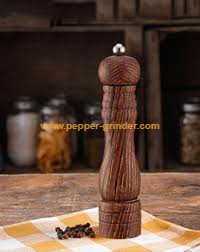
A pepper mill looks like a simple object until you try to manufacture one at scale. The burr must cut rather than crush, the shaft must stay true through thousands of rotations, and the body must feel solid without becoming heavy in the hand. Inside any serious Pepper Mill Factory, these concerns are treated as a single interconnected problem rather than separate line items. Yongkang City, Zhejiang Province, China, has long been a center for kitchen hardware, and the manufacturing culture there reflects a practical understanding that a mill's reputation is built or lost at the grinding interface.
From the materials standpoint, the burr set is where quality begins. Hardened steel burrs cut peppercorns with a sharp, consistent bite but require protective finishing to resist corrosion, while ceramic burrs offer excellent wear resistance and are unaffected by salt. The shaft material and its straightness determine whether the burr rotates concentrically; a shaft that flexes even slightly produces an uneven grind that worsens over time. Body materials range from solid wood and stainless steel to engineered plastics, each with different implications for weight, durability, and the feel of the mill in use. Internal springs and adjustment mechanisms are often overlooked, yet they are what allow the user to move between coarse and fine settings without the grind drifting.
The buying guide angle starts with the end user's kitchen habits. A mill destined for a restaurant pass needs to withstand constant use and frequent refilling, while one designed for a home dining table can prioritize form and quiet operation. Buyers should also consider whether the mill will be used for salt as well as pepper, since salt demands corrosion-resistant burrs and hardware. Adjustment ergonomics deserve early attention too: a top-knob adjustment suits table use, while a bottom adjustment keeps the profile cleaner but requires lifting the mill. Sampling remains essential, because grind consistency and the feel of the adjustment mechanism cannot be judged from photographs.
Function and technology converge on burr alignment and adjustment precision. A well-made mill holds the burr gap steady across the full range of settings, so the output stays uniform rather than shifting between coarse and fine as the mill is used. The drive train should transmit force smoothly without play, and the adjustment mechanism should move with a defined, repeatable feel. These are the qualities that separate a mill that performs reliably from one that frustrates the user after a few weeks.
Design and appearance shape how the mill is perceived before it is ever used. Proportions, finish, and the tactile quality of the body communicate whether the object is meant for daily handling or occasional display. A well-weighted base prevents tipping, and a clear fill window or an easy-loading top makes refilling less of a chore. These details are not decorative; they determine how willingly the mill is picked up at every meal.
What a Pepper Mill Factory ultimately sells is not a single product but a repeatable standard of consistency. Exploring the range at https://www.pepper-grinder.com/ offers a practical way to compare how materials, burr alignment, and adjustment design come together in mills built for daily use.
 Italiano
 English
 Arabic
 French
 Spanish
 Portuguese
 Deutsch
 Turkish
 Dutch
 Russian
 Romaian
 Portuguese (Brazil)
 Greek