


How to Improve UPSC Sociology Optional Answer Writing Using Previous Year Questions
Answer writing is one of the most important skills required for success in UPSC Sociology Optional. Candidates may understand sociological thinkers, theories and concepts, but presenting that knowledge in a relevant and analytical manner is equally important.
Previous Year Question Papers (PYQs) provide an effective way to understand the expectations of the examination. They help aspirants identify question patterns, practise different directives and develop the ability to apply sociological knowledge to unfamiliar topics.
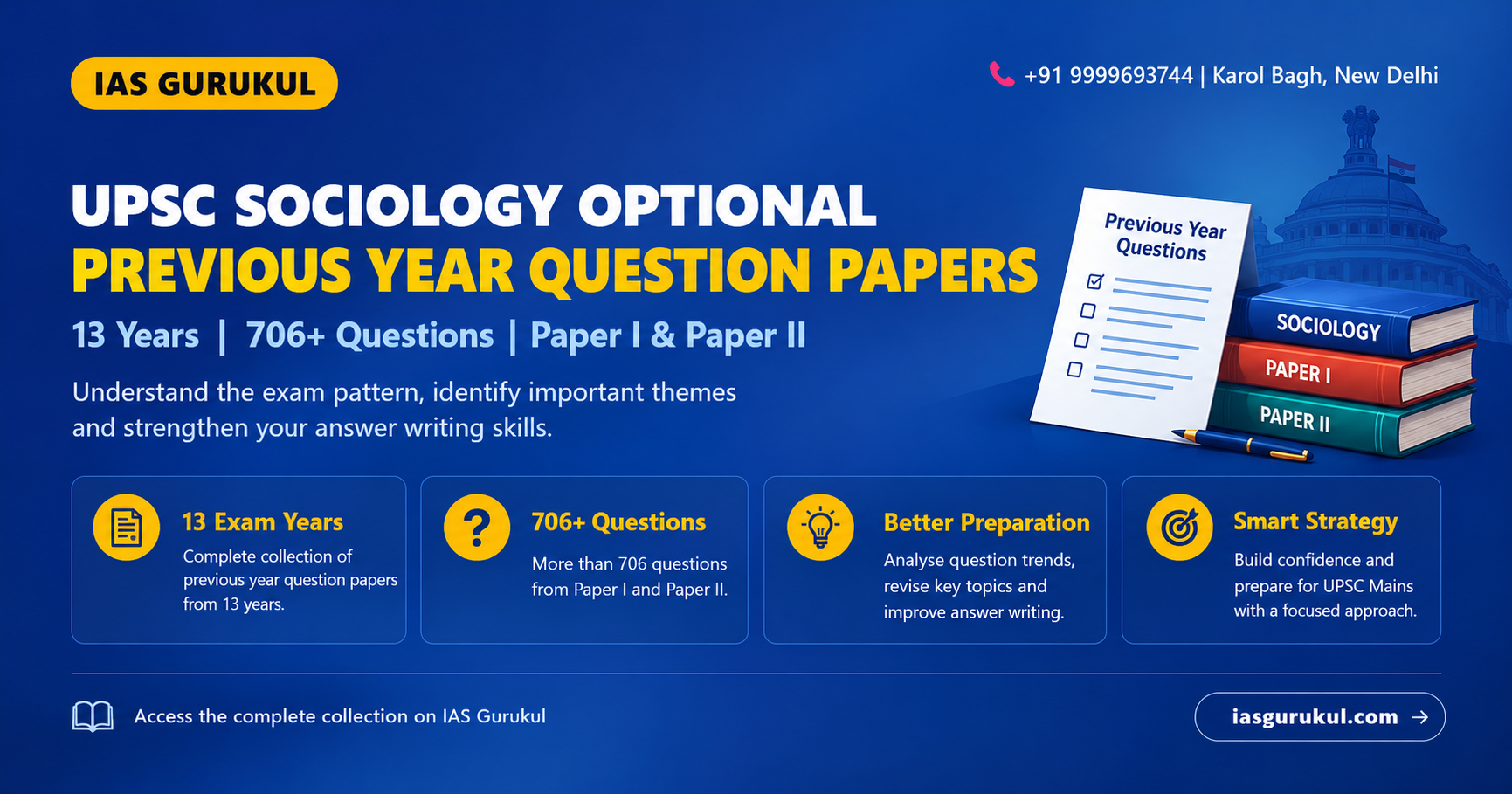
The IAS Gurukul Sociology Optional PYQ resource offers an archive covering 13 examination years and more than 706 questions across Paper I and Paper II.
Why PYQs Are Essential for Answer Writing
Reading the syllabus provides an understanding of what needs to be studied. PYQs show how that knowledge may be tested.
Regular practice helps aspirants:
-
Understand the language and structure of UPSC questions.
-
Identify the central demand of a question.
-
Apply sociological thinkers and concepts appropriately.
-
Develop relevant introductions and conclusions.
-
Improve analytical and critical thinking.
-
Manage answer-writing time more effectively.
PYQs should be used for developing understanding and practice, not for predicting the exact questions in future examinations.
Understand the Question Before Writing
One common mistake is starting an answer without identifying what the question actually demands.
Pay attention to the directive and the main subject of the question.
| Directive | How to approach it |
|---|---|
| Discuss | Explain different arguments and perspectives |
| Examine | Analyse the issue in detail |
| Critically examine | Present arguments, limitations and a balanced assessment |
| Evaluate | Assess the significance and effectiveness of an argument |
| Compare | Highlight similarities and differences |
| Comment | Present a reasoned interpretation |
Before writing, identify the topic, directive and specific dimensions that must be addressed.
Build a Strong Sociology Answer Structure
A well-organised answer makes it easier for the examiner to follow the argument.
1. Introduction
Begin with a relevant definition, concept, sociologist or brief context. Avoid lengthy introductions that do not address the question.
2. Main Discussion
Develop the central argument using sociological concepts, theories and relevant thinkers. Divide complex discussions into logical dimensions.
3. Examples and Critical Analysis
Use relevant examples from Indian society, contemporary developments or sociological studies. Where appropriate, include alternative perspectives and limitations.
4. Conclusion
End with a balanced conclusion that directly responds to the question. Avoid introducing unrelated arguments at this stage.
Use Sociological Thinkers Effectively
Thinkers should strengthen your argument rather than appear as decorative references.
Some useful connections include:
-
Karl Marx: Class conflict, capitalism and economic inequality.
-
Max Weber: Social stratification, authority and social action.
-
Émile Durkheim: Social facts, solidarity and division of labour.
-
M. N. Srinivas: Sanskritisation, westernisation and dominant caste.
-
G. S. Ghurye: Caste, tribes and Indian society.
For example, an answer on social inequality may use Marx to explain class relations and Weber to examine the additional influence of status and power.
Connect Paper I and Paper II
Aspirants should learn to connect theoretical concepts from Paper I with Indian society topics in Paper II.
| Paper I concept | Paper II application |
|---|---|
| Social stratification | Caste and class inequalities |
| Social mobility | Changing caste relationships |
| Family and kinship | Transformation of Indian families |
| Social change | Urbanisation and modernisation |
| Gender and society | Gender inequality in India |
| Religion | Religious diversity and secularism |
This connection helps candidates develop answers that demonstrate both theoretical understanding and knowledge of Indian society.
A Practical Weekly Answer-Writing Plan
| Day | Practice activity |
|---|---|
| Monday | Two Paper I conceptual questions |
| Tuesday | Two questions on sociological thinkers |
| Wednesday | Research methodology questions |
| Thursday | Paper II caste and tribal society |
| Friday | Rural society and social movements |
| Saturday | Timed answer-writing practice |
| Sunday | Review answers and revise weak areas |
Start with a manageable number of questions. Gradually increase practice as your conceptual understanding improves.
Common Answer-Writing Mistakes
Avoid these common problems:
-
Writing everything you know instead of answering the actual question.
-
Mentioning thinkers without explaining their arguments.
-
Using examples that are unrelated to the topic.
-
Repeating the same content in multiple paragraphs.
-
Ignoring the question directive.
-
Writing lengthy introductions and conclusions.
-
Neglecting revision and answer evaluation.
The aim should be clarity, relevance and sociological analysis rather than unnecessary complexity.
Practise with IAS Gurukul Sociology Optional PYQs
Aspirants can use the IAS Gurukul Sociology Optional Previous Year Question Papers to practise questions from Paper I and Paper II. The archive covers 13 examination years and more than 706 questions.
For structured learning, explore the Sociology Optional Classroom Course.
Candidates looking for an assessment-focused programme can also review the Sociology Optional Test Series for 70 Days. Confirm current schedules and availability with the institute.
Learn more about the faculty through the Pranay Aggarwal profile.
Frequently Asked Questions
1. How can PYQs improve Sociology Optional answer writing?
PYQs help aspirants understand question patterns, practise directives and learn to apply sociological concepts to examination questions.
2. How many answers should I practise daily?
Begin with two or three well-structured answers and increase the number according to your preparation stage and available time.
3. Should I include sociological thinkers in every answer?
No. Use thinkers when their theories or concepts directly contribute to the argument.
4. How can I make Sociology Optional answers analytical?
Explain concepts, compare perspectives, use relevant examples and examine different dimensions of the issue.
5. Where can I practise Sociology Optional PYQs?
Visit the IAS Gurukul Sociology Optional PYQ archive for questions from both papers.
Conclusion
Effective answer writing develops through consistent practice, conceptual clarity and careful evaluation. PYQs provide a practical foundation for understanding UPSC expectations and applying sociological knowledge in a structured manner.
Make previous year questions part of your regular preparation routine and focus on writing answers that are relevant, balanced and analytical.
 Portuguese (Brazil)
 English
 Arabic
 French
 Spanish
 Portuguese
 Deutsch
 Turkish
 Dutch
 Italiano
 Russian
 Romaian
 Greek