


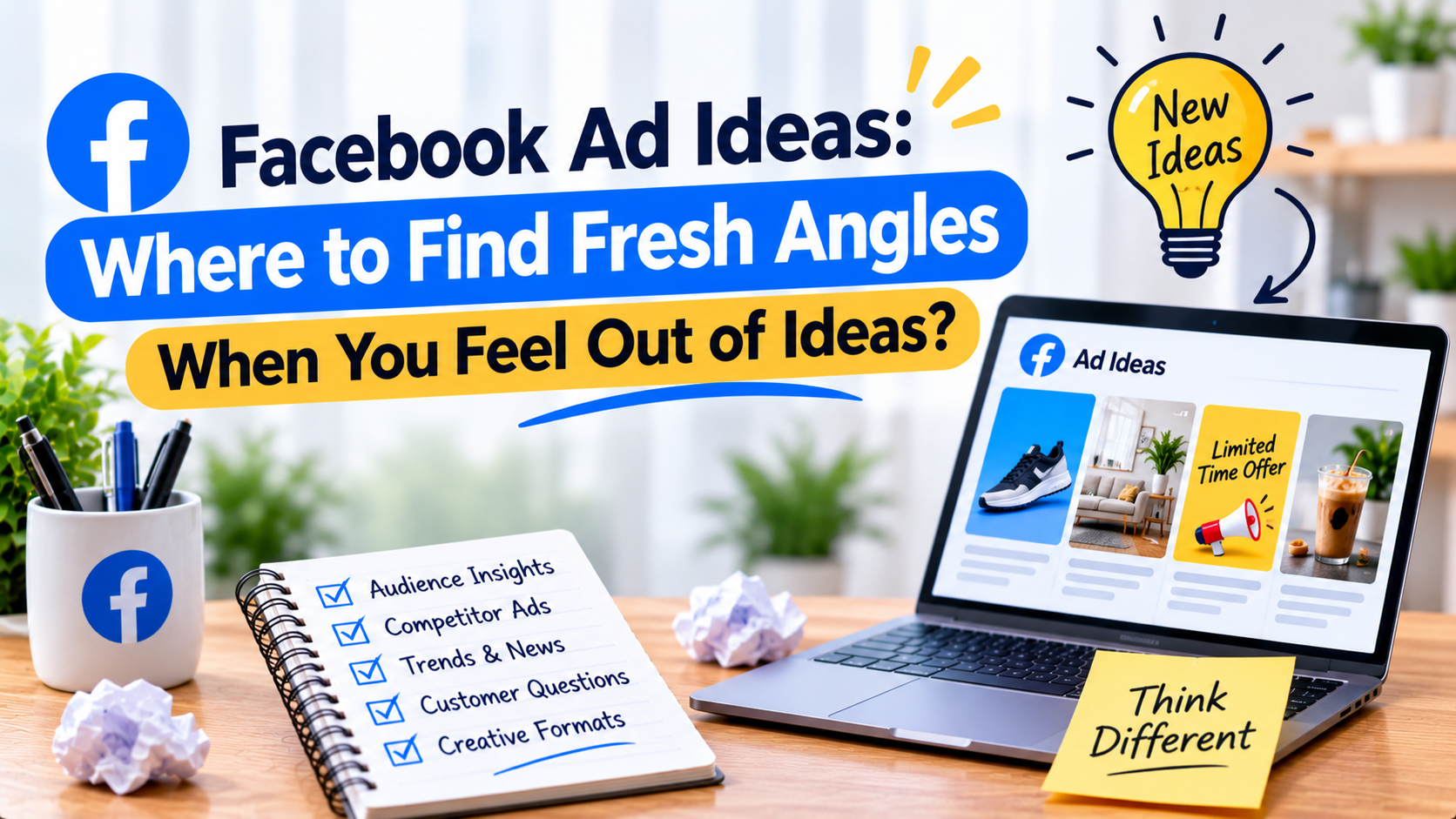
Facebook Ad Ideas: Where to Find Fresh Angles When You Feel Out of Ideas
Every advertiser hits the wall eventually. The best ad has worn out, the team has produced the same message in six different outfits and nobody can think of anything new to say about the product. The blank page returns, and the pressure to launch something builds.
Here is the reassuring part: you are almost never out of ideas. You are usually out of angles, and angles can be found. This guide shows where to look for them and how to turn them into ads worth testing.
Angles and Variations Are Not the Same Thing
Before hunting for ideas, it helps to separate two things that are often confused. A variation is the same message dressed differently, such as a new thumbnail, a different headline or a slightly different edit. An angle is a different reason for someone to care.
Saving time, saving money, avoiding embarrassment, feeling more confident and trusting what other people say are all separate angles for the same product. Ten variations of one angle will tire out together, but five genuine angles give you five separate chances to reach people.
Look Inside Your Own Business First
Customer Reviews
Reviews are the richest source of ideas you already own. Read them slowly and highlight the problems people mention, the surprises they report and the exact words they use. A line such as “I didn't expect it to be this easy” contains a complete angle: effortlessness.
Support Emails and Chats
People write to support when something confuses or worries them. Those messages show you the doubts that stop others from buying, which makes them perfect material for ads that answer objections before they are raised.
Comments and Messages
The comments under your own posts and ads tell you what people notice and ask about. Questions that appear again and again are angles waiting to be turned into ads.
Sales Conversations
If you talk to customers before they buy, take notes. The reasons they give for choosing you, and the reasons they hesitate, are the foundation of a solid UGC creative strategy because creator videos work best when they tell stories customers recognize.
Ask Customers Directly
If your existing material feels thin, ask. A short survey to recent buyers can reveal more than weeks of brainstorming. Useful questions are simple: what problem were you trying to solve, what almost stopped you from buying and how would you describe the product to a friend?
Keep the questions open so people answer in their own words. The sentences you collect will often sound better than anything written in a meeting.
Study What Others Are Running
Meta's Ad Library lets you see which ads a brand is currently running. Browse competitors and notice which messages they keep using. An ad that has been live for a long time is a sign that it is probably paying for itself.
Do not copy. Look for the underlying angle and ask whether it fits your customers. It also helps to look at adjacent industries or brands in other countries, where you may find approaches that feel fresh to your audience because nobody in your category has used them yet.
Turn Ideas Into Openings
An angle becomes an ad when it has a strong opening. Once you pick an idea, write several different first lines for it, such as one that names a problem, one that shows a result and one that tackles a doubt. Careful hook development multiplies the value of every angle, because the same idea can reach different people through different doors.
Keep each opening short and specific, and write it the way a real person would say it. If a line sounds like a slogan, rewrite it.
Use Different Formats to Express the Same Angle
One angle can become a testimonial video, a simple image with a headline, a short demonstration or a creator story. Changing the format changes how the idea feels without losing its meaning, and it gives you more to test from the same research.
A quick, inexpensive way to explore an angle is to make a simple image ad first. If it earns attention, you can invest in video knowing the idea has already shown promise.
Build a Habit Instead of Waiting for Inspiration
Inspiration is unreliable. A routine is not. Set aside a short regular time, perhaps once a week, to read new reviews, check comments and add fresh ideas to a running list. When an ad starts to fade, you will already have a queue of angles ready.
Keep the list organized, noting the source of each idea, the customer phrase behind it and whether it has been tested. Over time it becomes a map of what your market cares about.
Test Your Ideas Before Committing
Not every angle will work, and that is fine. The aim is to find out cheaply. Launch a few distinct ideas in a testing setup, give each a fair budget and watch how people respond. Compare how many stop, how many click and what each result costs.
Resist the urge to judge too early or to declare a winner after a day. Let the data build a pattern, then keep the strongest idea and develop new versions around it.
When to Ask for a Second Opinion
Sometimes the problem is not a lack of angles but a lack of fresh eyes. Someone close to the product often cannot see what outsiders find interesting. A Facebook ads expert can look at your account, your customer language and your results, and point to angles you have overlooked.
Frequently Asked Questions
How many ad angles should I have at once?
There is no fixed number, but running several genuinely different angles gives you more resilience than relying on one. Start with a small group and expand as your budget and capacity grow.
What is the difference between an ad angle and an ad variation?
An angle is a different reason to care. A variation is the same message presented in a different way. Variations help refine an angle, while new angles open new audiences.
Where can I find ad ideas for free?
Your reviews, support messages, comments and sales notes are free and highly relevant. Meta's Ad Library is another free source of examples.
How often should I look for new ad ideas?
Regularly, rather than only when performance drops. A weekly routine keeps a steady queue of angles ready.
Final Thoughts
Running out of ideas is usually a sign that you have been looking in the wrong place. Start with what your customers already say, ask them for more, study the market and turn each angle into several openings and formats. With a simple habit and honest testing, fresh ideas stop being a crisis and become part of your routine.
 Dutch
 English
 Arabic
 French
 Spanish
 Portuguese
 Deutsch
 Turkish
 Italiano
 Russian
 Romaian
 Portuguese (Brazil)
 Greek