


What Drives the Allergic Rhinitis Market Beyond Seasonal Demand?
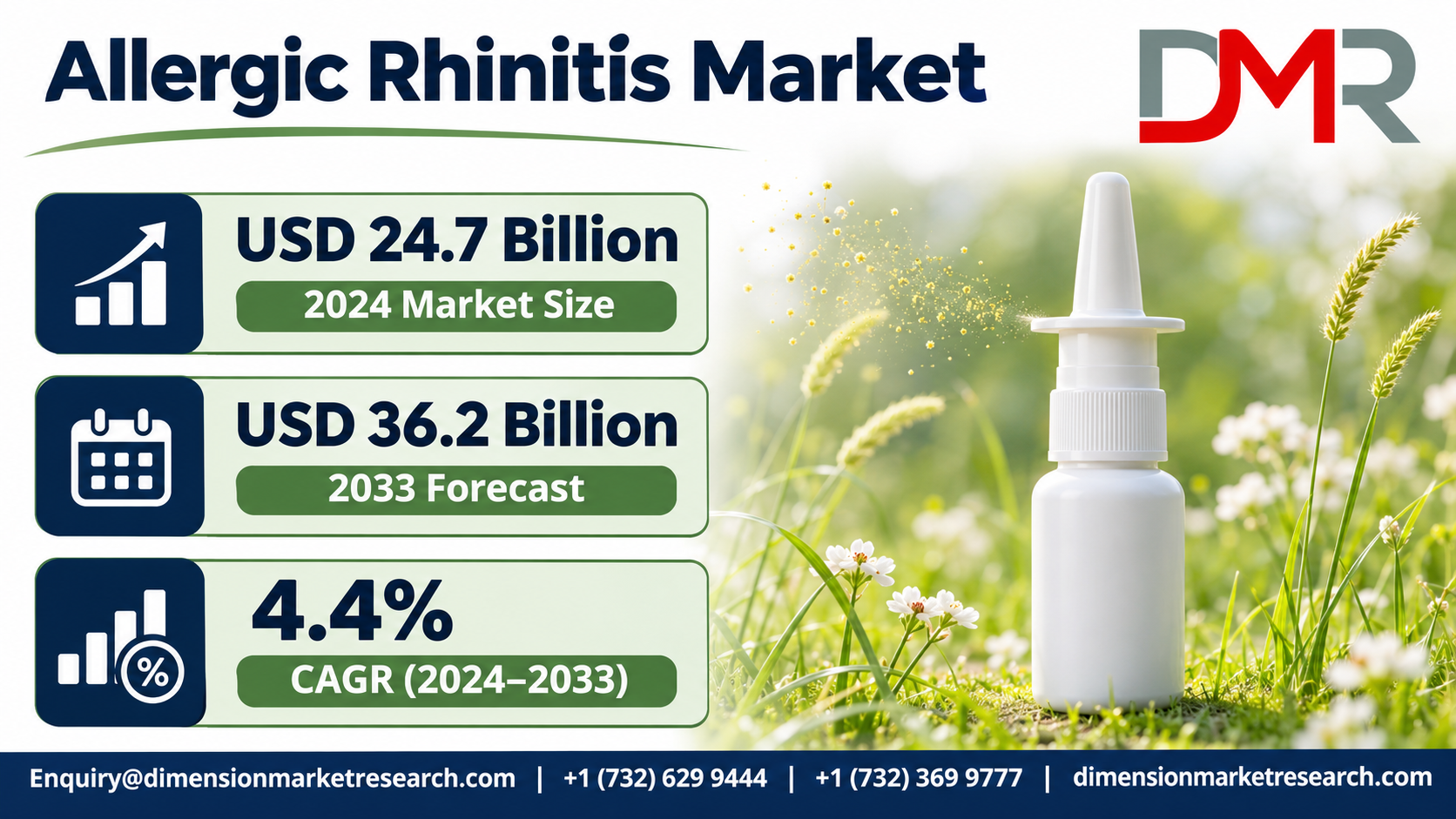
According to Dimension Market Research, the global Allergic Rhinitis Market was estimated at USD 24.7 billion in 2024 and is projected to reach USD 36.2 billion by 2033, growing at a 4.4% CAGR from 2024 to 2033. Tablets and capsules anchor the formulation mix, while allergen testing and immunotherapy address different needs within the same market. North America accounted for more than half of global revenue in the report’s 2023 regional analysis.
Get a Free Sample
Preview the report’s coverage of formulations, applications, regional demand, and the competitive landscape.
https://dimensionmarketresearch.com/request-sample/allergic-rhinitis-market/
What is driving the Allergic Rhinitis Market?
Allergic rhinitis, commonly known as hay fever, is an allergic response to airborne triggers such as pollen, dust mites, and pet dander. Symptoms can include sneezing, nasal congestion, and watery eyes. Pollen can produce seasonal patterns of demand, while indoor allergens can contribute to symptoms throughout the year. The report identifies rising prevalence and greater awareness of allergic conditions as drivers of demand for both diagnosis and treatment.
For pharmaceutical companies and healthcare providers, the timing of symptoms has a practical implication. Seasonal demand can concentrate around periods of allergen exposure, while persistent symptoms can lead patients to seek evaluation or ongoing management. A company assessing market potential can therefore distinguish between products purchased for occasional symptom relief and services or therapies used to investigate and manage recurring symptoms.
Why solid formulations lead the Allergic Rhinitis Market
Solid formulations accounted for more than 66% of market revenue in 2023. The report links the position of tablets and capsules to ease of use, convenience, and shelf life. It identifies antihistamines, corticosteroids, and decongestants among the treatment categories used for symptom management. Formulation and treatment class are separate dimensions. The formulation describes how a product is delivered, while the treatment class describes the role it serves.
That distinction matters when comparing portfolios. The leading share for solid products provides a benchmark for delivery format, but it cannot identify which class accounts for that revenue on its own. Product teams can use the formulation breakdown to understand where sales are concentrated, then examine the specific symptoms, patient needs, and treatment settings their products are intended to address.
Hospitals, allergen testing, and immunotherapy
Hospitals accounted for roughly 50% of the report’s application segment in 2023. The report also covers skin and blood tests used to identify specific allergens. These tests answer a different question from symptom management. They help establish what triggers a reaction, which can inform discussions about reducing exposure and evaluating more targeted options. This makes diagnostic capability relevant to companies serving patients whose symptoms recur or whose triggers are unclear.
The report identifies subcutaneous and sublingual immunotherapy as approaches that aim to reduce sensitivity to specific allergens over time. It also highlights interest in more individualized care based on patients’ triggers and symptom patterns. For businesses evaluating this part of the market, the opportunity involves a different care pathway from routine symptom relief. Identifying the relevant allergen and supporting treatment over time are part of that pathway.
North America leads Allergic Rhinitis Market revenue
North America accounted for 56.2% of global market revenue in 2023, the largest regional share reported in the study. The figure provides a benchmark for where commercial demand was concentrated. It comes from a different year than the 2024 market estimate, so it is best read as a historical snapshot of the regional mix.
Regional revenue and product mix answer different business questions. The first indicates the scale of demand in a geography. The second helps manufacturers assess whether their portfolio fits the products and care settings that contribute to that demand. Looking at both makes it easier to distinguish the opportunity for an established oral formulation from the opportunity for a diagnostic test or allergen-specific therapy.
Access the Complete Report
Compare the full forecast, formulation segments, application breakdowns, and regional outlook. Select a purchase option on the official report page and choose Proceed to Checkout.
https://dimensionmarketresearch.com/checkout/allergic-rhinitis-market/
Frequently Asked Questions
1. How large was the global Allergic Rhinitis Market in 2024?
The report’s Key Takeaways and Report Details estimate USD 24.7 billion in 2024.
2. What is the Allergic Rhinitis Market forecast for 2033?
Those sections project USD 36.2 billion by 2033, at a 4.4% CAGR from 2024 to 2033.
3. Which formulation held the largest revenue share?
Solid formulations, including tablets and capsules, accounted for more than 66% of revenue in 2023.
4. What share did hospitals hold in 2023?
Hospitals represented roughly 50% of the report’s application segment.
5. Which region led the market in 2023?
North America led with 56.2% of global revenue.
Conclusion
The allergic rhinitis market spans routine symptom management, diagnostic testing, and allergen-specific treatment. Solid formulations provide the largest established product base in the report’s historical breakdown. Testing and immunotherapy address different points in the care pathway, which affects how businesses assess demand, distribution, and the evidence needed to support a product’s use.

 Arabic
 French
 Spanish
 Portuguese
 Deutsch
 Turkish
 Dutch
 Italiano
 Russian
 Romaian
 Portuguese (Brazil)
 Greek