


AI-Powered Food Robotics Market: Growth Opportunities in Intelligent Manufacturing and Quality Control
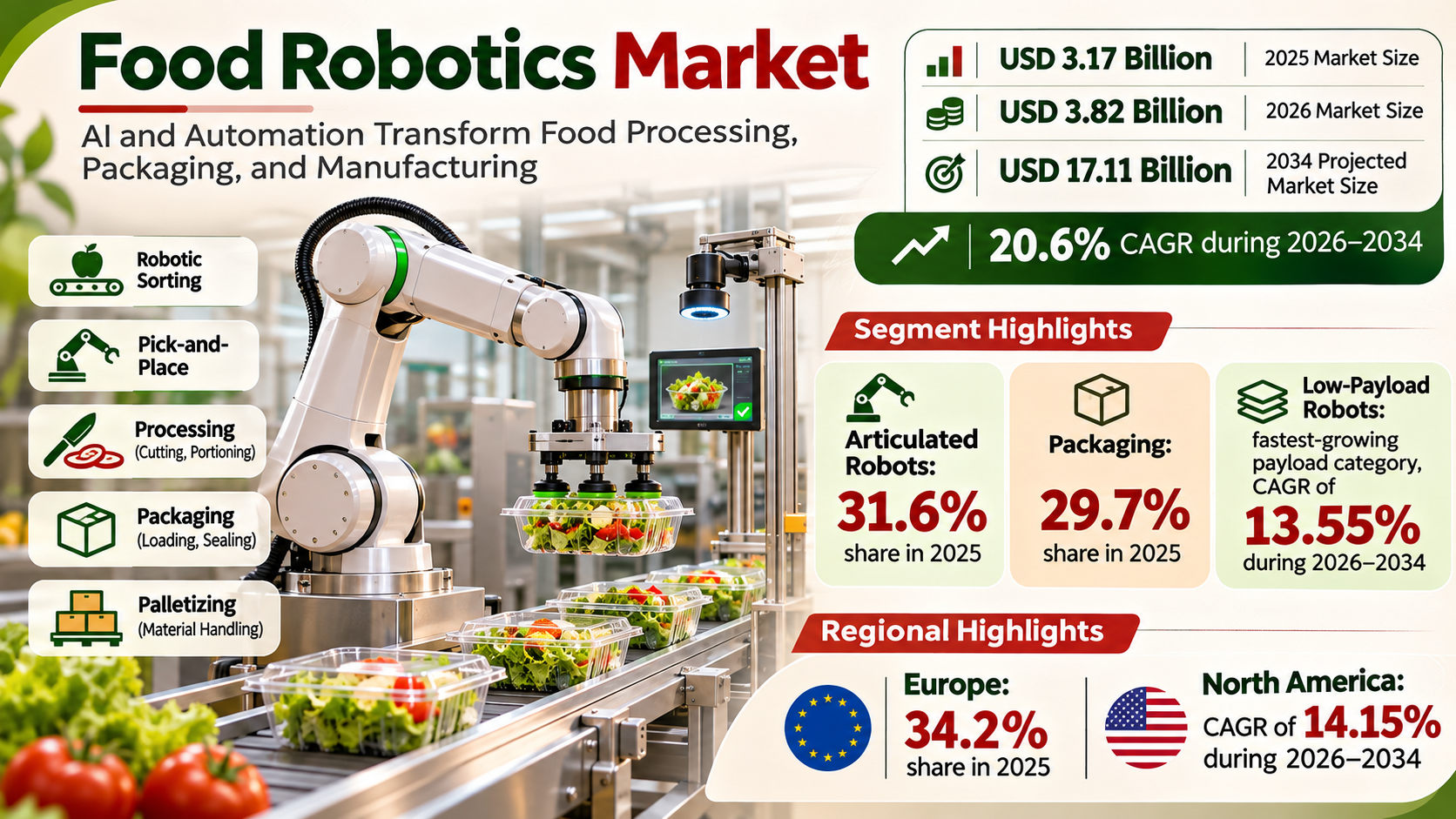
The food and beverage industry is increasingly adopting robotics to improve production efficiency, maintain product consistency, and address labor-intensive operations. Food robotics combines industrial automation, artificial intelligence (AI), machine vision, and precision engineering to perform tasks such as sorting, cutting, picking, packaging, inspection, and palletizing. As food manufacturers seek faster production cycles and more consistent quality, robotic systems are becoming an important part of modern processing facilities.
According to Straits Research, the global food robotics market was valued at USD 3.17 billion in 2025 and is projected to increase from USD 3.82 billion in 2026 to USD 17.11 billion by 2034, registering a CAGR of 20.6% during the forecast period 2026–2034. This growth reflects the expanding role of automation across food manufacturing, processing, and packaging operations.
Automation Reshapes Food Processing Operations
Food manufacturers are increasingly turning to robotic systems to automate repetitive and precision-sensitive production tasks. Applications such as cutting, sorting, portioning, and product handling require consistent execution, particularly in high-volume processing environments. Robotics helps manufacturers improve production speed while reducing dependence on manual operations.
Machine vision and AI are also expanding the capabilities of food robotics. These technologies allow robotic systems to identify products, assess their position, and perform handling tasks with greater precision. The combination of intelligent inspection and automated handling supports quality control, reduces product damage, and improves manufacturing efficiency.
Packaging Applications Strengthen Market Demand
Packaging accounted for a leading 29.7% share of the food robotics market in 2025. The segment benefits from the need for high-speed, consistent, and hygienic packaging operations across processed foods, beverages, and ready-to-eat products. Robotic systems can automate tasks such as loading, sealing, sorting, case packing, and product placement.
The expansion of packaged food production and the need for efficient handling across manufacturing facilities are strengthening demand for packaging automation. Robotic packaging systems also support flexible production lines, allowing manufacturers to manage different product formats and packaging requirements with greater operational efficiency.
Articulated Robots Lead Adoption Across Types
Articulated robots held a dominant 31.6% market share in 2025. Their multi-jointed structure provides flexibility and a wide range of motion, making them suitable for applications such as picking, placing, processing, and palletizing. Their ability to perform complex movements across different production stages supports their adoption in food manufacturing facilities.
The low-payload segment is projected to be the fastest-growing payload category, with a CAGR of 13.55% during 2026–2034. These systems are suited to lightweight food products and precision handling tasks where controlled movement and careful product placement are important. Their adoption supports automation in applications that require delicate handling and repeatable operations.
Hygienic Design and Intelligent Handling Expand Opportunities
Food production environments require equipment that can meet strict hygiene and cleaning requirements. Robotic manufacturers are therefore focusing on designs suitable for food-processing conditions, including systems that support easier cleaning and reduce contamination risks. These requirements are particularly relevant in meat, poultry, seafood, dairy, and ready-meal production.
Soft grippers and machine vision are also expanding the range of products that robots can handle. Delicate food items often require careful gripping to prevent bruising, deformation, or product loss. Advances in robotic end-effectors and vision-guided handling are helping manufacturers automate tasks that previously required substantial manual involvement.
Europe Leads the Regional Market
Europe dominated the food robotics market with a 34.2% share in 2025. The region's established food processing industry and emphasis on production efficiency, quality standards, and manufacturing automation support its leading position. Demand for automated packaging, inspection, and handling systems also contributes to the adoption of food robotics across European production facilities.
North America is projected to be the fastest-growing region, registering a CAGR of 14.15% during 2026–2034, according to the report. Investments in food manufacturing automation, robotics, and intelligent production systems are creating opportunities for technology providers across the region.
Asia Pacific also represents an important market, supported by its expanding food processing industry, growing packaged food production, and investments in manufacturing infrastructure. Increasing automation across food production facilities is expected to create additional opportunities for robotic system suppliers.
Competitive Landscape and Future Outlook
The food robotics market features automation companies and robotics manufacturers developing solutions for food processing, packaging, inspection, and material handling. Key players identified in the Straits Research report include Mitsubishi Electric Corporation, ABB Group, Kawasaki Heavy Industries Ltd., Rockwell Automation Incorporated, FANUC Corporation, Universal Robots A/S, Seiko Epson Corporation, Yaskawa Electric Corporation, Staubli International Corporation, and Mayekawa Mfg. Co., Ltd.
The future of food robotics will be shaped by improvements in AI-powered vision systems, flexible robotic handling, hygienic equipment design, and integrated production automation. As manufacturers seek to increase throughput and improve product consistency, robotic solutions are expected to become more widely integrated across food manufacturing operations.
With the market projected to reach USD 17.11 billion by 2034, food robotics is positioned to play an increasingly important role in the modernization of food processing and packaging.
Explore the full report: https://straitsresearch.com/report/food-robotics-market
About Straits Research
Straits Research is a market intelligence and consulting firm providing industry insights, market sizing, competitive analysis, and strategic research across multiple sectors. Its reports help businesses understand emerging trends, evaluate market opportunities, and make informed decisions.
 Deutsch
 English
 Arabic
 French
 Spanish
 Portuguese
 Turkish
 Dutch
 Italiano
 Russian
 Romaian
 Portuguese (Brazil)
 Greek