


A Day in the Life of a Yoga Teacher Training Student in Mysore
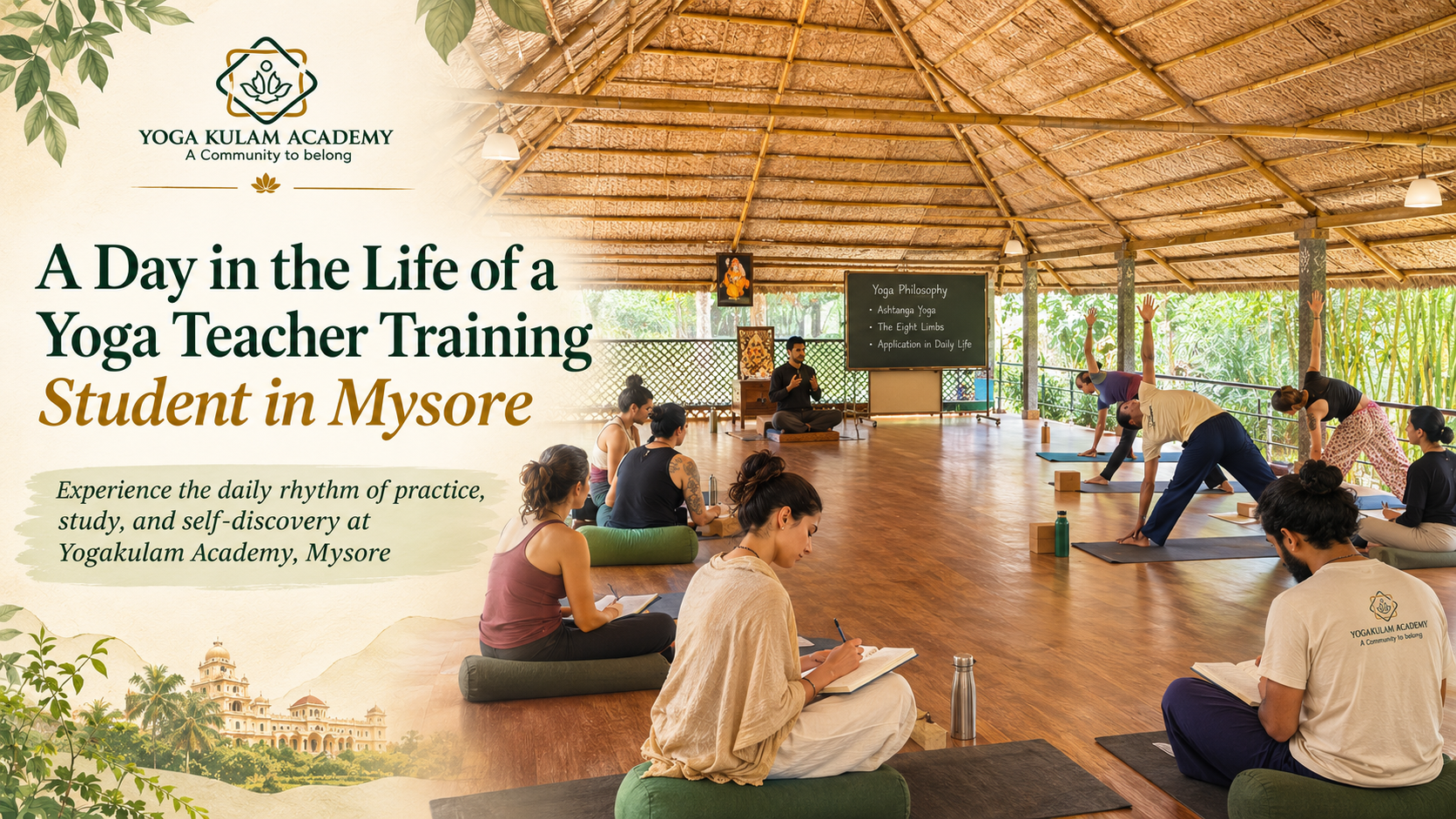
From Early Morning Hatha Yoga to Evening Meditation: Experiencing Daily Life at a Traditional Yoga School
At 5:30 in the morning, Mysore is still quiet.
The streets are peaceful, the air feels cooler, and many people are still asleep. But for students attending a residential yoga teacher training program, the day is already beginning.
There are no rushed commutes to the office or last-minute decisions about when to exercise. Instead, the day follows a structured routine of yoga practice, breathing exercises, philosophy, anatomy, meditation, and study.
For someone arriving from a busy city, this routine may feel unfamiliar at first.
But after several days, something interesting happens. The schedule begins to feel natural, and yoga becomes more than a class attended for an hour.
It becomes part of everyday life.
Here is what a typical day at Yogakulam Academy's Mysore campus can look like, based on its published residential training schedule.
5:30 AM – Waking Up Before the Day Gets Busy
The first challenge of residential yoga training often happens before anyone steps onto a mat.
Waking up early requires adjustment, especially for students accustomed to late nights or irregular schedules.
At Yogakulam Academy, the daily routine begins between 5:30 and 6:00 AM.
This gives students time to prepare for morning practice.
The early start also introduces an important principle: consistency.
Students researching the Best 200 hour yoga teacher training mysore may initially focus on certification, accommodation, and curriculum. Yet the opportunity to develop a consistent daily routine can be one of the most valuable parts of residential learning.
6:00 AM – Beginning the Day With Hatha Yoga
Morning Hatha Yoga takes place from 6:00 to 7:30 AM.
Instead of rushing through postures, students have time to focus on alignment, breathing, stability, and movement.
Some asanas may feel comfortable, while others reveal limitations in strength, mobility, or balance.
A posture that seemed easy yesterday might feel more demanding today.
This is part of the learning experience.
Regular practice helps students understand how the body responds to repetition, recovery, and changing energy levels.
Over time, the objective becomes less about performing impressive postures and more about developing awareness.
7:30 AM – Understanding Karma Yoga
From 7:30 to 8:00 AM, the schedule includes Karma Yoga.
Karma Yoga is traditionally associated with action performed with responsibility and without attachment to personal reward.
Within yoga training, it introduces students to a dimension of yoga that extends beyond physical postures.
The purpose is to reflect on how everyday actions, service, discipline, and intention relate to yogic philosophy.
For students seeking certified yoga teacher training India Mysore, this is a reminder that meaningful yoga education involves more than mastering asanas or completing assessments.
Yoga also asks us to examine how we act outside the classroom.
8:00 AM – Pranayama and Breath Awareness
After the morning practice, students attend pranayama from 8:00 to 9:00 AM.
Breathing is something we do automatically, but structured pranayama introduces a different level of attention.
Students explore how breathing techniques are practised, why different methods are used, and what precautions may be necessary.
Beginners may discover that even observing their natural breath requires concentration.
More experienced practitioners may begin noticing subtle habits, including unnecessary effort or breath-holding.
The emphasis should be on learning appropriate techniques safely rather than forcing advanced breathing practices.
9:00 AM – Breakfast and a Chance to Connect
After several hours of morning activities, breakfast becomes a welcome part of the routine.
At Yogakulam Academy, residential training includes vegetarian meals.
Breakfast is also an opportunity to step away from formal instruction, relax, and connect with fellow students.
People arrive at yoga teacher training with different experiences.
Some are preparing for a professional teaching career.
Others want to deepen their personal practice.
Some are travelling to India for the first time.
Sharing everyday experiences can gradually create a sense of community.
10:30 AM – Yoga Philosophy Beyond the Postures
From 10:30 to 11:30 AM, students move into yoga philosophy.
This is where questions become more complex.
What does yoga mean beyond physical exercise?
How do traditional teachings relate to everyday life?
What is the role of discipline, self-study, and ethical awareness?
Philosophy encourages students to explore these questions rather than simply memorise definitions.
For many trainees, the most interesting part is discovering connections between ideas discussed in class and their own behaviour during practice.
12:00 PM – Learning Alignment and Adjustments
The next session focuses on adjustment and alignment.
Students explore how postures can be taught clearly and adapted for different bodies.
An instruction that works for one student may not suit another.
Some practitioners have limited mobility.
Others have greater flexibility but need more stability.
Understanding these differences is essential for responsible teaching.
When comparing the top yoga schools in Mysore for teacher training, prospective students should pay attention to the amount of practical guidance and feedback offered.
Learning how to perform a posture is only one part of teacher education.
Learning how to explain it to others is another.
1:00 PM – Lunch and Afternoon Rest
Lunch is scheduled from 1:00 to 2:00 PM, followed by a rest period until 3:00 PM.
Rest may seem like a small detail in an intensive training schedule, but it serves an important purpose.
Students are combining physical practice with several hours of theoretical learning.
Having time between sessions allows them to eat, recover, and prepare for afternoon activities.
A structured yoga routine should recognise that recovery supports learning.
Not every available hour needs to be filled with strenuous activity.
3:00 PM – Anatomy: Understanding the Body
The afternoon anatomy class runs from 3:00 to 4:00 PM.
Anatomy helps future teachers understand movement, joints, muscles, and basic principles of physical safety.
Students begin connecting what they experience during asana practice with what they learn about the body.
Why does one person find a posture comfortable while another struggles?
How can a movement be modified?
What should a teacher do when someone experiences pain?
These are practical questions that require careful study.
A strong anatomy foundation does not make a yoga teacher a medical professional, but it can help develop better observation and teaching judgment.
4:30 PM – Ashtanga Yoga and Developing Consistency
The schedule continues with Ashtanga practice from 4:30 to 6:00 PM.
Ashtanga introduces a more structured approach to sequencing, with attention to coordination between breathing and movement.
Students may find the physical demands different from their morning Hatha practice.
The combination allows them to explore different approaches to asana within the same training environment.
For someone evaluating the best Yoga Teacher Training Mysore experience, this balance between practice, theory, and teaching skills is worth considering.
The value lies not simply in how many yoga styles are included but in how carefully they are taught.
6:00 PM – Meditation After a Full Day
From 6:00 to 7:00 PM, the timetable includes meditation.
After a day filled with movement, study, and discussion, meditation introduces an opportunity for quieter observation.
Some students may find sitting still surprisingly difficult.
Their minds may return to conversations, assignments, or the day's practice.
That does not necessarily mean they are doing something wrong.
Meditation involves learning to recognise the activity of the mind without expecting every session to feel peaceful.
With regular practice, students have opportunities to become more familiar with their attention and habits.
7:00 PM – Dinner and Evening Self-Study
Dinner takes place from 7:00 to 8:00 PM.
The day concludes with self-study between 8:00 and 9:00 PM.
Students can review class notes, revisit philosophy topics, prepare for assessments, or reflect on what they learned.
This is where different parts of the day's training may begin to connect.
An anatomy concept may help explain something experienced during morning practice.
A philosophy discussion may make more sense after meditation.
The structured routine encourages students to revisit their learning rather than constantly moving to new material.
What About Free Time and Exploring Mysore?
Residential training involves a demanding schedule, but the wider environment can also be part of the experience.
Yogakulam Academy's Mysore campus is situated near the Kaveri River, away from the busiest parts of the city.
When the timetable permits, students may have opportunities to explore Mysore's cultural heritage, markets, temples, and historic landmarks.
Some travellers initially consider a yoga retreat in mysore because they want time away from daily pressures.
A yoga teacher training program offers a different experience, with more formal study, practical learning, and assessment.
Both can be meaningful, but they serve different purposes.
Is This Routine Suitable for Beginners?
A full residential training schedule can feel demanding at first.
Students need to adapt to early mornings, regular physical practice, and concentrated study.
For someone primarily interested in exploring yoga, the Best 100 hour yoga teacher training mysore option may be a shorter introduction to structured yoga education.
A 200-hour course generally offers a broader foundation for aspiring teachers.
Meanwhile, 300-hour training is intended for students looking to develop beyond foundational yoga teacher education.
The appropriate choice depends on experience, learning goals, and readiness for the course.
What Students Take Away From Daily Yoga Training
The lasting value of residential training often comes from ordinary experiences.
Waking up even when you feel tired.
Practising a familiar posture again.
Asking a question during philosophy.
Learning to explain an alignment principle.
Recognising when the body needs rest.
Studying when you would normally be scrolling through your phone.
These habits may seem small, but they can change how students approach yoga.
A course does not need to promise dramatic transformation to provide meaningful learning.
Sometimes the greatest difference comes from having enough time and structure to practise consistently.
Final Thoughts
A day in the life of a yoga teacher training student in Mysore is much more than a sequence of yoga classes.
It brings together physical practice, breathing, philosophy, anatomy, meditation, community, and self-study.
At Yogakulam Academy, the published daily schedule provides a framework for students to explore these subjects within a residential learning environment.
For those considering the Best 200 hour yoga teacher training mysore, the most important question is not simply what certificate they will receive.
It is what they will learn through the experience.
Because the real value of yoga teacher training is not only found in the hours spent on the mat.
It is also found in the habits, understanding, and self-awareness developed throughout the day.
 Spanish
 English
 Arabic
 French
 Portuguese
 Deutsch
 Turkish
 Dutch
 Italiano
 Russian
 Romaian
 Portuguese (Brazil)
 Greek