


How Do Online Yoga Teacher Training Students Practice Teaching Real People?
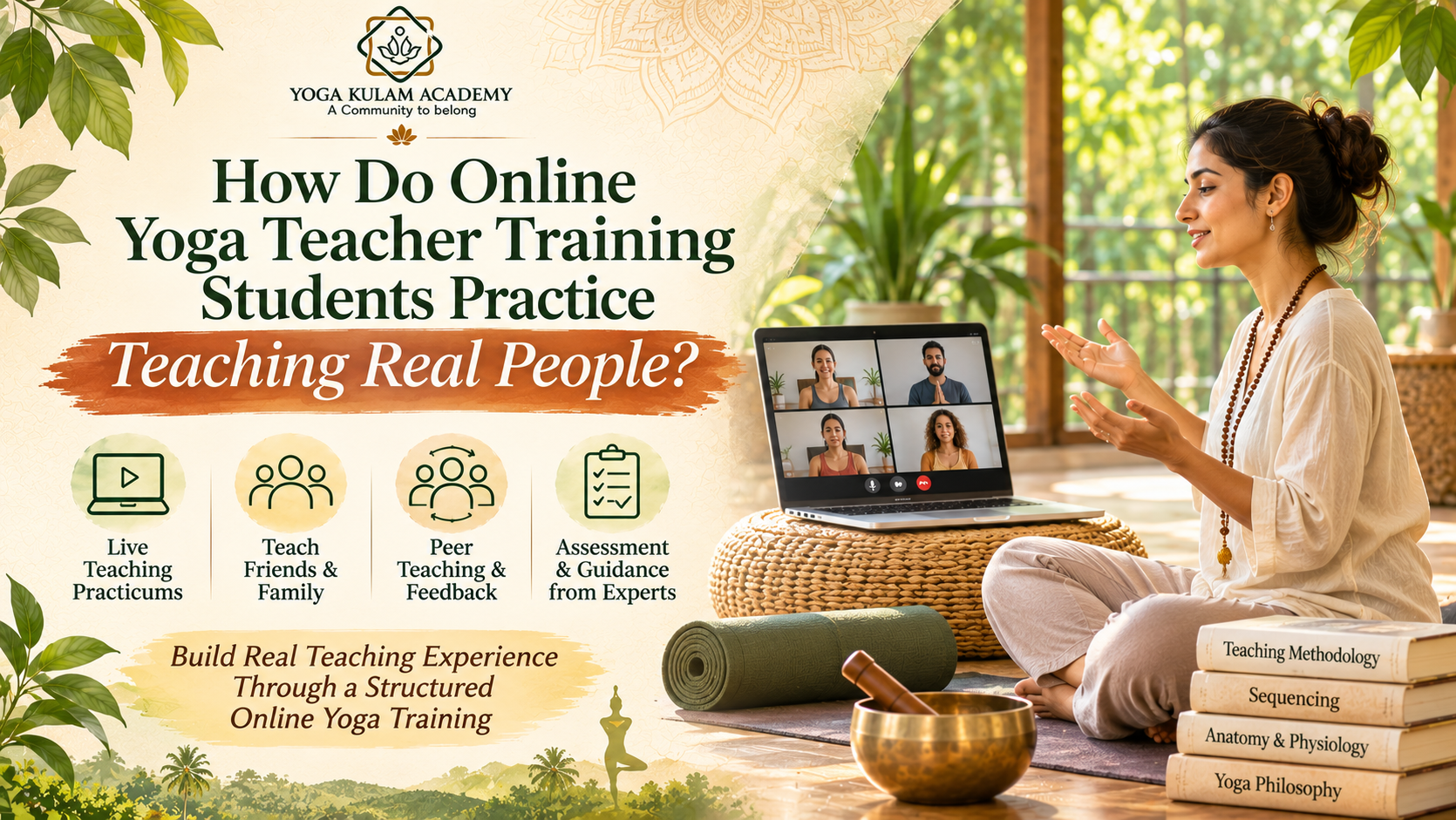
Learning yoga online is one thing. Learning to guide another person through a yoga class is another. Here's how aspiring teachers can develop real teaching experience without attending a physical yoga school.
Imagine completing 200 hours of yoga education.
You understand the basic principles of Hatha Yoga, know the names of different asanas, have studied anatomy, and can explain the eight limbs of yoga.
Then someone asks you a simple question:
"Can you teach me a yoga class?"
Suddenly, everything feels different.
Knowing how to perform Trikonasana is not the same as explaining it to someone who has never practised yoga. Understanding breathing techniques doesn't automatically mean you can guide a group of students through pranayama.
This is where yoga teacher training becomes something more than personal practice.
And it raises an important question for anyone considering online education: How do students actually practise teaching real people when their entire course takes place online?
The answer lies in how practical teaching experience is incorporated into the training.
1. The Difference Between Practising Yoga and Teaching Yoga
During a personal yoga practice, your attention is primarily directed inward.
You observe your breathing, notice sensations, and respond to your body's limitations.
Teaching requires a different kind of awareness.
While demonstrating a posture, you must also explain the movement, observe students, offer modifications, maintain the pace of the class, and communicate clearly.
For example, a beginner may not understand the instruction "engage your core."
A knowledgeable practitioner might know exactly what that means, but a capable teacher must explain it in language the student understands.
This is why a 200 Hour Online Yoga TTC should involve more than watching demonstrations and memorizing sequences.
Students need opportunities to practise guiding others and receive constructive feedback on their teaching.
2. Live Online Teaching Practicums
One of the most practical ways online students develop teaching skills is through live teaching sessions.
In a well-structured 200 Hour Online Yoga Teacher Training & Certification program, teaching practicums can be organized through video conferencing platforms.
Students may take turns leading short segments of a class while their instructors and classmates participate as students.
One trainee might guide a five-minute warm-up.
Another may demonstrate standing postures, while someone else leads breathing or relaxation exercises.
The instructor observes how clearly each student communicates.
Does the trainee explain transitions properly? Are their instructions easy to follow? Do they provide options for different abilities?
These sessions allow students to experience the responsibility of teaching while receiving guidance.
Although everyone may be participating from different locations, the teaching experience involves real people responding to real instructions.
3. Teaching Friends and Family Members
A particularly useful way to gain practical experience is to begin teaching people you already know.
For example, a student enrolled in a 200-Hour Yoga Teacher Training Course Online might invite a friend to participate in a short beginner-friendly session.
The first class could last just 15 or 20 minutes.
It might include gentle warm-ups, basic standing postures, comfortable seated movements, and relaxation.
The goal is not to deliver a perfect yoga class.
It is to discover what happens when someone else tries to follow your instructions.
You may realize that you speak too quickly, forget to explain transitions, or assume that everyone understands the same terminology.
These experiences can reveal teaching habits that are difficult to notice during personal practice.
However, trainees should practise within their level of competence, obtain participants' consent, and avoid offering guidance for injuries or medical conditions beyond their training.
4. Peer Teaching With Other Trainees
One advantage of online teacher training is the opportunity to connect with fellow students from different backgrounds.
Peer teaching allows trainees to practise guiding each other.
Imagine being paired with a student from another country.
You prepare a 20-minute sequence and teach it through a live video session.
Your partner then shares feedback.
Perhaps your explanation of Warrior II was clear, but your transition into Triangle Pose felt rushed.
Maybe your voice was calm and reassuring, but you didn't provide enough time for students to settle into each posture.
Later, you exchange roles.
You become the student while your partner practises teaching.
This helps you develop two essential skills: teaching others and observing how different teaching approaches feel from a student's perspective.
Peer teaching can also expose trainees to different communication styles, learning needs, and cultural perspectives.
5. Why Teaching Without Physical Adjustments Matters
In a residential yoga classroom, teachers can move around the room and observe students from different angles.
Depending on their training, professional boundaries, and student consent, they may also use hands-on adjustments.
Online teaching removes much of that possibility.
At first, this might seem like a disadvantage.
However, it can encourage students to develop stronger verbal teaching skills.
Instead of physically moving someone's arm into position, a teacher must explain how to adjust it.
Instead of assuming everyone can see a demonstration, the instructor must describe the movement clearly.
For example, rather than simply saying "straighten your spine," a teacher could explain:
"Sit comfortably, allow your shoulders to relax, and imagine the crown of your head gently reaching upward."
Clear verbal cues help students become more aware of their own movements.
Physical observation remains limited online, so instructors must recognize when camera-based feedback is insufficient and avoid claiming to assess everything through a screen.
6. Recording Practice Classes for Feedback
Recorded teaching sessions can provide another valuable learning opportunity.
Students taking a 200-Hour Yoga Teacher Training Course may be asked to prepare and record a short class as part of their practical assessments.
Watching yourself teach can initially feel uncomfortable.
You might notice that you frequently repeat certain words, demonstrate postures without explaining them, or spend too much time looking at your notes.
But this self-observation can be extremely useful.
A recording allows you to evaluate your pacing, clarity, sequencing, and communication.
When instructors review these sessions, they can offer specific suggestions for improvement.
If other participants appear in a recording, their permission and privacy should be respected.
The purpose of recording is not to create polished social media content.
It is to become a more observant and effective teacher.
7. Learning to Teach Different Types of Students
A yoga class rarely consists of people with identical abilities.
One student might be completely new to yoga.
Another may have difficulty balancing, while someone else may prefer a gentler practice.
This variation is where teaching becomes more complex.
During a 200-Hour Yoga Teacher Training Course Online, trainees can learn how to prepare beginner-friendly sequences and offer appropriate options.
For example, a teacher might demonstrate a standing balance posture while suggesting that students use a wall or chair for additional support.
However, learning basic modifications does not qualify a new teacher to manage every medical condition or specialized population.
Pregnancy, significant injuries, rehabilitation, and complex health conditions may require additional qualifications and healthcare guidance.
A responsible teacher understands both their abilities and their limitations.
8. What Should a Practical Teaching Assessment Include?
Not every online yoga teacher training course uses the same assessment process.
This makes it important to examine the training structure before enrolling.
A meaningful practical assessment might evaluate:
-
Clarity of verbal instructions
-
Understanding of posture alignment
-
Appropriate sequencing
-
Safe transitions between postures
-
Ability to offer basic modifications
-
Class timing and organization
-
Communication and professional conduct
-
Confidence when guiding participants
Assessments should encourage improvement rather than reward students only for performing advanced postures.
A flexible yoga practitioner is not automatically an effective teacher.
Teaching competence develops through preparation, repetition, observation, and feedback.
9. How Advanced Online Training Builds Teaching Experience
After completing foundational training, yoga teachers may decide to continue their education through an Online 300-hour yoga teacher training course.
Advanced education can introduce more detailed studies of philosophy, anatomy, pranayama, sequencing, meditation, and teaching methodology.
For experienced teachers, practical assignments may involve developing longer classes, presenting specialized topics, or refining their instructional approach.
The goal is not simply to accumulate more training hours.
It is to improve the quality and depth of the teaching experience.
Teachers who already conduct regular classes can also reflect on their experiences and bring real classroom challenges into their advanced studies.
Continuing education becomes especially valuable when it connects theory with actual teaching practice.
10. Developing Teaching Confidence at Yogakulam Academy
At Yogakulam Academy, online yoga teacher training provides students with an opportunity to study traditional yoga subjects through a structured learning environment.
The academy's online programs introduce foundational practices, yoga philosophy, anatomy, pranayama, meditation, and teaching methodology.
Students considering online training should ask about live teaching opportunities, practical assessments, instructor feedback, and requirements for successful course completion.
The most meaningful training experience is one in which students actively participate rather than simply attend classes.
Whether a person eventually hopes to teach online, conduct community yoga sessions, or lead classes in a studio, the transition from practitioner to teacher requires consistent practice.
And that transition begins with the willingness to guide someone else.
Final Thoughts: You Learn to Teach by Teaching
The biggest misconception about online yoga teacher training is that students must remain passive observers.
A thoughtfully designed course can create opportunities to teach classmates, guide friends, practise verbal instructions, and receive professional feedback.
Of course, online training has limitations.
Camera angles cannot reveal everything, and digital teaching does not completely reproduce the experience of working with students in the same room.
But meaningful teaching practice is still possible.
A certificate may recognize the completion of your education, but confidence develops when you begin applying that knowledge.
You don't become a yoga teacher simply by knowing more postures. You become a better teacher by learning how to guide real people with clarity, patience, awareness, and responsibility.
And that learning can begin online.
 Russian
 English
 Arabic
 French
 Spanish
 Portuguese
 Deutsch
 Turkish
 Dutch
 Italiano
 Romaian
 Portuguese (Brazil)
 Greek