


Food Enzymes Market Size to Reach USD 12,928.4 Mn by 2034
The global Food Enzymes Market is expanding as food and beverage manufacturers invest in efficient processing technologies, functional ingredients, and solutions that improve product quality while supporting evolving consumer preferences.
According to Dimension Market Research, the market is projected to reach USD 6,413.8 million in 2025 and grow to USD 12,928.4 million by 2034, registering a CAGR of 8.1%.
Demand is supported by increasing consumption of processed foods, expanding beverage production, advances in food biotechnology, and interest in more efficient manufacturing processes.
Enzymes are becoming increasingly important to food production because they can improve processing performance, product texture, flavor development, and nutritional characteristics.
What Is the Food Enzymes Market?
Food enzymes are biological catalysts used to accelerate specific biochemical reactions during food and beverage manufacturing.
They are commonly derived from microorganisms, plants, and animals and are selected according to their functional characteristics.
These enzymes support processes such as starch conversion, protein modification, lactose breakdown, fermentation, juice clarification, and fat processing.
For example, amylases help break down starch, proteases modify proteins, and lipases act on fats.
Enzymes can also help manufacturers improve process consistency and achieve specific product characteristics.
Their applications extend across bakery products, dairy processing, beverages, and other food manufacturing activities.
Why Is the Food Enzymes Market Growing?
Increasing demand for processed and convenience foods is a major growth driver.
Food producers must maintain consistent quality while managing production efficiency, ingredient performance, and manufacturing costs.
Enzyme technology supports these objectives by enabling targeted biochemical reactions during processing.
Changing consumer preferences are also influencing demand.
Manufacturers are exploring processing methods that support product quality, nutritional positioning, and cleaner ingredient formulations.
In dairy processing, enzymes such as lactase enable the production of lactose-reduced or lactose-free products.
In baking, enzymes can influence dough properties, fermentation performance, and finished product texture.
The growing importance of biotechnology and fermentation-based manufacturing is also supporting enzyme development.
Get a Free Sample of the Food Enzymes Market Report
Understand market demand by enzyme type, biological source, formulation, application, and geography through Dimension Market Research's detailed industry analysis.
https://dimensionmarketresearch.com/request-sample/food-enzymes-market/
Food Enzymes Market: Key Statistics
● 2025 Market Size: USD 6,413.8 Million
● 2034 Forecast: USD 12,928.4 Million
● Forecast CAGR: 8.1%
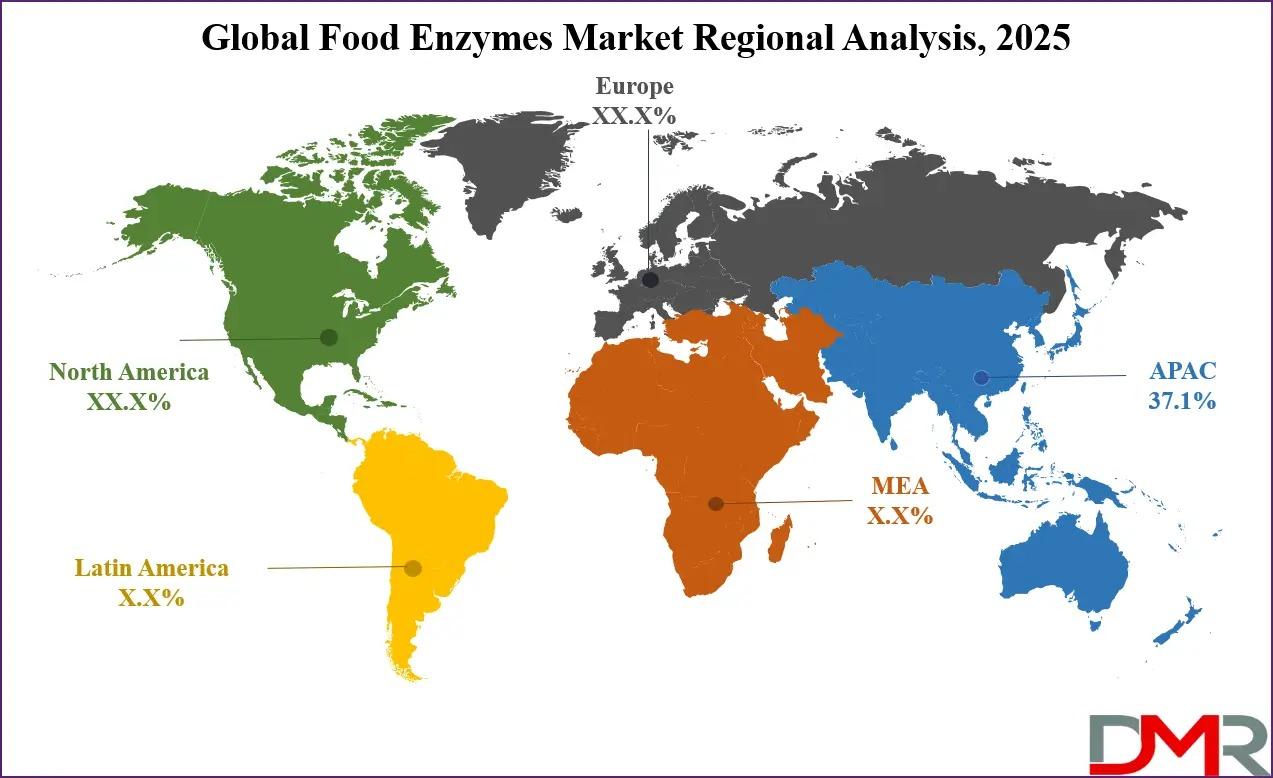
● Leading Region: Asia Pacific, 37.1% share in 2025
● U.S. Market Size in 2025: USD 1,618.2 Million
● Japan Market Size in 2025: USD 384.83 Million
Market Segmentation and Enzyme Applications
Carbohydrases Support Multiple Food Processes
Carbohydrases represent an important enzyme category and include amylases, cellulases, lactases, pectinases, and other specialized enzymes.
Amylases are widely used in starch processing and bakery applications.
Lactase supports lactose breakdown in dairy manufacturing, while pectinases are useful in fruit juice processing and clarification.
Other enzyme types covered in the report include proteases, lipases, polymerases, and nucleases.
Each enzyme category performs specific functions, creating demand for application-specific formulations.
Microbial, Plant, and Animal Sources
Food enzymes are categorized according to biological sources, including microorganisms, plants, and animals.
Microbial production is particularly relevant to industrial biotechnology because fermentation enables scalable manufacturing under controlled conditions.
Plant-derived and animal-derived enzymes also serve established processing applications.
Selection depends on the required enzyme activity, manufacturing method, regulatory requirements, and food formulation.
The market includes lyophilized powders, liquid enzymes, and other formulations designed for different operational conditions.
Technology Trends Shaping Food Enzyme Development
One major trend is the increasing use of enzyme technology to improve food processing efficiency.
Manufacturers are exploring specific enzyme combinations to optimize production conditions and maintain product consistency.
Another development is the growing importance of enzymes in functional food innovation.
Changing dietary preferences are encouraging the development of specialized products, including lactose-reduced dairy, plant-based foods, and products with tailored processing characteristics.
Enzyme engineering and biotechnology also support the development of formulations with improved performance under specific temperature and processing conditions.
At the same time, manufacturers must consider enzyme stability, compatibility with ingredients, regulatory requirements, and overall production economics.
Regional Outlook: Asia Pacific Leads
Asia Pacific is expected to account for 37.1% of global market revenue in 2025.
Growth is supported by food processing activity, changing dietary habits, and demand for processed and functional foods.
China, India, and Japan represent important markets within the region.
Japan's food enzymes industry is projected to reach USD 384.83 million in 2025 and USD 672.78 million by 2034, at a CAGR of 7.2%.
North America also represents a significant market, supported by industrial food manufacturing and biotechnology development.
The United States market is forecast to reach USD 1,618.2 million in 2025 and USD 3,130.6 million by 2034.
Europe remains relevant through established food ingredient manufacturing, enzyme research, and sustainability-oriented food production.
Competitive Landscape
The global Food Enzymes Market includes biotechnology companies, ingredient manufacturers, and specialized enzyme developers.
Prominent companies identified in the DMR report include Novozymes, DuPont (Danisco), DSM, BASF, Chr. Hansen, AB Enzymes, Advanced Enzyme Technologies, Kerry Group, Lesaffre, and Amano Enzyme.
Competition centers on enzyme performance, formulation expertise, application development, processing efficiency, and relationships with food manufacturers.
Research and development are important because food companies increasingly require tailored enzyme solutions for specific product categories.
Explore the Complete Food Enzymes Market Analysis
Access comprehensive enzyme segmentation, regional forecasts, competitive developments, application trends, and growth opportunities through the Dimension Market Research industry report.
https://dimensionmarketresearch.com/checkout/food-enzymes-market/
Frequently Asked Questions
1. What is the global Food Enzymes Market size?
The market is projected to reach USD 6,413.8 million in 2025 and USD 12,928.4 million by 2034.
2. What is the expected Food Enzymes Market CAGR?
The market is expected to expand at a CAGR of 8.1% through 2034.
3. What are the main types of food enzymes?
The market includes carbohydrases, proteases, lipases, polymerases, nucleases, and other specialized enzymes.
4. Which region leads the Food Enzymes Market?
Asia Pacific leads with an anticipated 37.1% market share in 2025.
5. What factors support future food enzyme demand?
Increasing food processing, biotechnology innovation, functional food development, and demand for manufacturing efficiency support market growth.
Conclusion
The Food Enzymes Market is benefiting from the increasing importance of biotechnology within modern food manufacturing.
As producers pursue improved processing efficiency, consistent product quality, and specialized food formulations, enzyme technologies are expected to remain important components of industrial food innovation.
Related Biotechnology and Enzyme Market Insights
Industrial Enzymes Market
The Industrial Enzymes Market Size is projected to reach USD 8.5 billion in 2025 and USD 16.3 billion by 2034, registering a CAGR of 7.5%. The market includes enzyme applications across food processing, textiles, biofuels, pharmaceuticals, and other industrial activities.

 Arabic
 French
 Spanish
 Portuguese
 Deutsch
 Turkish
 Dutch
 Italiano
 Russian
 Romaian
 Portuguese (Brazil)
 Greek