


College Industrial Visits from Surat: Practical Learning Beyond the Classroom
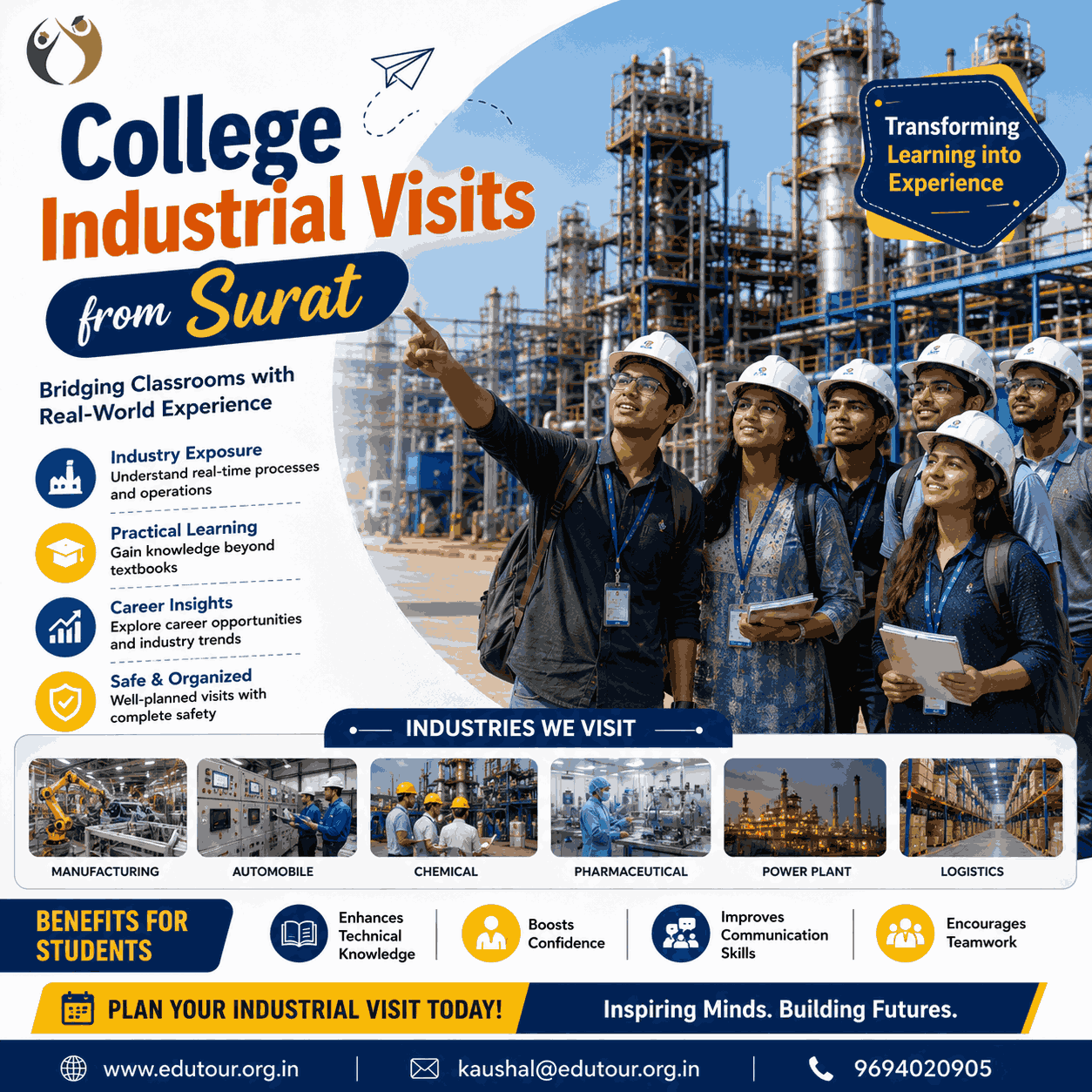
College education is no longer limited to lectures, textbooks, assignments, and examinations. Students increasingly need opportunities to understand how academic concepts operate in professional environments. An industrial visit can bridge this gap by taking learners beyond the classroom and placing them closer to the workplaces, technologies, processes, and professionals they may encounter after graduation.
For colleges and universities in Gujarat, College Industrial Visits from Surat can provide students with meaningful exposure to manufacturing units, technology companies, research facilities, logistics centres, renewable energy projects, pharmaceutical organisations, and other professional environments. Such experiences help students connect theoretical knowledge with practical applications while developing a clearer understanding of workplace expectations.
An effective educational visit is not simply a change of location. It is a structured learning activity with academic objectives, preparation, observation, interaction, and post-visit reflection. When planned thoughtfully, an industrial tour can help students ask better questions, understand professional roles, recognise industry trends, and make more informed career decisions.
Why Industrial Visits Matter in Higher Education
Students often understand a concept in theory long before they have an opportunity to observe it in practice. A classroom may explain how a production line works, for example, but seeing machinery, quality-control procedures, inventory systems, safety protocols, and employees working together creates a much more complete picture.
Industrial visits can also make academic subjects more relevant. Engineering students can observe production and automation systems. Management students can learn about supply chains, human resources, marketing, and operations. Computer science students may gain exposure to software development environments and cybersecurity practices. Pharmaceutical and biotechnology students can observe laboratories, manufacturing processes, quality assurance, and regulatory procedures where access is permitted.
This real-world exposure can improve engagement because students can see why their academic subjects matter. Instead of treating a topic as something required for an examination, they may begin to recognise it as a skill used in an actual professional setting.
Another important benefit is career awareness. Students sometimes choose specialisations without having a clear understanding of the roles associated with them. Meeting professionals and observing workplaces can help them develop realistic expectations about different career paths.
Turning Classroom Theory into Practical Understanding
The strongest industrial visits are designed around specific learning outcomes. Before travelling, faculty members can identify the topics students have already studied and determine which aspects can be demonstrated through an industry visit.
For instance, a mechanical engineering class studying manufacturing processes might benefit from observing machining, assembly, maintenance, material handling, and quality inspection. A business-management group could focus on procurement, operations, employee coordination, customer service, and supply-chain management.
The objective is not to make students memorise everything they see. Instead, the visit should encourage them to observe relationships between different activities.
A manufacturing facility, for example, can demonstrate that production is rarely an isolated activity. Raw materials must arrive on schedule, machines require maintenance, workers need training, quality standards must be followed, finished products need storage, and logistics teams have to coordinate deliveries. A student who sees this complete system can better understand why different subjects are interconnected.
Choosing the Right Destination
The destination should match the academic purpose of the trip. A popular company is not automatically the best educational destination. Colleges should consider whether students will actually be able to observe meaningful processes and interact with knowledgeable representatives.
Before confirming a visit, institutions can evaluate factors such as:
- Relevance to the students' academic programme and semester syllabus
- Availability of guided tours or professional interactions
- Safety standards and visitor requirements
- Group capacity and suitable facilities
- Accessibility and realistic travel time
- Permission requirements for photography, recording, or documentation
- Opportunities for students to ask questions
Faculty members should also confirm what students are expected to learn during the visit. A short briefing from the host organisation can make the experience significantly more valuable.
For colleges looking for structured educational travel support, Edutour can be considered as a resource when exploring academic travel and industrial-visit planning.
The Role of Faculty Members
Faculty members are central to the success of an industrial visit. Their responsibility begins before the group leaves campus and continues after students return.
A pre-visit briefing can introduce the organisation, industry sector, expected learning outcomes, professional etiquette, safety instructions, and questions students should consider. This preparation gives students a framework for observation.
During the visit, faculty members can encourage students to connect what they see with concepts discussed in class. They can also help students maintain appropriate behaviour, follow safety instructions, and respect workplace confidentiality.
After the visit, faculty members can use assignments, presentations, group discussions, or reflective reports to reinforce learning. Asking students to explain one process they observed and relate it to a classroom concept can turn a one-day experience into a longer learning activity.
What Students Can Learn from an Industrial Environment
Industrial exposure provides learning that extends beyond technical knowledge. Students can observe professional communication, time management, teamwork, leadership, workplace discipline, safety culture, and problem-solving.
They may also notice that professional environments involve continuous improvement. A process that appears simple from the outside may include multiple checks designed to improve efficiency, quality, or safety.
For students, one of the most useful lessons can be understanding the difference between an ideal process described in a textbook and the practical challenges faced by organisations. Real workplaces must respond to changing customer requirements, resource limitations, equipment issues, regulations, deadlines, and unexpected problems.
Seeing professionals deal with these challenges can develop a more practical mindset. Students learn that successful organisations depend not only on knowledge but also on communication, adaptability, decision-making, and collaboration.
Planning an Effective Industrial Visit from Surat
Planning should begin well before the proposed travel date. Colleges typically need to coordinate academic schedules, student participation, permissions, transportation, accommodation when required, meals, documentation, and communication with the host organisation.
The first step is to define the educational objective. Once the objective is clear, organisers can identify destinations that align with the students' course and learning requirements.
The next stage involves logistical planning. The institution should establish the number of students and faculty members, expected duration, travel route, reporting time, emergency contacts, and required documents. If the programme involves multiple destinations, sufficient time should be allowed between activities rather than creating an unnecessarily tight schedule.
Travel arrangements also deserve careful attention. Students may become tired if long road journeys are combined with multiple visits in a single day. A balanced itinerary can provide enough time for learning while also allowing reasonable breaks.
Safety should remain a priority throughout the planning process. Colleges should understand the host organisation's safety rules, ensure students follow instructions, and maintain clear communication between faculty members and participants.
Industrial Tour Operators and Academic Planning
Educational travel requires different considerations from ordinary tourism. The success of a student trip depends on academic relevance, group coordination, permissions, safety, timing, and educational value.
This is why institutions evaluating Industrial Tour Operators in Surat should look beyond basic transportation or sightseeing arrangements. The more important question is whether the programme supports the institution's learning objectives.
A suitable educational travel partner should understand that college groups have specific requirements. Faculty members may need assistance with schedules, destination coordination, student documentation, accommodation, transportation, and communication with host organisations.
However, colleges should retain academic control over the programme. The travel partner can support logistics, but faculty members should determine what students need to learn and how the experience connects with their curriculum.
Preparing Students Before the Visit
Student preparation can significantly improve the quality of an industrial tour. Instead of arriving without background knowledge, participants should understand what they are about to observe.
Faculty members can provide a short overview of the host organisation and its industry. Students can then research basic terminology, products, services, technologies, or processes associated with the organisation.
A simple question-based exercise can also encourage active observation. Students might be asked to identify a production bottleneck, observe how quality is maintained, note examples of automation, or identify different professional roles.
Students should also be reminded that an industrial facility is a working environment. They should follow instructions, remain with their group, avoid unauthorised areas, and respect restrictions regarding photography and confidential information.
Making the Visit Interactive
Passive observation can limit learning. Students benefit more when they are encouraged to interact with professionals and ask relevant questions.
A guided discussion could cover topics such as how employees enter the industry, which skills are currently valued, how technology is changing the sector, what challenges organisations face, and how students can prepare for entry-level roles.
Question-and-answer sessions can be especially useful because they allow students to hear practical perspectives from people working in the field. A professional's explanation of a typical workday or career progression can sometimes clarify career possibilities more effectively than a general classroom discussion.
Where appropriate, demonstrations can further strengthen understanding. Seeing a machine, software platform, laboratory process, warehouse system, or renewable-energy installation in operation can make an abstract concept easier to remember.
Extending Learning After the Trip
The learning process should not end when students return to campus. Post-visit activities help convert observations into knowledge.
Students can prepare short reports describing the organisation, processes they observed, technologies involved, and lessons relevant to their academic discipline. Group presentations can encourage students to compare their observations and discuss different aspects of the same workplace.
Faculty members can also use the experience for classroom discussions. A visit to a logistics facility, for example, can become a case study for supply-chain management. A technology-company visit can support discussions about software development, project management, data security, or emerging technologies.
Reflection is equally important. Students can be asked what surprised them, which classroom concepts became clearer, what skills appeared important in the workplace, and what they would like to learn next.
Measuring the Educational Value
Institutions can improve their programmes by evaluating each visit. A simple feedback process can identify whether the destination was relevant, whether students received adequate interaction, and whether the schedule allowed sufficient learning time.
Useful evaluation questions include:
- Did the visit meet its stated learning objectives?
- Which activities generated the most student interest?
- Did students understand the connection with their coursework?
- Was the duration appropriate?
- Were communication and logistics handled effectively?
- What could be improved for the next group?
Collecting this information helps colleges develop a stronger approach to experiential learning. Over time, institutions can build relationships with organisations that provide consistently valuable educational exposure.
Building a Culture of Experiential Learning
Industrial visits work best when they are part of a wider educational strategy rather than isolated events. Colleges can combine workplace visits with internships, expert talks, practical projects, workshops, laboratory activities, research assignments, and career-development programmes.
This creates multiple opportunities for students to apply knowledge in different contexts. An industrial visit might introduce students to a technology, while a later project allows them to explore that technology in greater depth.
Such continuity can make experiential learning more meaningful. Students gradually develop the ability to observe professional environments, identify problems, analyse information, and apply academic knowledge to real situations.
Conclusion
Industrial visits can play an important role in preparing students for a world where academic knowledge and practical capability must work together. For colleges in Surat, a carefully planned educational tour can provide exposure to real workplaces while helping students understand how classroom concepts are applied across different industries.
The value of an industrial visit depends on thoughtful destination selection, clear academic objectives, student preparation, responsible travel planning, meaningful interaction, and post-visit reflection. When these elements are brought together, even a short visit can leave students with a stronger understanding of professional life.
Ultimately, the purpose of educational travel is not simply to take students somewhere new. It is to give them an opportunity to observe, question, connect, and learn. With the right planning, industrial exposure can become a practical extension of classroom education and a valuable step toward building confident, informed, and career-ready graduates.
 Greek
Greek
 English
 Arabic
 French
 Spanish
 Portuguese
 Deutsch
 Turkish
 Dutch
Dutch
 Italiano
 Russian
 Romaian
 Portuguese (Brazil)