


Contextual SEO vs Keyword SEO: Which Strategy Builds Lasting Organic Traffic?
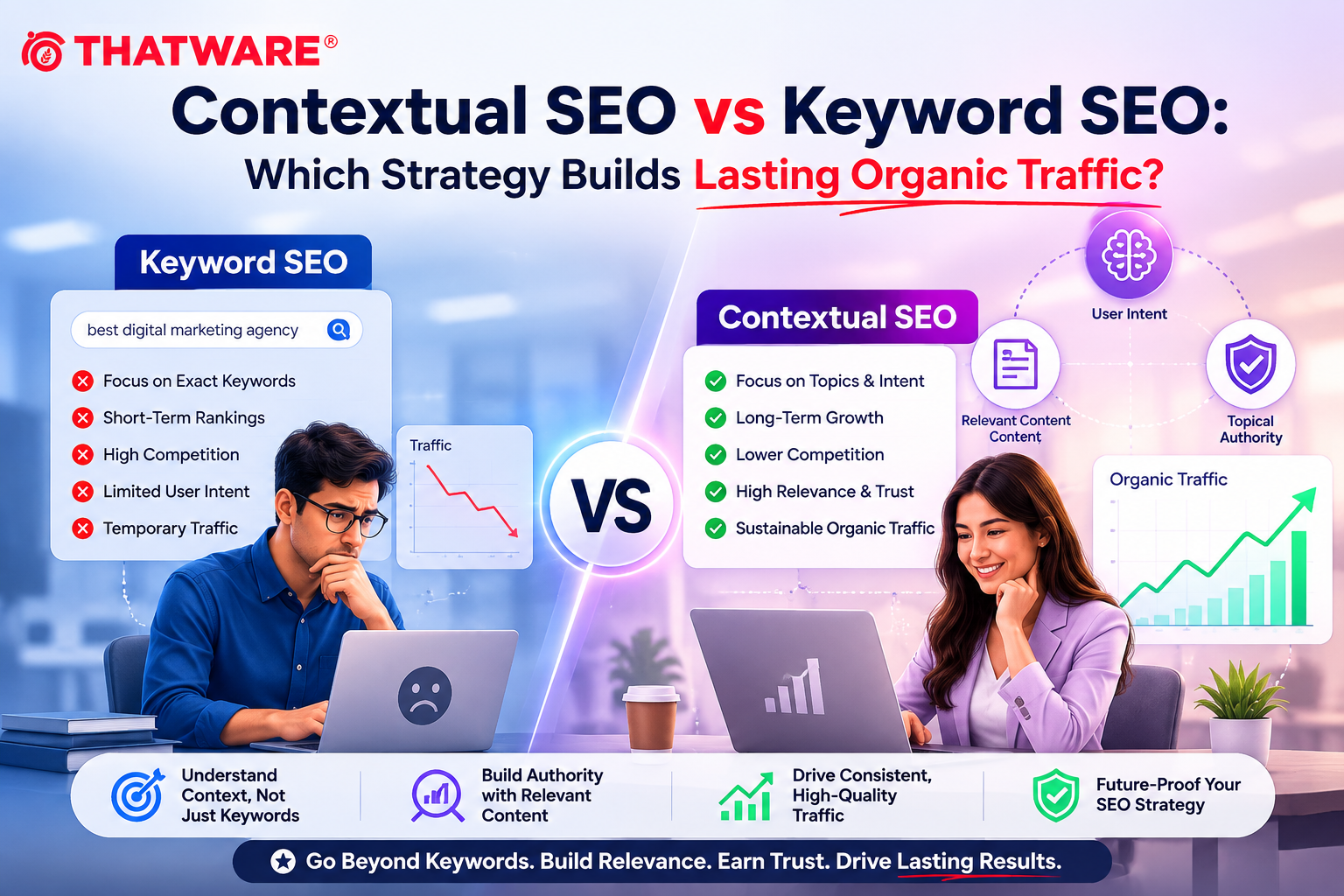
Discover how contextual SEO and keyword SEO differ in building sustainable search visibility, topical authority, and long-term organic traffic. Learn why semantic relevance, content relationships, and comprehensive topic coverage can create a more resilient SEO foundation. ThatWare LLP helps businesses develop data-driven SEO strategies designed to strengthen authority and maintain consistent search performance.
The Shift From Keywords to Context
SEO has evolved considerably as search engines have become better at understanding meaning, intent, entities, and relationships between topics. Traditional keyword SEO remains an important part of organic search, but businesses increasingly need to think beyond individual search phrases.
Keyword-focused optimization asks an essential question: which terms should a page rank for? Contextual SEO takes a broader approach by asking what subjects a business should become recognized as an authority on. This distinction can significantly influence how organic visibility develops over time.
Where Keyword SEO Still Delivers Value
Keyword SEO remains highly effective when businesses need to target specific queries with measurable search demand. Through keyword research, competitor analysis, content optimization, and strategic on-page SEO, websites can identify valuable opportunities and create pages designed around user searches.
This approach can produce relatively quick ranking opportunities, particularly when a website targets long-tail or moderately competitive keywords. However, keyword-driven strategies can become fragmented when every page is created around an isolated phrase without considering how that page contributes to the broader subject.
Over time, businesses may need to continuously refresh content, target additional variations, and strengthen individual pages to maintain their rankings.
How Contextual SEO Creates Stronger Topic Relationships
Contextual SEO focuses on creating a connected information ecosystem. Instead of producing independent articles for hundreds of unrelated keywords, businesses build comprehensive coverage around strategically important subjects.
A central topic can be supported by related subtopics, informational resources, comparison pages, guides, and frequently asked questions. These pages are connected through meaningful internal links, helping users and search engines understand the relationships between different pieces of information.
This structure can strengthen topical authority because the website demonstrates knowledge across an entire subject rather than focusing exclusively on isolated search terms.
Why Semantic Relevance Matters
Modern search systems increasingly evaluate content based on meaning and relationships. A page does not necessarily need to repeat an exact keyword extensively to demonstrate relevance.
Semantic SEO considers related concepts, entities, search intent, terminology, questions, and contextual connections. When these elements are incorporated naturally, content can potentially become relevant to a broader range of searches.
This makes contextual optimization particularly useful for businesses competing in complex industries where users search using different language variations for the same underlying need.
Building a More Durable Content Architecture
One of the biggest advantages of contextual SEO is its cumulative nature. A well-planned content architecture allows new pages to strengthen existing resources while existing pages provide authority and relevance to newer content.
For example, an authoritative guide can link to detailed articles covering specific subtopics. Those supporting pages can then link back to the central resource and connect with related resources. Over time, the website develops a network of information rather than a collection of disconnected landing pages.
This approach can make organic growth more sustainable because the value of the content ecosystem extends beyond individual keyword rankings.
The Role of Internal Linking
Internal linking is especially important in contextual SEO. Strategic links help establish relationships between related pages and guide visitors through the information they need.
Rather than adding links simply to increase the number of internal connections, contextual strategies focus on relevance. A page discussing technical SEO, for instance, may naturally connect to resources about website architecture, crawlability, indexing, structured data, and site performance.
Such relationships help create a clearer topical structure while improving navigation and content discovery.
Which Approach Builds More Durable Traffic?
Keyword SEO can be excellent for capturing immediate search opportunities, while contextual SEO is better suited to building broader and more defensible topical authority.
The strongest strategy is rarely about choosing one and completely abandoning the other. Keywords remain useful for understanding demand, identifying search intent, and measuring performance. Context provides the framework that connects those keywords into a meaningful content strategy.
Businesses looking for sustainable growth should therefore use keyword research as a foundation while developing content around topics, entities, intent, and relationships.
The Long-Term SEO Advantage
Durable organic traffic is rarely created by optimizing one page for one keyword and moving on to the next opportunity. Sustainable visibility comes from consistently demonstrating relevance, expertise, usefulness, and comprehensive coverage.
Contextual SEO provides a framework for achieving this by turning individual content pieces into components of a larger authority-building system. When supported by technical SEO, quality content, strategic internal linking, and legitimate authority signals, this approach can create a stronger foundation for long-term search growth.
For businesses planning beyond short-term ranking gains, combining keyword intelligence with contextual and semantic optimization can provide a more resilient path to organic visibility. ThatWare LLP can help brands develop strategic SEO frameworks that connect search intent, topical authority, and content architecture for sustainable digital growth.

 English
 Arabic
 French
 Spanish
 Portuguese
 Deutsch
 Dutch
 Italiano
 Russian
 Romaian
 Portuguese (Brazil)
 Greek