


Why Anchor Bolts Rust Where You Can’t See: Preventing Corrosion at the Base
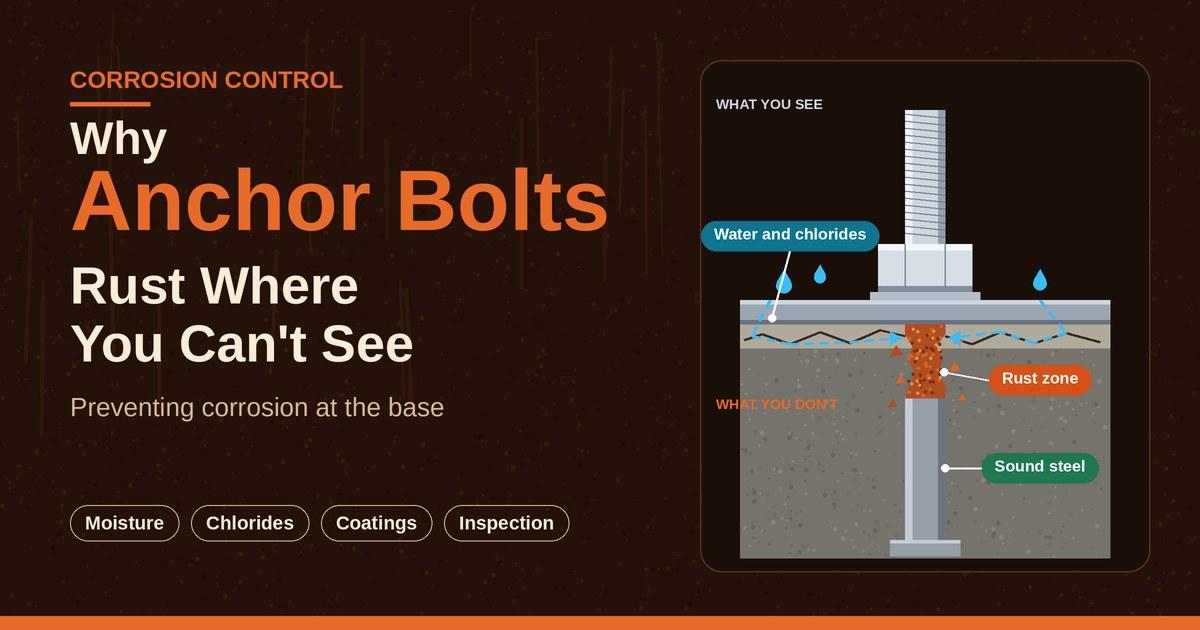
Most Anchor Bolts do not fail because someone overloaded them. They fail slowly, from rust that nobody saw. The visible threads above the nut may look fine for years, while the steel just below the base plate loses section a little at a time. By the time a plate shifts or a stain appears, the damage is already well advanced. This guide explains why corrosion hides at the base, how to prevent it, and how to find it early.
Why the Base Is the Danger Zone
Steel buried in sound concrete is protected by the concrete’s high alkalinity, which forms a thin, stable film on the surface. Steel in open air has no such protection, so it rusts like any other steel unless it is coated.
The spot where an anchor rod leaves the concrete is where those two worlds meet. Water collects on the plate, finds its way along the rod, and sits in the gap between grout, plate, and nut. Oxygen levels differ between the buried and exposed portions, and the two can form a corrosion cell, with rust concentrating at the boundary. Because the plate, grout, and nut cover that zone, nobody sees it.
What Drives Corrosion at the Base
Several factors, usually acting together, decide how fast Anchor Bolts rust:
- Moisture. Rain, washdown water, condensation, and leaks keep the interface wet.
- Chlorides. Coastal air, de-icing salts, and many Gulf-region sites bring chlorides that break down the protective film on steel.
- Carbonation. Over time, carbon dioxide can lower the alkalinity of the concrete near the surface, weakening its protection.
- Cracks and voids. Cracked grout or concrete lets water and salts reach the rod directly.
- Wet and dry cycles. Repeated wetting and drying concentrates salts and speeds corrosion.
- Chemicals and heat. Process spills and hot surfaces change how coatings and concrete behave.
- Mixed metals. Dissimilar metals in wet contact can corrode one another.
Rust also takes up more volume than the steel it replaces, so it can crack the surrounding grout and concrete, which opens a path for even more water.
Where Rust Hides
| Location | Why it is vulnerable | Typical sign |
|---|---|---|
| Rod surface at the concrete line | Water, oxygen, and salts meet here | Rust staining below the plate |
| Under the base plate | Trapped moisture and voids in the grout | Rust bleeding from the plate edge |
| Under leveling nuts and washers | Crevices hold water | Seized or flaking nuts |
| Inside the nut and thread | Damaged coating, tight crevices | Hard-to-turn nuts, thread loss |
| Cracked grout or pier top | Direct path for water | Cracks, hollow sound, spalling |
| Contact with dissimilar metals | Galvanic action when wet | Localized corrosion at the joint |
Prevention Starts With Design
The cheapest corrosion control happens before the concrete is poured. Designers and detailers can:
- Keep water away. Slope grout and pier tops away from the rods, and avoid pockets or recesses that trap water around the base.
- Choose the right protection. Match the coating or material to the environment, and say how far the coating must extend, including the portion embedded in concrete.
- Use dense, low-permeability concrete with adequate cover, and control cracking where possible.
- Specify full grouting. A solid grout layer excludes water, while voids invite it.
- Plan for sealing. Where the specification calls for it, seal the plate edge and the joint around the rod.
- Avoid or isolate dissimilar metals in damp locations.
- Include the base in the inspection plan, so nobody has to guess later.
Choosing Protection for Anchor Bolts
| Option | Strengths | Watch for |
|---|---|---|
| Hot-dip galvanizing | Thick zinc layer, long outdoor life, widely used | Nuts must be oversize-tapped; special care with high-strength steel |
| Stainless steel | Good corrosion resistance without a coating | Grade choice matters in chlorides, lower strength than some carbon steel, galvanic effects with other metals |
| Epoxy or organic coatings | Chemical resistance, added barrier | Chips and scratches expose steel; needs good surface preparation |
| Duplex system (galvanizing plus paint) | Extra life in severe marine or chemical settings | Cost, and compatibility between layers |
| No coating | Acceptable for dry, indoor, fully embedded rods | Not suitable for exposed or wet locations |
Hot-dip galvanizing is usually specified to a fastener standard such as ASTM F2329. High-strength rods, such as ASTM F1554 Grade 105, need extra care around galvanizing because of hydrogen embrittlement risk, so that choice belongs with the engineer.
Installation Habits That Keep Rust Out
Even good protection can be undone on site. A few habits matter:
- Handle rods carefully so coatings are not scraped, and repair any damage before the rod is covered
- Protect threads with tape or caps before the pour, so concrete does not foul them
- Touch up cut or damaged galvanizing with an approved zinc-rich repair product, following a standard such as ASTM A780
- Grout fully, with no voids, and finish the grout so water runs away from the plate
- Keep standing water off the plate during construction, and clear debris from the base
- Match nuts and washers to the rod and its coating, ordered as a set
How to Inspect Anchor Bolts for Hidden Rust
A short, regular walk-around catches most problems. Look for:
- Rust stains or streaks below the plate or on the pier
- Cracked, crumbling, or hollow-sounding grout, found by gentle tapping
- Cracks or spalling in the concrete near the rods
- Nuts that are seized, flaking, or unusually loose
- Gaps between the plate and grout, or signs the plate has moved
- Ponded water or debris around the base
Where corrosion is suspected, clean the area and measure what remains with calipers. If cracks or hidden damage are possible, an engineer may call for non-destructive testing, such as ultrasonic inspection of the rod. Inspect more often in coastal, chemical, or high-humidity sites, and after storms or spills. The engineer of record or the owner’s plan should set the actual schedule.
What to Do When You Find Rust
The response depends on how deep the problem goes:
- Light surface rust: clean to sound metal, treat and recoat to the specification, and fix the cause, such as drainage or cracked grout
- Pitting or visible section loss: measure, photograph, and report to the engineer, because capacity may be reduced
- Cracked grout or concrete: repair so water cannot enter again, and ask whether the cracks signal overload
- Seized or damaged nuts: report before forcing them, since overtightening or hammering can damage the rod
Do not weld, heat, or straighten corroded rods without written approval. Where replacement is needed, the engineer approves the method, whether new post-installed anchors, a modified plate, or another remedy.
Buying Rods That Resist Corrosion
Protection only works if the product matches the paperwork. Ask for mill test certificates, grade markings, and galvanizing reports, and check that coating thickness results meet the specified standard. Suppliers differ in what they make, test, and document, so compare them on certification and traceability as well as price. A buyer in the Gulf, where chlorides make corrosion a particular concern, might add Petrofast Middle East FZC, an Abu Dhabi-based manufacturer whose catalog lists stud anchors, to a shortlist and then request those documents. Whoever you choose, reject any delivery of Anchor Bolts that does not match its paperwork, and send substitutions to the engineer for written approval.
Quick Prevention Checklist
- Coating or material chosen for the environment, with its extent shown
- Nuts and washers matched to the rod and coating
- Grout solid, sloped, and sealed where specified
- Drainage clear, with no ponding at the plate
- Threads protected and damaged coatings repaired
- Certificates and coating reports verified on delivery
- Base included in a regular inspection plan
- Findings recorded and escalated promptly
Conclusion: Make the Hidden Visible
Rust on Anchor Bolts is slow, quiet, and easy to miss, which is exactly why it deserves attention. Keep water away, choose protection that suits the environment, install carefully, and look at the base on a schedule. A few small habits at the start and a few minutes during each inspection can add decades to the life of the connection. Final specifications, repairs, and acceptance always belong with the engineer of record and the governing code.

 Arabic
 French
 Spanish
 Portuguese
 Deutsch
 Turkish
 Dutch
 Italiano
 Russian
 Romaian
 Portuguese (Brazil)
 Greek