


SAP SuccessFactors Variable Pay Exam Guide: Certification Scope and Preparation
Quick Summary
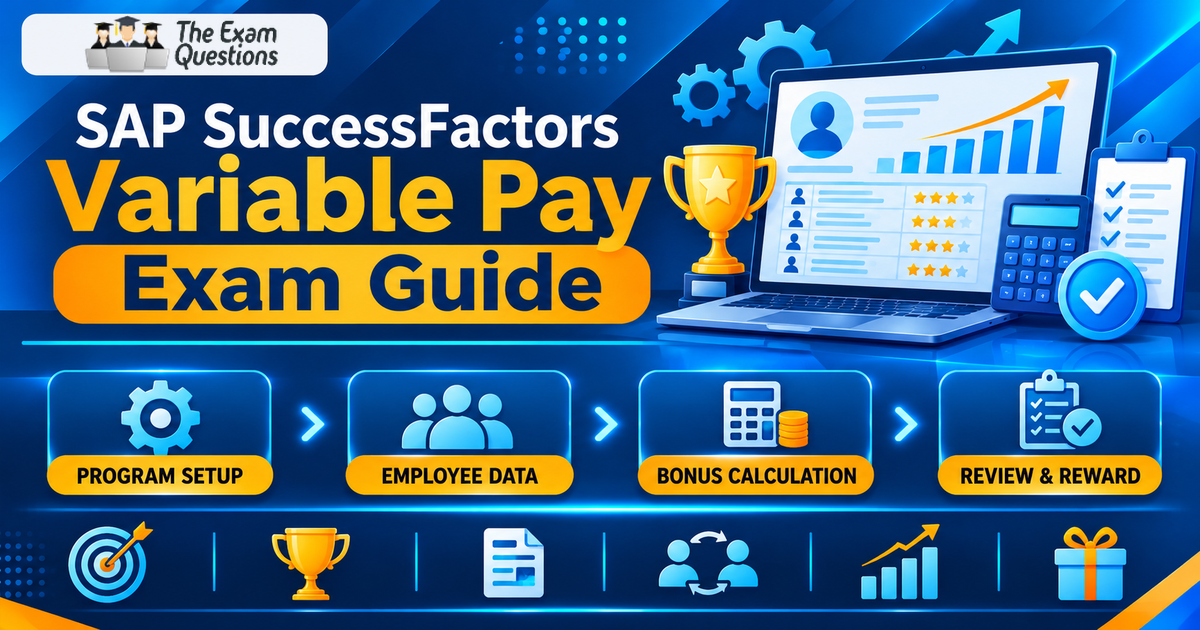
The SAP SuccessFactors Variable Pay Exam Guide explains what the certification covers, what a Variable Pay consultant is expected to do, and how to prepare. It walks through the seven Academy units, the five stages of the incentive process, the technical areas that matter most, and the current SAP assessment format. Use it to check your understanding of how programme settings, employee data, bonus calculations, and approvals fit together.
Introduction: what the Variable Pay certification expects from you
Running an incentive programme involves far more than deciding how much bonus each person receives. An organisation has to define plans, identify eligible employees, measure performance, calculate payouts, and review the results.
SAP SuccessFactors Variable Pay supports those tasks through configurable programmes and integrated employee information. A decision made during setup can change who is eligible, how bonuses are calculated, what managers see on their worksheets, and what appears on final statements. The certification tests whether you can reason through those effects.
What is SAP SuccessFactors Variable Pay?
SAP SuccessFactors Variable Pay is a compensation solution for administering short-term incentive programmes. Regular salary is generally paid in steady amounts through the year, while variable compensation moves with predefined performance measures. Companies use it to reward contributions to profitability, team or departmental results, individual achievements, operational targets, and quality and safety objectives.
A typical example is an annual bonus where the payout depends on business results, individual performance, the periods an employee was eligible, and the bonus plan assigned to that person. The system supplies the configuration and calculation tools to manage those combinations.
What does the certification cover?
The official SAP SuccessFactors Variable Pay Academy gives the main framework. SAP rates the course as intermediate, with about 5 hours and 24 minutes of content across seven units:
- Introduction to Variable Pay and customer analysis, covering the purpose of incentive programmes and how customer requirements shape implementation.
- Programme setup and employee data, covering programme properties, history records, and the data calculations need.
- Bonus plans and form setup and management, covering plan configuration, participation, planning forms, and workflows.
- Advanced features and functionalities, for more complex incentive requirements.
- Employee Central integration, which links employee information to Variable Pay.
- Total Compensation Plan Template, which places Variable Pay inside wider compensation planning.
- Succeeding as a consultant, which covers responsibilities and the practical approach to implementation.
These units describe the course. They do not guarantee the exact topic list or question weighting of the assessment, so confirm the current details on the SAP official certification page.
The five stages of the Variable Pay business process
Business requirement analysis
Before configuring anything, a consultant asks who participates, which measures drive the payout, whether incentives rest on individual, team, or company results, how targets are set, and who reviews and approves. The answers shape the programme design.
Programme and bonus plan configuration
This stage covers programme properties, dates, guidelines, calculation settings, and bonus plan assignments. A good design follows the organisation's compensation policy and does not lean on system defaults.
Employee data and eligibility
The system needs accurate history, bonus targets, salary basis, employment dates, eligibility details, and business goals. Employee data and eligibility are related and still separate: a record can exist without making that employee eligible for a given bonus plan.
Bonus calculation and review
Calculations can draw on performance results, goal weights, targets, proration, and payout limits. Administrators should review results and look into unexpected values before anything is finalised.
Forms, approval, and reporting
Forms, planner structures, route maps, and Role-Based Permissions support review and approval. Once the process closes, reports and compensation statements communicate the outcome.
Technical areas worth extra attention
Programme settings govern dates, functional currency, hierarchy, bonus cap behaviour, guidelines, and calculation options. Know how changing one setting can affect other parts of the process.
Employee history holds effective-dated information. A change in salary, employment dates, or assignments during the performance period can alter the figures a calculation uses, and bonus plan assignments decide which arrangements apply to whom. Review these two together when eligibility or payouts differ from expectations.
Business goals represent the performance measures, and their weights set relative importance. Keep three ideas apart: a goal's weight, its actual achievement, and the share it contributes to the payout.
Proration matters when participation, salary, or target changes mid-period, and bonus caps can limit the final amount. Instead of memorising one formula, understand how each setting and input moves the result.
Role-Based Permissions use two parts. Permission roles define the actions a user can perform, and permission groups identify the granted users and their target population. That split matters when you set up administrator, HR, and manager responsibilities.
What a Variable Pay consultant should be able to do
A consultant analyses requirements before configuring, identifies the data employees need to participate, understands how plans and eligibility rules interact, and recognises how history changes affect results. The role also includes working with Employee Central, setting up or evaluating forms and workflows, applying permissions, investigating unexpected results, and explaining decisions in business terms.
Take a report that an employee's bonus is lower than expected. A consultant should leave the calculation settings alone at first and check the bonus plan, history, eligibility, performance results, goal weights, and proration rules in turn.
How to prepare for the exam
Start with the platform foundation. SAP lists the THR80 SAP SuccessFactors Platform Introduction Academy as a prerequisite for the Variable Pay course. That applies to the course, and you should not read it as a requirement to sit the exam.
Next, complete the seven-unit Academy and keep revision notes for each area, paying attention to how configuration, employee data, plans, and calculations relate. Use the SAP Help Portal when you need detail on a setting or process.
Then practise implementation cases: wrong eligibility, missing employee information, payout differences, and stalled approvals. Explain the cause and your investigation method in your own words.
SAP's current certification approach
SAP has been introducing performance-based practical assessments. Its guidance describes them as open-book, with either system-based tasks or scenario-based questions. For scenario-based assessments, SAP offers an AI-guided roleplay and a video submission reviewed by a person. The individual certification decides which format applies, so candidates cannot pick their own.
SAP suggests using the Help Portal, SAP Community, and SAP Joule for Consultants where applicable. Finding documentation quickly helps, but it works best as a supplement to real product understanding. Check your SAP certification account for exact instructions and technical requirements before you begin.
Common mistakes to avoid
- Memorising terms without understanding how each feature affects the whole programme.
- Ignoring employee history, which can change eligibility, bonus basis, and proration.
- Treating eligibility and plan assignment as the same thing.
- Overlooking permissions, since a correct configuration is hard to use without the right roles and target populations.
- Reading the Academy curriculum as an exact exam blueprint.
- Relying on outdated exam details instead of the current SAP certification page.
Final thoughts
Approach this certification from both the product and the implementation side. Candidates need to see how organisations design incentive programmes and how the system handles eligibility, calculations, manager reviews, and reporting. Tying each business requirement to a configuration and an expected outcome builds the practical judgement that scenario questions and later consulting work both call for.
For more exam information and practice-focused preparation, visit The Exam Questions.
 Portuguese (Brazil)
 English
 Arabic
 French
 Spanish
 Portuguese
 Deutsch
 Turkish
 Dutch
 Italiano
 Russian
 Romaian
 Greek