


Data Center Interconnect Market Size worth $79.4 Bn by 2034
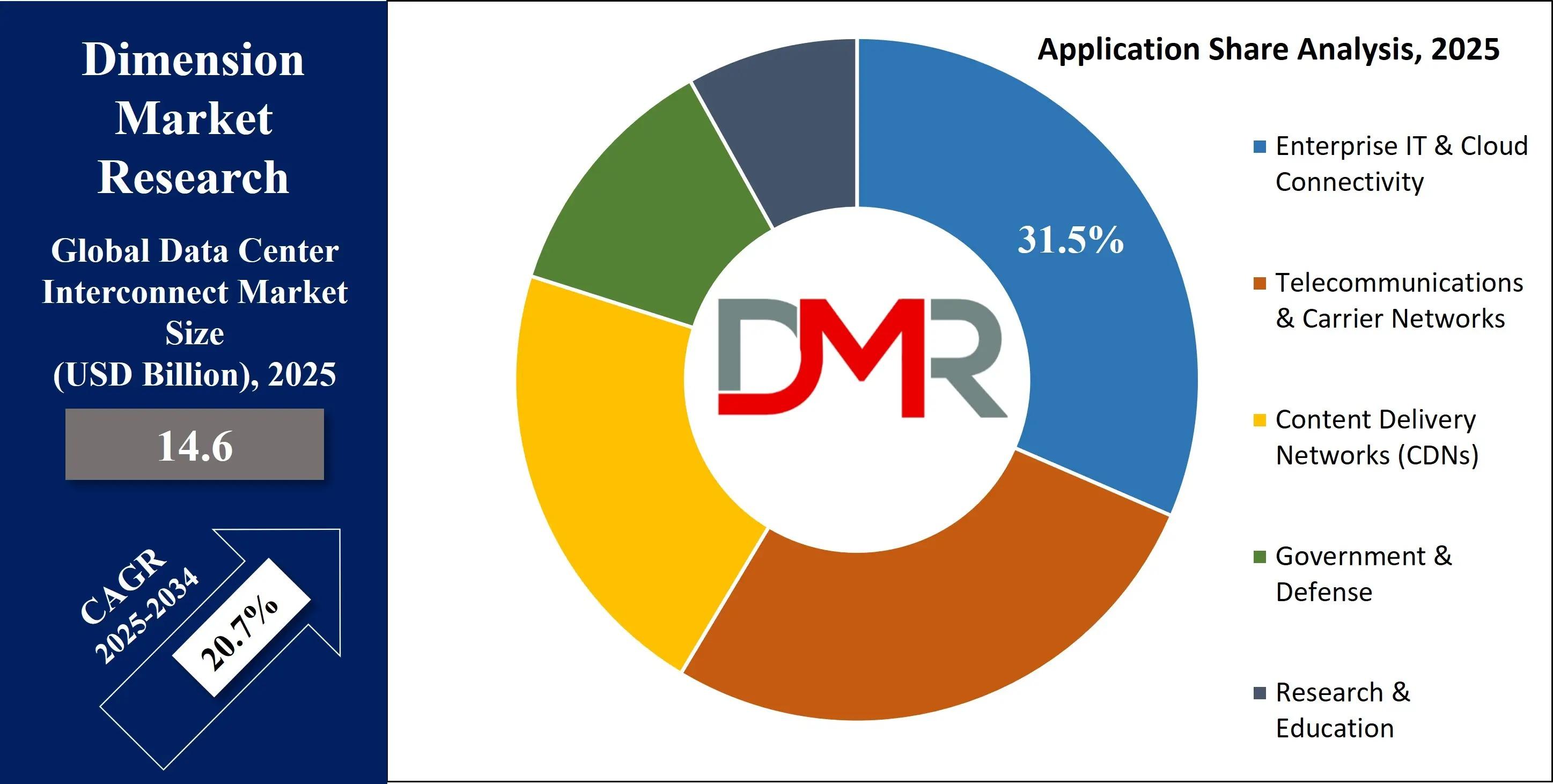
The global Data Center Interconnect Market is experiencing substantial growth as cloud computing, artificial intelligence, and hyperscale infrastructure increase the need for reliable, high-capacity communication between geographically distributed data centers. According to Dimension Market Research, the market is projected to reach USD 14.6 billion in 2025 and USD 79.4 billion by 2034, expanding at a CAGR of 20.7% during 2025 to 2034.
The expansion reflects a fundamental transformation in how enterprises manage digital infrastructure. Businesses increasingly operate across multiple cloud regions, distributed facilities, and interconnected computing environments, creating greater demand for secure, low-latency data exchange.
Advances in optical networking, software-defined networking, and intelligent traffic management are also influencing infrastructure investment decisions.
What Is the Data Center Interconnect Market?
The Data Center Interconnect Market includes hardware, software, and services that enable communication and data transfer between two or more data centers. These connections support workload migration, data replication, disaster recovery, cloud connectivity, and enterprise network operations.
Data center interconnect solutions use technologies such as optical transport networks, wavelength division multiplexing, packet-based switching, and software-defined networking to transmit information efficiently across metropolitan, regional, and long-distance networks.
As digital applications become more distributed, interconnect infrastructure helps organizations maintain service availability, network resilience, and consistent application performance.
Why Is the Data Center Interconnect Market Growing?
Increasing cloud adoption is a major factor behind market expansion. Enterprises are implementing hybrid and multi-cloud strategies to distribute workloads, strengthen business continuity, and improve infrastructure flexibility.
Artificial intelligence and machine learning are creating additional bandwidth requirements. Large computing environments generate substantial volumes of information that must move between processing, storage, and application infrastructure.
Telecommunications operators are also expanding connectivity infrastructure to support 5G networks, edge computing, and growing digital traffic.
Another important growth factor is the increasing requirement for disaster recovery and real-time data synchronization. Organizations depend on interconnected facilities to maintain operations when individual locations experience disruptions.
Get a Free Sample of the Data Center Interconnect Market Report
Explore detailed market segmentation, regional performance, technology developments, and competitive intelligence through Dimension Market Research's comprehensive analysis. The sample report provides an opportunity to evaluate the research coverage before purchasing.
https://dimensionmarketresearch.com/request-sample/data-center-interconnect-market/
Data Center Interconnect Market Size and Key Statistics
● 2025 Market Size: USD 14.6 Billion
● 2034 Forecast Value: USD 79.4 Billion
● Forecast CAGR: 20.7%
● Leading Region: North America, 38.0% share in 2025
● Leading Component: Hardware
● Leading Application: Enterprise IT & Cloud Connectivity
● High-Growth Region: Asia Pacific
These findings indicate expanding investment opportunities across optical networking equipment, network management software, cloud connectivity, and managed interconnect services.
Market Segmentation and Key Applications
The Data Center Interconnect Market is segmented by component, technology, application, and end user.
By Component: Hardware represents the largest revenue-generating segment, supported by investment in networking switches, routers, optical transport systems, and high-capacity transmission equipment.
Software and services are gaining importance as operators introduce automated provisioning, centralized management, predictive maintenance, and network monitoring capabilities.
By Technology: Packet-based switching remains widely deployed because it provides flexible connectivity for enterprise workloads and cloud applications. Optical transport technologies, including WDM and OTN, support high-bandwidth transmission across extensive fiber networks.
By Application: Enterprise IT and cloud connectivity represent the dominant application area. Organizations rely on interconnect infrastructure for cloud integration, workload mobility, disaster recovery, and geographically distributed operations.
By End User: Cloud service providers and telecommunications carriers are major customers, while enterprise adoption is expanding as organizations modernize private and hybrid cloud environments.
How AI and Optical Technologies Are Transforming Connectivity
Artificial intelligence is influencing both network demand and infrastructure management.
AI-enabled network analytics can examine traffic patterns, detect potential congestion, support automated routing, and identify equipment issues before they significantly affect operations.
Software-defined networking allows operators to manage complex interconnect environments through centralized platforms, improving flexibility and reducing manual configuration requirements.
Meanwhile, coherent optical technologies and dense wavelength division multiplexing are increasing transmission capacity and supporting more efficient fiber utilization.
These developments are particularly relevant for hyperscale cloud operators and enterprises managing data-intensive applications across multiple locations.
Regional Outlook and Emerging Opportunities
North America is projected to lead the Data Center Interconnect Market with 38.0% of global revenue in 2025. Its position reflects extensive hyperscale infrastructure, mature cloud ecosystems, and substantial investment in advanced networking technologies.
The United States market is projected to reach USD 4.7 billion in 2025, supported by growing requirements for cloud connectivity and high-performance digital infrastructure.
Europe represents another important market, with demand influenced by enterprise cloud adoption, data protection requirements, and secure cross-border connectivity.
Asia Pacific is expected to record the fastest regional growth as China, India, Japan, and other regional economies invest in cloud infrastructure, digital services, and data center capacity.
Hybrid cloud deployment, optical network modernization, and managed connectivity services present opportunities for technology providers throughout the forecast period.
Competitive Landscape
Competition in the Data Center Interconnect Market involves established networking companies, optical technology specialists, and software-defined infrastructure providers.
Prominent companies identified in the DMR report include Cisco Systems, Ciena Corporation, Nokia Corporation, Huawei Technologies, Infinera Corporation, Juniper Networks, Arista Networks, Fujitsu, NEC Corporation, and Hewlett Packard Enterprise.
Companies compete through transmission capacity, equipment performance, network automation, cybersecurity capabilities, and integration with existing infrastructure.
Increasing demand for scalable connectivity is encouraging technology development across optical transport equipment, programmable networking platforms, and managed services.
Explore the Complete Data Center Interconnect Market Analysis
Dimension Market Research provides detailed insights into market forecasts, technology segmentation, regional opportunities, industry developments, and competitive positioning. The complete study is designed to support infrastructure investment planning, market entry strategies, and technology assessments.
https://dimensionmarketresearch.com/checkout/data-center-interconnect-market/
Frequently Asked Questions
1. What is the global Data Center Interconnect Market size?
The market is projected to reach USD 14.6 billion in 2025 and USD 79.4 billion by 2034.
2. What is the CAGR of the Data Center Interconnect Market?
The market is forecast to expand at a CAGR of 20.7% during 2025 to 2034.
3. Which segment leads the Data Center Interconnect Market?
Hardware leads by component, while enterprise IT and cloud connectivity represent the dominant application segment.
4. Which region dominates the Data Center Interconnect Market?
North America leads with an estimated 38.0% market share in 2025.
5. What is the future outlook for the Data Center Interconnect Market?
Expansion of hyperscale facilities, AI workloads, hybrid cloud adoption, and high-capacity optical networking is expected to support sustained market growth.
Conclusion
The Data Center Interconnect Market is becoming increasingly important as digital infrastructure shifts toward distributed, cloud-integrated computing environments.
Rising bandwidth requirements, artificial intelligence workloads, and growing demand for resilient connectivity are supporting market expansion. Continued development in optical transport, network automation, and software-defined infrastructure is expected to create opportunities for network equipment providers, telecommunications operators, and enterprise technology suppliers.
Related Data Center and Optical Networking Market Insights
Data Center Market Size
The global Data Center Market is projected to increase from USD 301.8 billion in 2026 to USD 805.3 billion by 2035, registering an 11.5% CAGR. Expansion of hyperscale facilities, cloud services, and AI infrastructure is supporting investment in computing capacity, storage, networking, and energy-efficient facilities.
Optical Interconnect Market Share
The global Optical Interconnect Market is projected to reach USD 55.0 billion by 2035, compared with USD 18.0 billion in 2026. Cable assemblies account for a leading 37.8% product-type share in 2026, while North America holds a 34.8% regional share. Increasing demand for high-bandwidth communication supports optical connectivity adoption.
Data Center Networking Market Growth
The global Data Center Networking Market is projected to grow from USD 42.1 billion in 2025 to USD 114.3 billion by 2034, at an 11.7% CAGR. Adoption of software-defined networking, network automation, high-speed Ethernet technologies, and hyperscale architectures is strengthening demand for advanced networking infrastructure.

 English
 Arabic
 French
 Spanish
 Portuguese
 Deutsch
 Dutch
 Italiano
 Russian
 Romaian
 Portuguese (Brazil)
 Greek