


Screen Printing Clothing and Cap Screen Printing in Australia: What Local Businesses Need to Know
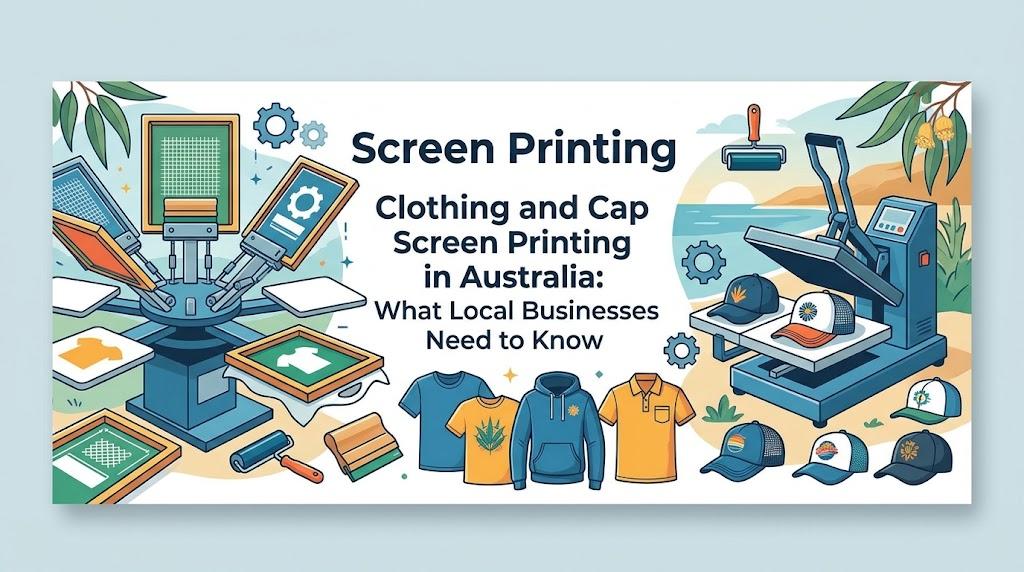
A café needs staff shirts that survive constant washing. A construction crew needs hi-vis workwear with a logo that stays visible in harsh sunlight. A school, sports club, or event organiser needs caps and T-shirts that look professional without blowing the budget. Across Australia, screen printing clothing and cap screen printing remain practical answers to these everyday branding and uniform challenges.
Screen printing is a decoration method where ink is pushed through a mesh stencil onto fabric. It is valued for producing bold, durable designs, particularly on larger orders of T-shirts, singlets, workwear, and caps. For Australian businesses, the decision is not simply “print a logo”; it is about choosing a method, garment, and supplier that can handle local weather, workplace safety expectations, and repeated laundering.jbuniforms.com
Why Screen Printing Still Matters in Australia
Australia’s climate and work environments place unusual demands on printed clothing. Outdoor crews face UV exposure, heat, dust, and frequent washing, while hospitality and healthcare teams need uniforms that stay presentable through long shifts. Screen printing t-shirts and caps can perform well in these conditions when the right ink system and fabric are selected.
Unlike some decoration methods that sit lightly on the surface, quality screen printing bonds ink into the fabric through curing. This makes it especially suitable for cotton and cotton-blend T-shirts, promotional tees, event shirts, and branded caps. For businesses ordering in reasonable quantities, it also offers strong value because setup costs are spread across the run.
Local buyers should also consider how the finished item will be used. A retail T-shirt may prioritise soft-hand feel and detailed artwork, while a worksite shirt needs durability, colourfastness, and clear visibility. The same logo may therefore require different placement, ink coverage, or garment choices.
Choosing Between T-Shirt and Cap Screen Printing
T-shirt screen printing and cap screen printing share the same core principle, but they are not identical in practice. Fabric texture, printing area, curvature, and garment construction all affect the result.
| Consideration | T-shirt screen printing | Cap screen printing |
|---|---|---|
| Best use | Event tees, staff shirts, sports uniforms, retail merchandise | Team caps, work caps, promotional giveaways |
| Typical artwork | Larger front, back, or sleeve designs | Small front, side, or rear logos |
| Fabric challenge | Fabric stretch and ink absorption | Curved panels and seams |
| Design advice | Keep fine text readable at distance | Use simplified, bold logos |
| Durability focus | Wash resistance and colour retention | Sun exposure, sweat, and shape retention |
For tshirt screen printing, artwork should be prepared with the final garment size in mind. A design that looks sharp on a screen may lose detail when printed across a textured cotton tee. For cap screen printing, less is usually more: a clean logo, strong contrast, and a well-placed design will outperform an overly complex graphic.
What Australian Customers Should Expect
Australian buyers often expect more than a low price. They want reliable turnaround, consistent colour matching, ethical garment sourcing, and prints that survive real-world use. This is particularly important for industries such as healthcare, hospitality, construction, education, and government, where screen printing t shirts represent both brand identity and workplace professionalism.jbuniforms.com
A dependable screen printing provider should be able to advise on:
-
Garment suitability: Cotton, poly-cotton, performance fabrics, hi-vis materials, and cap construction all behave differently.
-
Print placement: Chest logos, back prints, sleeve details, and cap panels require different artwork dimensions.
-
Ink and curing: Proper curing helps prevent cracking, fading, or peeling after washing.
-
Colour consistency: Brand colours should remain consistent across repeat orders.
-
Order planning: Larger runs generally improve unit economics, while smaller runs may suit digital alternatives.
It is also wise to ask for a sample or a printed proof before approving a full production run. This is especially useful for caps, where a design may need adjustment to suit curved surfaces.
Practical Tips for Better Printed Clothing
The best screen printed garments start long before ink touches fabric. Careful preparation reduces costly revisions and helps the final product look professional.
-
Start with print-ready artwork. Use vector files where possible, and ensure text is converted to outlines. Avoid relying on low-resolution images pulled from social media.
-
Simplify for small items. Caps have limited printable space. Remove unnecessary detail and prioritise the core logo or wordmark.
-
Choose garments for the environment. Lightweight cotton tees suit events and retail, while durable workwear and hi-vis clothing suit industrial settings.
-
Think about washing instructions. Provide staff with simple care guidance, such as washing inside out and avoiding high-heat drying, to extend print life.
-
Order strategically. Combine repeat-use items such as staff T-shirts, caps, and aprons into a coordinated branding plan rather than treating each item as a separate project.
-
Check compliance needs. For workwear, confirm that decoration does not interfere with required safety features, reflective tape, or visibility standards.
A practical example: a landscaping business might choose high-visibility shirts with a simple chest logo and a cap with a bold front emblem. The T-shirt design can carry more information, while the cap remains clean and instantly recognisable from a distance.
Screen Printing Versus Other Decoration Methods
Screen printing is not always the only option. Embroidery, heat transfer, and digital printing each have strengths, and the right choice depends on quantity, fabric, artwork, and budget.
-
Screen printing is strong for bold graphics, larger quantities, and durable T-shirt prints.
-
Embroidery suits polos, caps, jackets, and premium uniforms where a textured, long-lasting finish is preferred.
-
Heat transfer can work well for small runs, names, numbers, and full-colour designs.
-
Digital printing is useful for photographic artwork or highly detailed multi-colour designs on suitable garments.
Many Australian uniform suppliers offer more than one decoration method because different garments call for different solutions. JB Uniforms, for example, supplies uniforms and workwear across sectors including hospitality, healthcare, corporate, schools, factories, and government, alongside logo embroidery services. For organisations building a complete uniform program, discussing screen printing clothing alongside embroidery can help match the decoration method to each garment’s purpose.jbuniforms.com
Frequently Asked Questions
How long does screen printing last on clothing?
A properly printed and cured screen print can last through many washes, particularly on cotton and poly-cotton garments. Longevity improves when the garment is washed inside out, dried at moderate heat, and not ironed directly over the print.
Is cap screen printing suitable for every cap style?
Not always. Structured caps, curved panels, mesh backs, and seams can limit the printable area. Simple logos and bold text usually work best, while highly detailed artwork may need a different placement or decoration method.
How many shirts do I need for screen printing to be cost-effective?
Screen printing often becomes more economical with larger quantities because setup is shared across the run. However, the ideal quantity depends on artwork complexity, number of print colours, garment type, and deadline.
Can screen printing match my brand colours?
Yes, but colour matching should be confirmed before production. Providing brand colour codes or a physical sample helps reduce variation, especially for repeat orders.
What artwork should I provide for tshirt screen printing?
Vector artwork is ideal. If only a raster image is available, it should be high resolution and sized correctly for the intended print area. Clear fonts, strong contrast, and simplified details produce better results.
Making the Right Local Choice
For Australian businesses, screen printing clothing is most effective when it is treated as part of a broader uniform and branding strategy. The right combination of garment quality, artwork design, print placement, and decoration method can help a team look cohesive while withstanding daily wear.
Whether the project involves tshirt screen printing for an event, screen printing t-shirts for staff, or cap screen printing for a sports team or worksite crew, start with the end use in mind. Ask practical questions, review samples, and choose a supplier that understands both the garment and the environment in which it will be worn. Businesses seeking uniform and workwear options can explore suppliers such as JB Uniforms, which serves a wide range of Australian industries and offers logo embroidery alongside uniform supply.
 Greek
 English
 Arabic
 French
 Spanish
 Portuguese
 Deutsch
 Turkish
 Dutch
 Italiano
 Russian
 Romaian
 Portuguese (Brazil)