


Advanced Tungsten Carbide Materials: Innovation in Wear Resistance and Industrial Performance
The growing demand for durable, wear-resistant materials across manufacturing, mining, construction, and aerospace industries is supporting the expansion of the global tungsten carbide market. Known for its exceptional hardness, thermal stability, and resistance to abrasion, tungsten carbide is widely used in cutting tools, drilling equipment, machine components, dies, and industrial wear parts. Its ability to withstand demanding operating conditions makes it an important material for precision engineering and heavy-duty industrial applications.
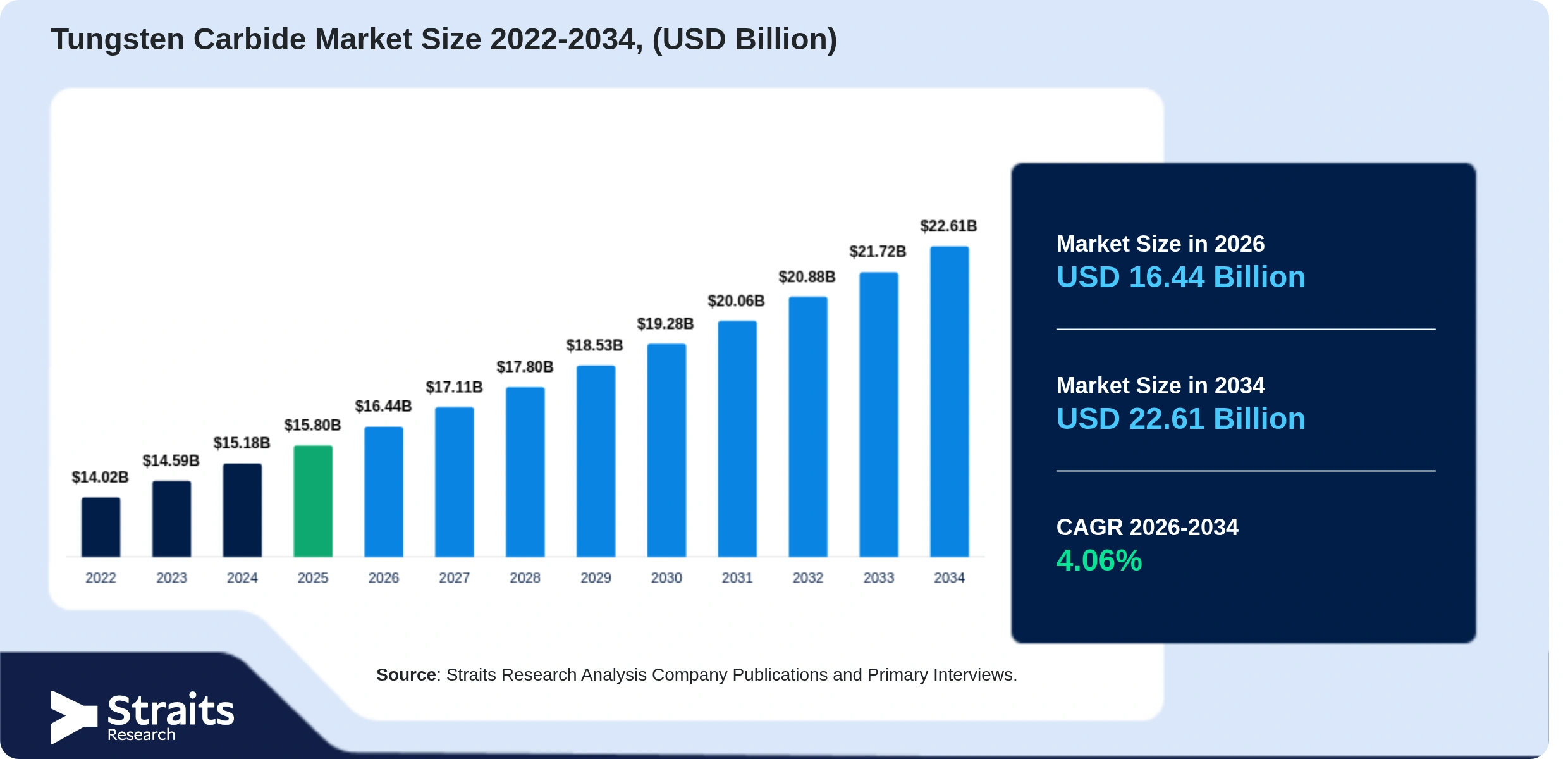
According to Straits Research, the global tungsten carbide market was valued at USD 15.8 billion in 2025 and is projected to increase from USD 16.44 billion in 2026 to USD 22.61 billion by 2034, registering a CAGR of 4.06% during the forecast period 2026–2034. Increasing investments in advanced manufacturing, infrastructure development, mining operations, and precision machining are expected to support market demand.
Advanced Manufacturing Technologies Strengthen Market Demand
The growing adoption of computer numerical control (CNC) machining, industrial automation, and precision manufacturing is increasing the importance of high-performance cutting materials. Tungsten carbide offers the hardness and wear resistance required for machining metals and manufacturing components with demanding dimensional specifications.
Technological developments in chemical vapor deposition (CVD) and physical vapor deposition (PVD) are improving the surface properties and durability of carbide components. Additive manufacturing is also creating opportunities to produce complex tungsten carbide parts with specialized geometries and optimized material utilization. These developments are supporting the adoption of advanced carbide solutions across automotive, aerospace, and industrial engineering applications.
Mining and Infrastructure Development Expand Industrial Applications
Mining and construction activities require equipment capable of operating under high-impact, abrasive, and demanding environmental conditions. Tungsten carbide is widely used in drilling bits, cutting edges, excavation equipment, and wear-resistant components because of its ability to maintain performance under intensive use.
Infrastructure investments and expanding mining operations are strengthening demand for durable drilling and machining tools. The material also supports applications in oil and gas exploration, where equipment must withstand demanding operating environments. These industrial requirements are creating opportunities for tungsten carbide manufacturers supplying specialized grades and engineered components.
Submicron Grade Leads the Product Landscape
Submicron tungsten carbide dominated the grade segment, accounting for 14.9% of the market share in 2025. Its fine grain structure provides a combination of high hardness, toughness, and wear resistance, making it suitable for precision cutting tools and demanding industrial applications.
Other important grades include general-purpose, metal-forming and wear, rotary drilling and mining, and corrosion-resistant tungsten carbide. Each grade serves different performance requirements, allowing manufacturers to develop specialized products for machining, drilling, metalworking, and industrial equipment applications.
Cutting Tools Create New Growth Opportunities
The cutting tools segment is projected to register the fastest growth among applications, with a CAGR of 7% during 2026–2034. Increasing demand for precision machining across automotive, aerospace, construction, and metalworking industries is supporting the adoption of tungsten carbide cutting solutions.
Machine tools and components, dies and punches, and abrasive products also contribute to market demand. Tungsten carbide's resistance to deformation and abrasion makes it suitable for manufacturing components that require extended service life and consistent operational performance. The increasing use of automated production systems is further strengthening demand for high-performance tooling materials.
Industrial Engineering Remains the Leading End-Use Segment
Industrial engineering accounted for 31.8% of the tungsten carbide market share in 2025, supported by extensive applications in machining, metal fabrication, industrial machinery, and manufacturing equipment. The material's durability and dimensional stability make it valuable for components exposed to continuous friction and mechanical stress.
Other important end-use industries include oil and gas, aerospace and defence, transportation, and mining and construction. The expanding use of precision-engineered components across these industries is expected to sustain demand for specialized tungsten carbide products.
Asia Pacific Leads While North America Records Faster Growth
Asia Pacific dominated the tungsten carbide market with a 42.5% share in 2025. The region's strong manufacturing base, industrialization, mining activities, and expanding automotive and electronics production support its leading position. China is an important contributor because of its tungsten mining and processing capabilities, while Japan benefits from advanced manufacturing and precision engineering industries.
North America is projected to be the fastest-growing regional market, registering a CAGR of 7.6% during 2026–2034. Demand from aerospace, defence, automotive, oil and gas, and industrial manufacturing is creating opportunities for tungsten carbide suppliers. Investments in advanced machining technologies and efforts to strengthen critical mineral supply chains are also supporting regional development.
Recycling and Supply Chain Diversification Shape Competition
The tungsten carbide industry is increasingly focusing on material recovery and recycling to improve resource efficiency and reduce dependence on primary tungsten supplies. Recycling used carbide tools and industrial components provides manufacturers with an alternative source of raw materials while supporting more sustainable production practices.
Key companies operating in the market include Sandvik AB, Kennametal Inc., CERATIZIT S.A., H.C. Starck GmbH, Xiamen Tungsten Co. Ltd., Sumitomo Electric Industries Ltd., Federal Carbide Company, Umicore N.V., Mitsubishi Materials Corporation, Plansee Group, Hitachi Metals, and TaeguTec Ltd.
Competition is shaped by product durability, manufacturing precision, coating technologies, material quality, and recycling capabilities. Manufacturers are increasingly investing in advanced carbide grades and specialized tooling solutions to serve the evolving requirements of industrial customers.
Future Outlook
The tungsten carbide market is expected to maintain steady growth as manufacturers, mining companies, and infrastructure developers continue investing in durable industrial materials. Advancements in precision machining, additive manufacturing, and carbide recycling are expected to influence future product development. With the market projected to reach USD 22.61 billion by 2034, cutting tools, industrial engineering, and mining applications will remain important contributors to industry demand.
Explore the full market report: https://straitsresearch.com/report/tungsten-carbide-market
About Straits Research
Straits Research is a market intelligence and consulting firm providing industry analysis, market sizing, competitive assessments, and strategic insights across global industries. Its research supports businesses and decision-makers in identifying market opportunities and making informed strategic decisions.
 Portuguese
 English
 Arabic
 French
 Spanish
 Deutsch
 Turkish
 Dutch
 Italiano
 Russian
 Romaian
 Portuguese (Brazil)
 Greek