


AI-Powered Predictive Vehicle Technology Market: Growth Opportunities in Connected and Autonomous Mobility
The automotive industry is moving toward intelligent vehicles that can anticipate problems rather than simply respond to them. Predictive vehicle technology is becoming an important part of this transition, using artificial intelligence (AI), machine learning, connected sensors, and predictive analytics to monitor vehicle conditions, identify potential failures, and improve driving safety. As manufacturers and fleet operators prioritize vehicle reliability and operational efficiency, demand for these solutions is gaining momentum.
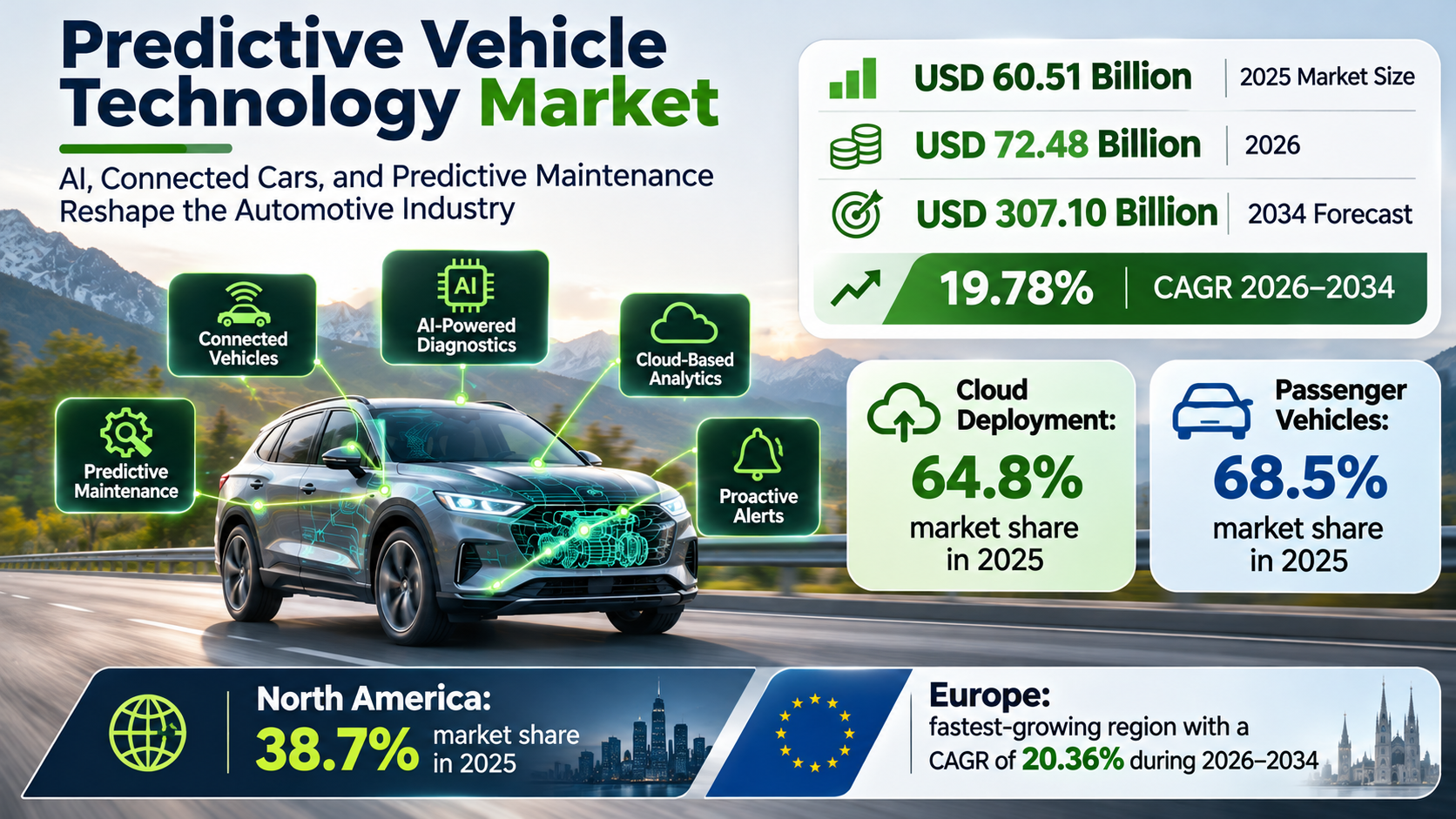
According to Straits Research, the global predictive vehicle technology market was valued at USD 60.51 billion in 2025 and is projected to increase from USD 72.48 billion in 2026 to USD 307.10 billion by 2034, registering a CAGR of 19.78% during the forecast period 2026–2034. The expansion reflects the growing role of connected mobility, intelligent diagnostics, and data-driven vehicle management.
Connected Vehicles Are Making Predictive Maintenance More Practical
Connected vehicles generate continuous streams of information through onboard sensors, telematics systems, cameras, GPS, and electronic control units. Predictive vehicle technology uses this information to identify unusual performance patterns and estimate when components may require maintenance. This allows manufacturers and fleet operators to move beyond fixed maintenance schedules and address potential problems before they lead to costly breakdowns.
The integration of AI and machine learning is further strengthening these capabilities. Predictive analytics can process historical and real-time vehicle data to support early fault detection, maintenance planning, route optimization, and performance monitoring. These capabilities are particularly valuable for commercial fleets, where unplanned downtime can affect delivery schedules, operating costs, and asset utilization.
Cloud Deployment Supports Real-Time Vehicle Intelligence
Cloud-based platforms play a central role in the development of predictive vehicle technology because they allow large volumes of vehicle data to be collected and analyzed across connected fleets. The cloud deployment segment accounted for a leading 64.8% market share in 2025. Its position reflects the demand for scalable analytics, remote monitoring, and centralized vehicle management.
Cloud infrastructure also supports over-the-air software updates and integration with telematics platforms. As connected vehicle ecosystems expand, cloud-based predictive solutions can help automotive manufacturers and fleet operators monitor vehicle health across multiple locations without relying entirely on local computing infrastructure.
Proactive Alerts Strengthen Vehicle Safety and Reliability
Predictive vehicle technology is increasingly being used to notify drivers and fleet managers about potential mechanical issues, maintenance requirements, and changing driving conditions. The proactive alerts application segment is projected to grow at a CAGR of 19.58% during 2026–2034, supported by demand for early warnings and preventive vehicle maintenance.
These alerts can help reduce unexpected component failures and improve vehicle availability. Predictive systems also complement advanced driver assistance systems (ADAS) and other safety technologies by using sensor and connectivity data to support more informed decisions. As a result, proactive monitoring is becoming an important feature of intelligent vehicle platforms.
Passenger Vehicles Lead Adoption Across Vehicle Types
Passenger vehicles accounted for 68.5% of the predictive vehicle technology market in 2025. The segment's leading position is supported by the increasing availability of connected vehicle features, advanced safety systems, and digital vehicle diagnostics in modern passenger cars. Automotive manufacturers are incorporating more intelligent software and sensor-based capabilities to improve the ownership experience and strengthen vehicle reliability.
Commercial vehicles also represent an important application area. Logistics companies, transportation providers, and fleet operators can use predictive technologies to monitor vehicle conditions, plan maintenance, and reduce operational disruptions. As fleet digitalization advances, predictive analytics is expected to become increasingly relevant to commercial transportation.
Europe Emerges as the Fastest-Growing Regional Market
North America dominated the predictive vehicle technology market with a 38.7% share in 2025, supported by the adoption of connected vehicles, automotive software, telematics, and AI-powered vehicle monitoring. The region's established automotive technology ecosystem and demand for fleet optimization solutions contribute to its market position.
Europe is projected to be the fastest-growing region, registering a CAGR of 20.36% during 2026–2034. The region's growth is supported by vehicle safety requirements, increasing adoption of electric and connected vehicles, and investments in intelligent mobility solutions. Automotive manufacturers are also focusing on software-defined vehicles and advanced diagnostics, creating opportunities for predictive technology providers.
Asia Pacific remains an important market due to its large automotive manufacturing base, expanding electric vehicle industry, and growing investments in connected transportation infrastructure. Increasing adoption of digital vehicle platforms across major automotive markets is expected to support regional demand.
Competitive Landscape and Future Outlook
The predictive vehicle technology market includes established automotive suppliers and technology companies developing advanced vehicle monitoring, analytics, and connectivity solutions. Key participants identified in the Straits Research report include Bosch, Continental, Garrett Motion, Aptiv, Aisin Seiki, ZF, NXP, and Valeo.
The market's future growth will depend on the integration of AI-driven diagnostics, connected vehicle platforms, cloud analytics, and predictive maintenance capabilities. Electric vehicle adoption and fleet digitalization are also expanding the need for technologies that can monitor battery health, optimize vehicle performance, and reduce downtime.
With the market projected to reach USD 307.10 billion by 2034, predictive vehicle technology is positioned to become an increasingly important part of the automotive industry's transition toward connected, intelligent, and data-driven mobility.
Explore the full report: https://straitsresearch.com/report/predictive-vehicle-technology-market
About Straits Research
Straits Research is a market intelligence and consulting firm providing industry insights, market sizing, competitive analysis, and strategic research across multiple sectors. Its reports help businesses understand emerging trends, evaluate market opportunities, and make informed decisions.
 Spanish
 English
 Arabic
 French
 Portuguese
 Deutsch
 Turkish
 Dutch
 Italiano
 Russian
 Romaian
 Portuguese (Brazil)
 Greek