


SAP C_HAMOD_2601 Study Guide: Build Your Foundation
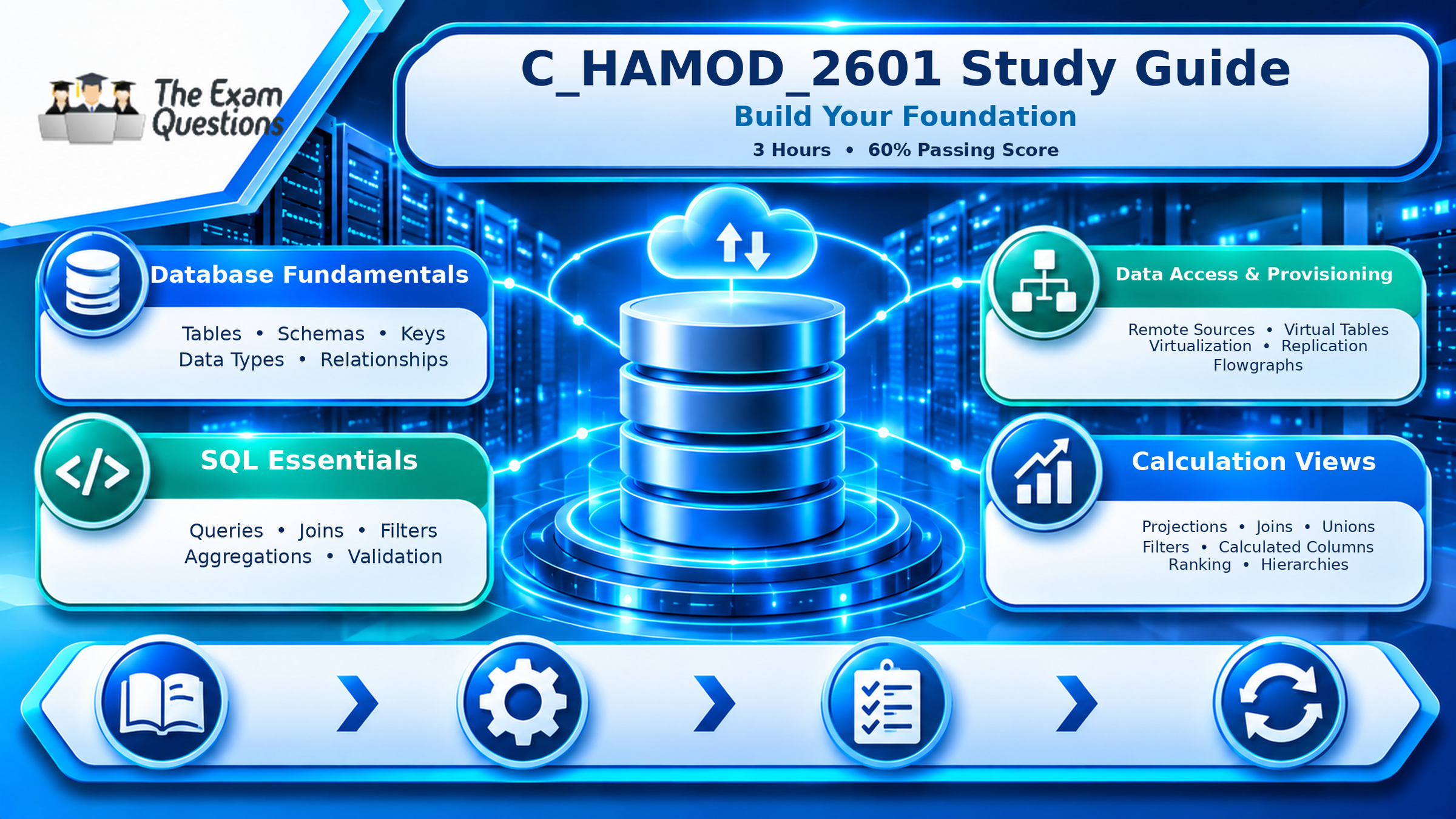
Quick Summary
The SAP Data Engineer - SAP HANA certification calls for skills in data provisioning, database modelling, and analytical development. This study guide introduces the essential foundations, including SQL, SAP HANA Cloud, data access, and calculation views, so candidates build their technical knowledge step by step.
Introduction
A strong foundation pays off in enterprise database work. Before developing advanced analytical models or connecting multiple data sources, professionals learn how databases store information, how queries retrieve records, and how components work together.
SAP HANA combines database management, data integration, and analytical processing. Working with these features rests on practical database knowledge that goes beyond familiar terminology.
The C_HAMOD_2601 Study Guide is intended for professionals preparing for the SAP Certified - Data Engineer - SAP HANA certification. It introduces the technical concepts behind data engineering activities and shows how candidates can build knowledge before tackling more complex SAP HANA operations.
Understand the Fundamentals of Data Engineering
Data engineering involves collecting, accessing, organising, transforming, and preparing information for analytical and business applications.
In an enterprise, information comes from customer databases, transaction systems, applications, and external services. A data engineer learns how these sources connect and how their information becomes available in a consistent format.
Before focusing on SAP-specific features, cover these database fundamentals:
- Tables, rows, columns, and database schemas.
- Primary keys and foreign keys.
- Relationships between datasets.
- Data types and constraints.
- Queries, filters, and aggregations.
- Data integrity and validation.
These concepts shape how information is accessed and how analytical models are designed in SAP HANA. A retail organisation, for example, may store customer details separately from product and sales information. Knowing the relationships between these datasets helps a data engineer combine them correctly, with each record counted once and the results accurate.
Build a Foundation in SQL
SQL is a core skill for relational databases. It retrieves, filters, combines, and analyses information.
Start with basic SELECT statements, WHERE conditions, ORDER BY clauses, and aggregate functions such as COUNT, SUM, and AVG. Then progress to joins, grouping, subqueries, and expressions.
Joins deserve particular attention because they combine related datasets so often. Learn the difference between INNER JOIN and LEFT OUTER JOIN, and see how the chosen condition shapes the resulting records. Aggregation matters just as much: grouping sales transactions by product category, for example, produces summaries that support business reporting.
Practise writing queries against small datasets and compare the returned results with manually calculated answers. Watch for NULL values, duplicate records, and incompatible data types. A strong SQL foundation makes custom modelling logic easier to understand and unexpected results easier to troubleshoot in SAP HANA.
Get Familiar with SAP HANA Cloud
SAP HANA Cloud is the database platform behind the Data Engineer - SAP HANA certification. Candidates explore its development environment and how database objects are organised.
Start with the basic structure of a database, including schemas, tables, views, and database objects. See how applications interact with the database and how developers organise modelling content.
SAP Business Technology Platform provides the broader environment for SAP HANA Cloud development, and knowing its purpose clarifies how database services and development tools fit into an enterprise application landscape.
SAP Business Application Studio supports development activities and offers an environment for managing projects and modelling content. Focus on how a project is organised, how development objects are maintained, and how changes move through the development lifecycle.
Learn the Basics of Data Provisioning
Data provisioning explains how information moves from source systems into an environment where it can be used. SAP offers several approaches, and understanding their differences is a key foundation for the certification.
Remote sources and virtualization
Remote sources connect SAP HANA to external databases or systems. Data virtualization gives access to remote information while the records stay in the source, and virtual tables are the database objects that expose that information.
Understand remote source configuration, virtual table creation, and access to remote tables in different environments, including classic schemas and HDI containers.
Data replication
Replication transfers information from a source system into another location. It suits cases where a target application needs a local copy of data or recurring updates.
Learn the role of replication tasks, services, and related technologies, then compare replication with virtualization so you can pick the approach that fits a requirement.
Data transformation
Transformation prepares data for a specific business or analytical purpose. It may filter records, change values, adjust structures, or prepare information for a target table.
SAP HANA Cloud supports Flowgraphs for designing transformation processes. Understand how source objects, transformation operations, and target objects relate to each other.
Understand Calculation Views and Data Modelling
Calculation views are central to analytical modelling in SAP HANA. They combine information from different sources and apply logic to produce structured outputs. Begin with the modelling environment and the steps for creating a calculation view.
The important components are:
- Projection: selects the required attributes and measures from a source.
- Join: combines related datasets through defined relationships.
- Union: combines compatible result sets from multiple sources.
- Filter: restricts the records included in a model.
- Calculated columns: derive additional values from existing fields.
SAP's modelling course also covers ranking, data slices, embedded functions, dynamic calculation views, and hierarchies.
A simple sales dataset is an effective way to see these operations at work. Combine product information with transaction records, calculate revenue, filter by date, and inspect the output. The exercise shows how individual modelling features add up to a complete analytical result.
Build Your Foundation Through Practical Exercises
Reading gives context, and performing database operations builds deeper understanding. Start with three manageable exercises.
Exercise A covers database and SQL fundamentals. Create or inspect a small dataset of customers, products, and sales transactions, then write queries to retrieve records, apply filters, and calculate totals.
Exercise B covers data provisioning. Study a remote source scenario, decide whether virtualization or replication fits, and trace how the information becomes available for database operations.
Exercise C covers calculation view development. Combine related datasets with suitable modelling operations, apply calculated columns or filters, and validate the resulting information.
After each activity, record what you did, why you chose a particular operation, and what result you expected. This builds a useful technical reference for future revision.
Organise Your Studies Around the Official Exam Scope
SAP currently lists the C_HAMOD assessment as a three-hour system-based examination with a 60% passing score. Its two main examination groups are Data Access and Calculation Views, each with a published weighting of 41 to 50%.
Once your foundation is in place, move step by step into the detailed technical subjects within these two areas. The SAP official certification page provides the current assessment information.
SAP also publishes two especially relevant courses: Developing Data Models with SAP HANA Cloud and Provisioning Data to SAP HANA Cloud. Their outlines offer a structured way to review modelling, remote sources, replication, transformation, and performance.
Build the basics first. Explaining and performing a basic operation independently gives you a stronger base than memorising several advanced features whose purpose stays unclear.
Frequently Asked Questions
What is included in the C_HAMOD_2601 Study Guide?
The guide covers database fundamentals, SQL, SAP HANA Cloud, data provisioning, remote sources, replication, Flowgraphs, and calculation views.
Do I need SQL knowledge before preparing for C_HAMOD?
A working knowledge of SQL is strongly recommended. Understanding queries, joins, filters, and aggregations makes data-access and modelling tasks easier.
What should beginners study first?
Start with relational database concepts, SQL fundamentals, and SAP HANA Cloud basics. Then progress to data provisioning and calculation view development.
Which technical areas carry the most exam weight?
SAP currently lists Data Access and Calculation Views at 41 to 50% each.
Is hands-on practice important for C_HAMOD?
Yes. SAP identifies the examination as system-based, so practise the relevant database and modelling operations and learn to validate your results.
Conclusion
A strong SAP HANA foundation begins with databases, SQL, data provisioning, and analytical modelling. These skills form the technical basis for working with enterprise information and building reliable analytical solutions.
Use this C_HAMOD_2601 Study Guide to strengthen the fundamentals before moving to more advanced certification topics. For additional C_HAMOD practice material, visit The Exam Questions and combine focused revision with practical SAP HANA activities.
 Dutch
 English
 Arabic
 French
 Spanish
 Portuguese
 Deutsch
 Turkish
 Italiano
 Russian
 Romaian
 Portuguese (Brazil)
 Greek