


What Affects the Selection of an Energy Absorber Lanyard?
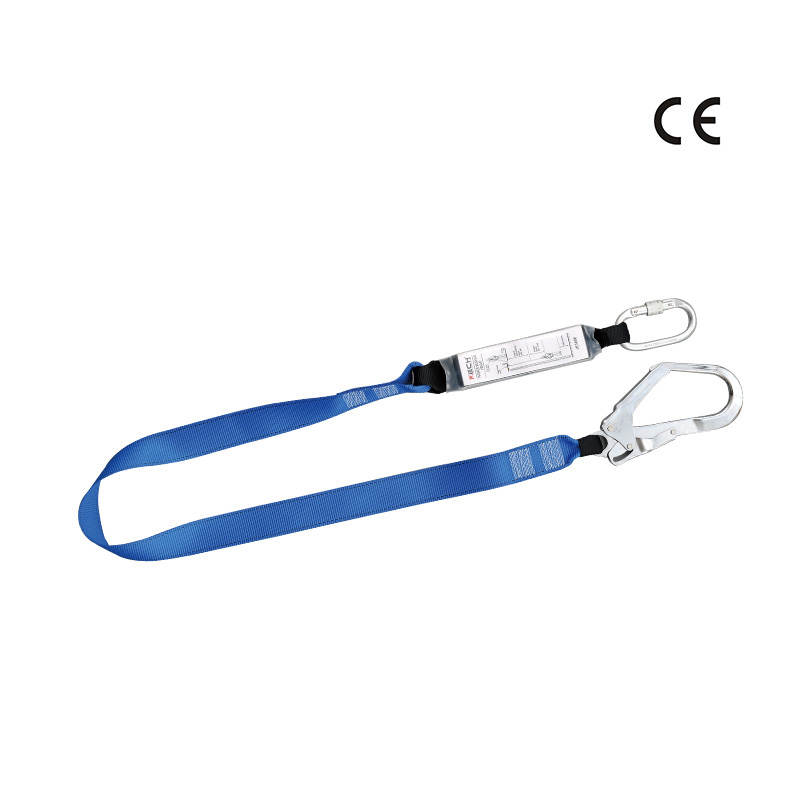
An Energy Absorber is designed to reduce the force transmitted to a worker during fall arrest. Many models use folded webbing enclosed in a protective cover. When a fall places sufficient load on the lanyard, controlled stitching begins to tear and the webbing extends. This process absorbs energy over a certain distance rather than stopping the movement abruptly.
The absorber's deployment distance is an important part of its specification. As the webbing extends, the worker continues moving downward, so the available clearance below the working position must be considered. A fall protection assessment needs to account for the lanyard length, absorber deployment, harness movement, connection arrangement and an appropriate safety margin. A suitable configuration cannot be selected by looking at the absorber's force rating alone.
Lanyard length also affects how the equipment is used. Fixed-length versions provide a defined connection distance, while adjustable models allow the user to change the effective length according to the working position. Elastic designs can reduce excess webbing hanging around the worker during movement. These differences influence convenience and positioning, but they do not replace the need to assess fall clearance and anchorage conditions.
Hook configuration is another consideration. Scaffold structures may require large-opening hooks, while steel beams, ladder sections and other anchor points can have different connection requirements. Hook size, gate opening and locking mechanism should be compatible with the intended anchorage point. The connection between the lanyard hook and the harness D-ring also needs to be checked to avoid unsuitable combinations.
Material selection contributes to the overall construction. Webbing lanyards are relatively flexible and lightweight, whereas rope versions may be considered for particular working environments and handling requirements. The choice depends on the structure, potential contact with sharp edges, movement patterns and the manufacturer's stated limitations.
For product comparisons, the absorber's maximum arresting force, deployment characteristics, lanyard length, hook type and applicable certification should be reviewed together. For example, a stated maximum force of 6 kN and a specified fall condition describe particular performance limits; they should not be treated as a guarantee that every installation will produce the same result.
A well-matched Energy Absorber Lanyard is therefore part of a complete fall protection system, not an independent solution. Its performance depends on the relationship between the absorber, harness, connectors, anchorage and available clearance. Understanding these details helps distinguish between lanyard configurations and their intended applications.
 Spanish
 English
 Arabic
 French
 Portuguese
 Deutsch
 Turkish
 Dutch
 Italiano
 Russian
 Romaian
 Portuguese (Brazil)
 Greek