


Understanding Features Labels and Predictions in Machine Learning
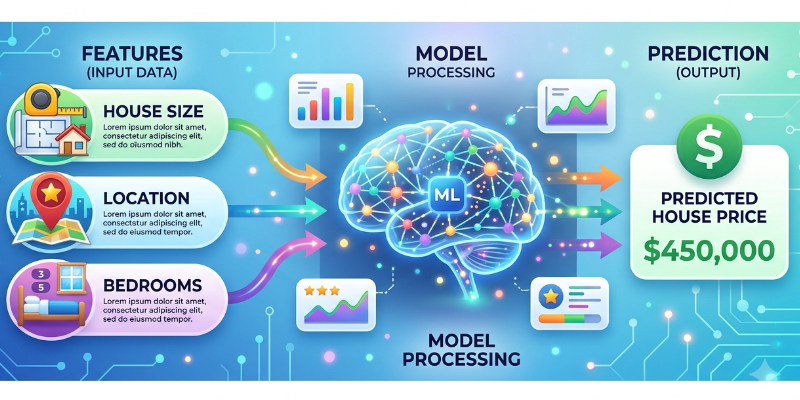
Machine Learning is essential to Artificial Intelligence, as it allows computers to learn from data and make informed choices. To grasp how machine learning operates, it's essential to understand three fundamental concepts: features, labels, and predictions. These ideas form the foundation for numerous machine learning models, spanning from simple recommendation systems to advanced AI applications.
Whether you are starting your AI journey or exploring practical applications, understanding these terms will help you learn how machines identify patterns and generate results. If you want to build a strong foundation in modern AI technologies, the Generative AI Course in Mumbai at FITA Academy can help you explore essential concepts and develop relevant skills.
What Are Features in Machine Learning?
Features are the individual pieces of information that a machine learning model uses to understand data and identify patterns. They act as inputs that help the model make decisions or predictions.
For example, imagine building a machine learning model to predict house prices. The model may use features such as the size of the house, number of bedrooms, location, age of the property, and number of bathrooms.
Each feature provides useful information about the house. When these features are combined, the model can identify relationships between property characteristics and their prices.
Features can be numerical or categorical. Numerical features include age, height, temperature, and salary. Categorical features include colour, product type, city, and payment method.
Choosing relevant features is important because good input data helps machine learning models produce better results.
What Are Labels in Machine Learning?
Labels represent the correct answers or outcomes associated with the training data. They help a machine learning model understand what it should learn to predict.
Consider the house price prediction example. The actual selling price of each house is its label. The model studies the relationship between the house features and their corresponding prices during training.
Labels are frequently utilized in supervised machine learning, where models train on instances that already have known outcomes.
For instance, in an email classification system, the features may include the email subject, message content, and sender information. The tag shows if the email is classified as spam or not spam.
Similarly, in a customer review analysis system, labels might identify reviews as positive, negative, or neutral.
Without accurate labels, supervised learning models may struggle to understand the correct relationship between inputs and expected outputs.
What Are Predictions in Machine Learning?
Predictions are the outputs generated by a trained machine learning model when it receives new input data.
After learning from training examples, the model uses the patterns it has identified to estimate an outcome for information it has not previously encountered.
For example, suppose a house price prediction model has learned from thousands of property records. When you provide details about a new house, such as its location, size, and number of bedrooms, the model estimates its market price.
Predictions are not always numerical values. They can also be categories, probabilities, or recommendations.
Some common examples include predicting customer behaviour, identifying fraudulent transactions, classifying images, and recommending products.
The precision of forecasts is influenced by the quality of the training data, chosen features, labels, and the design of the model.
Understanding the Relationship Between Features Labels and Predictions
Features, labels, and predictions work together throughout the machine learning process.
Features provide the input information, while labels provide the expected answers during training. The model studies the relationship between them and learns patterns from the available examples.
Once training is complete, the model receives new features and generates predictions without needing the actual labels in advance.
For example, think about a model created to forecast if a customer is likely to buy a product.
-
Features: Customer age, browsing history, purchase history, and product preferences.
-
Label: Whether the customer purchased the product.
-
Prediction: Whether a new customer is likely to purchase the product.
This relationship allows businesses to understand customer behaviour, improve recommendations, and make informed decisions.
Why Are Features, Labels, and Predictions Important?
Understanding these three concepts is essential for building effective machine learning models.
Selecting meaningful features helps models identify useful patterns. Accurate labels provide reliable learning examples. Good predictions help organizations make decisions based on data.
These concepts are widely used in healthcare, finance, retail, education, manufacturing, and many other industries.
For beginners, learning how these components work together makes advanced machine learning topics easier to understand. If you want to expand your knowledge of AI concepts and explore how intelligent systems work, consider joining an Artificial Intelligence Course in Mumbai to strengthen your understanding of machine learning fundamentals and practical AI applications.
Features, labels, and predictions are three fundamental building blocks of machine learning. Features represent the input information, labels provide the correct outcomes during supervised training, and predictions are the results generated by trained models.
Understanding their relationship is an important first step toward learning machine learning and Artificial Intelligence. Once you understand these concepts, exploring model training, evaluation, classification, and regression becomes much easier.
 French
 English
 Arabic
 Spanish
 Portuguese
 Deutsch
 Turkish
 Dutch
 Italiano
 Russian
 Romaian
 Portuguese (Brazil)
 Greek