


Custom Medical Boxes: Types, Uses and How to Choose
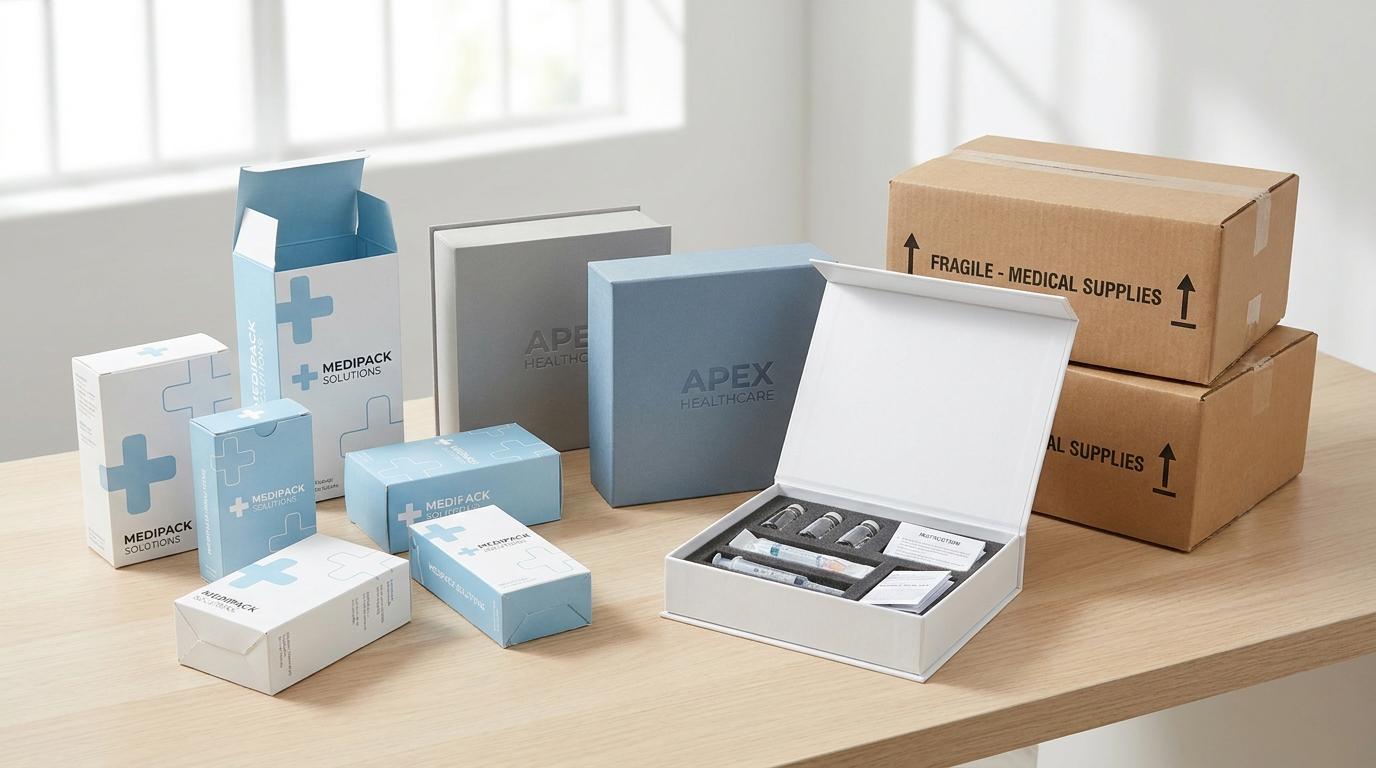
Custom medical boxes are designed for particular medicines, devices, diagnostic kits and healthcare supplies. Dimensions, materials and layout should match the product and packaging level. A printed outer carton, for example, is not a sterile barrier.
What Are Custom Medical Boxes?
These are boxes specified around a product rather than selected from a standard size range. Customisation may cover dimensions, board, artwork, closures and inserts. Most paperboard medical cartons are secondary packaging: they enclose a product already held in a bottle, blister or pouch. Primary packaging directly contains the product; tertiary packaging groups packs for storage or distribution, such as a transit case. Each level has a different function.
Different Types of Custom Medical Boxes
Folding Medical Cartons
Made from paperboard and usually supplied flat, folding cartons are erected and closed with tuck flaps or glued seams. Straight-tuck and reverse-tuck ends are common. They suit selected boxed medicines, small accessories and individually packed healthcare products when the board grade and structure match the product and handling conditions.
Rigid Medical Boxes
Rigid boxes use thick, firm board, often wrapped in printed paper. They suit selected kits, equipment collections or presentation sets. Their substantial construction does not make them sterile or automatically suitable for a particular device; assess the complete packaging system and distribution needs.
Corrugated Medical Boxes
Corrugated board combines flat liners with a fluted middle layer. Single- and double-wall constructions are available. These boxes can serve as outer or transit packaging for selected supplies and larger packaged products. Select the grade for product weight, stacking and handling; not all corrugated boxes perform alike.
Inserts, Trays and Sleeves
Die-cut inserts, dividers and shaped holders can separate components and limit movement. A sleeve may slide over an inner tray, creating an organised opening for kits or grouped products. Match each space to the item’s shape and orientation. Inserts organise products; they are not sterile barriers.
Tamper-Evident and Child-Resistant Features
A tamper-evident feature indicates whether a pack may have been opened or disturbed. Child-resistant packaging is designed to make access difficult for young children while remaining usable by adults. They serve different purposes and apply only where required. A seal on an ordinary outer carton does not, by itself, establish compliance or child resistance.
Materials Used for Custom Medical Packaging
Paperboard is widely used for folding cartons and supports printed text and graphics. Grades, coatings and thicknesses vary, so specify the board for the product and carton design. Rigid board creates a firm structure; corrugated cardboard uses fluting between liners. Kraft paperboard has a natural brown appearance and can be printed depending on its surface and process. None is automatically suitable for direct contact, sterile containment or every use.
| Material | General characteristics | Potential applications | Important considerations |
|---|---|---|---|
| Paperboard | Varied grades and printable surfaces | Folding cartons and outer packs | Grade, dimensions and load |
| Rigid board | Firm construction | Selected kits and presentation boxes | Construction and storage space |
| Corrugated board | Fluting between liners | Outer and distribution boxes | Board grade and handling |
| Kraft paperboard | Often natural brown; coated or uncoated | Selected kraft-style cartons | Surface, print and specification |
These are general comparisons; confirm grade and finished-pack performance for the intended use.
Printing, Labelling and Finishes
Custom printed medical boxes can carry logos, product names, manufacturer details, instructions and approved artwork. CMYK combines four process inks; Pantone uses specified spot colours for brand references. Results depend on board and process.
Information may include batch or lot details, expiry or storage statements, barcodes, QR codes or Data Matrix codes. Requirements vary by product; this is not a universal label checklist. Have regulatory or quality staff approve the artwork and confirm code readability before printing.
Foil stamping adds metallic detail; embossing raises a design and debossing presses it into the surface. Matt and gloss coatings or laminations change appearance and feel. Keep decoration clear of essential information and check board compatibility.
Choosing a Box for Different Medical Products
Start with the product and its existing primary pack. A medicine carton must fit its bottle or blister and leave room for required information or a leaflet. A medical device box may need an insert for an instrument, cable or accessory; any sterile-barrier need is determined by the device’s packaging system. A diagnostic kit containing a test device, tubes and instructions may need separate compartments. Individually wrapped gloves or dressings may need a simpler layout. Consider quantity, weight, fragility, storage and handling needs.
Get the Dimensions and Layout Right
Measure the packaged item’s length, width and height, then specify the required internal dimensions. External measurements include the board and construction. Account for closures, trays, inserts and product orientation, avoiding crushing or unnecessary empty space. A single boxed test kit may need one fitted area, while a multi-part kit may need separate spaces for the device, sample containers and instructions. Confirm the layout with a drawing or sample.
UK Medical Packaging Considerations
Medicines and medical devices follow different regulatory frameworks. MHRA guidance covers medicines labelling, including Braille and clear identification; the Human Medicines Regulations 2012 set statutory packaging information requirements. Medical devices have separate rules: Great Britain and Northern Ireland do not have identical market requirements, so confirm the applicable route, markings and label details for the destination. Rules concern the product and packaging system, not a generic cardboard box. Have regulatory or quality staff approve the specification and artwork before production.
Material and Sustainability Choices
Paper-based options and recycled-content board may be suitable where product requirements allow. Recycled content describes what went into a material; recyclability concerns whether the finished pack can be collected and processed. Coatings, laminations, windows and mixed materials can affect disposal. Avoid unnecessary components without removing packaging needed for protection or compliance. Check supplier specifications and UK packaging design guidance on Artsy Packaging.
How to Specify a Custom Medical Box
Before requesting a quote, record the product and primary pack, packaging level, internal dimensions, weight, quantity, preferred structure, insert needs, storage and distribution conditions, and approved artwork. Compare materials and closures, confirm regulatory details, then review the final dimensions and proof. Request a sample where available; judge the complete design, not appearance or price alone.
Frequently Asked Questions
What Are Custom Medical Boxes?
Made-to-specification cartons or boxes designed around a medical product, its existing packaging and intended use.
What Types Are Available?
Folding cartons, rigid boxes, corrugated outer boxes, and designs with inserts, trays or sleeves.
Which Materials Are Commonly Used?
Paperboard, rigid board, corrugated board and kraft paperboard are common options; suitability depends on grade and application.
What Is the Difference Between Folding and Rigid Boxes?
Folding cartons are creased from paperboard and usually supplied flat. Rigid boxes use thicker board and retain a firm shape.
Can Boxes Include Printing and Product Information?
Yes, but the manufacturer’s regulatory or quality team should approve required wording, symbols and codes.
How Do I Choose the Right Size?
Measure the product in its primary packaging and specify space for inserts, dividers and closures.
Can Medical Boxes Include Inserts?
Yes. Inserts and dividers can organise multiple components when their shape and dimensions suit the products.
Conclusion
The right custom medical box depends on the product, packaging level, material, internal layout and applicable requirements. Compare structures and board grades, plan readable approved artwork, and check dimensions with a sample where possible. Visit Artsy Packaging to discuss your requirements.

 Arabic
 French
 Spanish
 Portuguese
 Deutsch
 Turkish
 Dutch
 Italiano
 Russian
 Romaian
 Portuguese (Brazil)
 Greek