


Is Owning a Live Streaming Platform Better Than Depending on YouTube or Twitch?
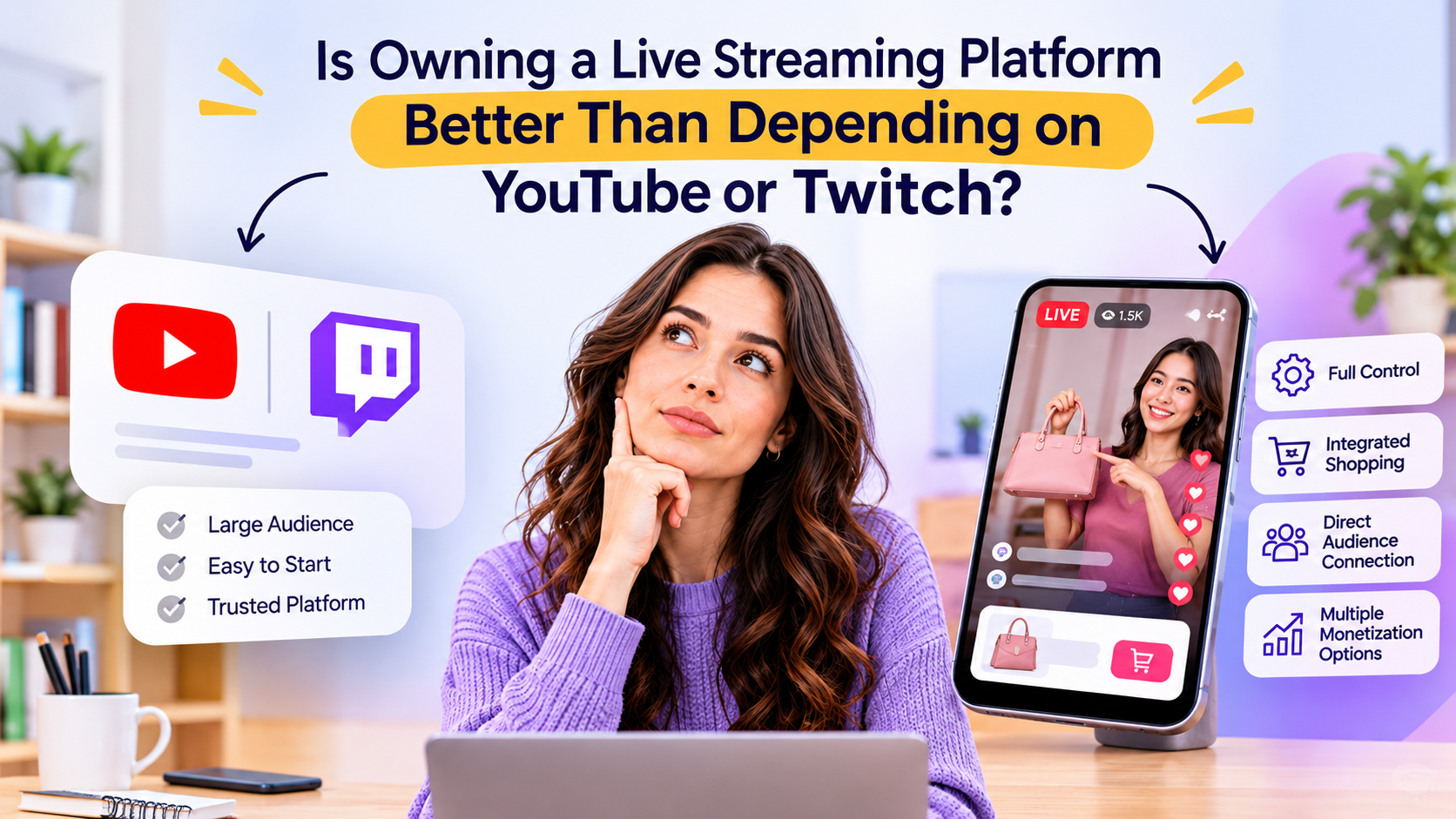
YouTube and Twitch have made live broadcasting accessible to almost anyone. A business can create an account, start streaming, build an audience, and interact with viewers without investing in its own infrastructure. For many creators and small businesses, this is a practical way to get started.
However, as businesses grow, their requirements can change. They may want more control over their audience, different monetization options, customized viewing experiences, or the ability to connect streaming directly with their products and services. This is where the conversation around live streaming shopping app development becomes relevant, particularly for businesses exploring their own digital platforms.
Owning a streaming platform might sound like a natural next step, but it also introduces responsibilities that businesses do not necessarily face when using established services.
So, is building an independent platform actually better, or are YouTube and Twitch still the smarter choices?
1. The Difference Between Using a Platform and Owning One
The biggest difference comes down to control.
When a business streams through YouTube or Twitch, it operates within an environment designed and managed by another company. The platform determines many aspects of the experience, including available features, content policies, monetization requirements, and the way viewers discover broadcasts.
An independently owned platform gives businesses more flexibility in deciding how their streaming environment should operate.
For example, a fashion retailer might want viewers to watch a product demonstration, ask questions, explore different product variations, and purchase an item without navigating away from the broadcast.
This is one situation where live streaming shopping app development can support a more connected experience. Instead of treating video streaming and ecommerce as separate activities, businesses can bring them together within one application.
However, ownership does not automatically mean better performance. A business must also consider development costs, maintenance, infrastructure, security, and the resources required to manage the platform.
2. What Businesses Gain From Third-Party Streaming Platforms
There are good reasons why businesses continue to use YouTube and Twitch.
Both platforms already have established audiences, familiar interfaces, and streaming infrastructure. Businesses do not need to build everything from the beginning.
Some important advantages include:
Existing audience discovery
People already visit these platforms to watch gaming streams, educational content, product reviews, interviews, and entertainment. Businesses can potentially reach viewers who have never interacted with their brands before.
Lower initial investment
Starting a channel generally requires fewer resources than developing and maintaining an independent streaming application.
Familiar user experience
Most viewers understand how to subscribe, comment, share broadcasts, and interact with streamers. There is less need to introduce users to an entirely new platform.
Established streaming infrastructure
Businesses can use existing broadcasting and video delivery capabilities instead of managing the entire streaming infrastructure themselves.
For companies testing whether live video is suitable for their audience, these advantages can make third-party platforms a sensible starting point.
3. Where Third-Party Platforms Can Become Limiting
The same convenience that makes established platforms attractive can also create limitations as a business grows.
A company may have a specific idea for its streaming experience, but the available platform features might not support every requirement.
Consider a few situations:
-
A retailer wants to display product availability directly beside a live broadcast.
-
An educational company wants to create private streaming sessions for registered members.
-
A fitness business wants to combine live classes with membership subscriptions.
-
A brand wants to customize its interface instead of using a standard video platform layout.
-
An entertainment business wants greater control over its subscription and content distribution model.
These requirements may need additional tools, integrations, or workarounds when using an external platform.
There is also the question of platform dependency. Businesses must operate within the service's policies and available features. Changes to those policies or monetization arrangements can affect how they reach and serve their audiences.
This does not mean third-party platforms are unsuitable. It simply means their capabilities may not match every business model.
4. Does Owning a Platform Give Businesses Better Audience Control?
Audience ownership is often one of the strongest reasons businesses consider independent streaming applications.
On third-party platforms, businesses build communities within an environment they do not control. They can interact with viewers, but the overall relationship remains connected to the platform's ecosystem.
An independent application can provide more direct ways to manage user accounts, subscriptions, preferences, and customer communication, subject to privacy regulations and user consent.
For instance, a company running paid educational broadcasts could create different membership levels. Viewers might receive access to specific sessions depending on their subscription.
Similarly, a retailer could offer registered customers early access to product demonstrations or exclusive shopping events.
The advantage is not simply having more user information. It is being able to design the relationship around the business's actual requirements.
However, there is an important trade-off: an independent platform does not automatically attract viewers. Businesses must invest in marketing, community development, and customer retention to encourage people to use it.
5. Monetization Looks Different on an Independent Platform
Revenue generation is another area where ownership can make a difference.
Third-party platforms offer established monetization options, but eligibility requirements, revenue-sharing arrangements, and available features vary.
An independently owned platform allows a business to explore monetization models that are more closely connected to its services.
Depending on the application, these could include:
-
Monthly or annual subscriptions.
-
Pay-per-view access to selected broadcasts.
-
Premium memberships.
-
Ticketed live events.
-
Product purchases during live sessions.
-
Exclusive content for registered customers.
-
Brand partnerships and sponsored sessions.
For example, a beauty retailer could organize paid expert sessions, offer product bundles during broadcasts, and provide exclusive demonstrations to subscribed customers.
A business can design these revenue models around its own audience instead of relying entirely on the monetization options offered by an external service.
Still, payment processing, refunds, subscription management, taxes, and transaction security need proper planning. Having control over monetization also means taking responsibility for these operations.
6. Why Some Businesses Consider a White Label Shopping App
Not every company wants to develop an entire application from the ground up.
Some businesses prefer a solution that provides an existing foundation while allowing customization according to their brand and operational needs.
This is where a white label shopping app can become relevant.
A white-label solution can provide a starting point for businesses that want to introduce their own branded shopping experience without building every component independently.
For businesses interested in combining commerce with video, the application may need capabilities such as:
-
Live video broadcasting.
-
Product catalogues and shopping categories.
-
Integrated shopping carts.
-
Customer accounts and order management.
-
Payment gateway connectivity.
-
Real-time audience interaction.
-
Product and inventory synchronization.
The exact features depend on the underlying solution. Businesses should examine how much customization is possible, whether the source code is accessible, what integrations are supported, and who is responsible for updates and maintenance.
A white-label product is not necessarily a complete replacement for custom development. Its suitability depends on how closely its existing capabilities match the business requirements.
7. When Does Building an Independent Streaming Platform Make Sense?
Owning a platform is not the right decision for every business. The investment becomes more reasonable when an organization has requirements that cannot be addressed efficiently through existing services.
Some situations where an independent platform may be worth considering include:
Established audience: A business already has customers or a community that it can encourage to use a dedicated application.
Specialized functionality: The streaming experience requires features that are not readily available through third-party platforms.
Multiple revenue streams: The company wants to combine subscriptions, product sales, premium content, and paid events.
Brand experience: The business needs complete control over its interface, navigation, and customer journey.
Long-term expansion: Streaming is becoming an important part of its business model rather than an occasional marketing activity.
For example, a company planning to develop a live commerce ecosystem may eventually need an application where video broadcasting, product discovery, customer interaction, and checkout work together.
Companies such as Triple Minds work in the application development space, including solutions for businesses exploring customized and white-label digital platforms. The important consideration for any business is whether the proposed development approach fits its actual operational needs.
8. A Hybrid Approach Could Be More Practical
There is another option that businesses sometimes overlook: they do not necessarily have to choose between third-party streaming and owning a platform.
A hybrid approach can allow companies to use established platforms for audience discovery while developing their own digital environment for specific customer experiences.
For example, a retailer could:
-
Publish product-related live content on YouTube to reach new audiences.
-
Direct interested customers to its own shopping application.
-
Host exclusive product sessions within its independent platform.
-
Offer registered customers personalized shopping experiences.
-
Build a direct relationship with returning buyers.
This approach allows businesses to benefit from existing audience networks while gradually developing their own customer ecosystem.
It can also reduce the pressure to attract a large audience to a newly launched application immediately.
The main challenge is maintaining a consistent experience across different channels and ensuring that customers understand where to find particular content and services.
9. So, Which Option Should a Business Choose?
The decision depends on what the business wants to achieve.
YouTube and Twitch are useful when the primary objective is broadcasting content, reaching existing audiences, and testing viewer interest without taking on the responsibility of operating an independent platform.
Owning a platform becomes more attractive when businesses need customized functionality, direct customer relationships, specialized monetization, and greater control over the overall experience.
A hybrid model may offer the most practical route for companies that want to maintain their existing audience channels while gradually developing independent capabilities.
There is no universal winner. The right approach depends on audience size, available investment, business objectives, technical requirements, and long-term plans.
Final Thoughts
Owning a live streaming platform is not automatically better than depending on YouTube or Twitch. Established platforms offer convenience, existing audiences, and infrastructure that would otherwise require significant investment.
However, businesses with specialized requirements may eventually find that operating within another company's ecosystem limits their ability to create the experience they want.
The important question is not simply whether a business should own its streaming platform. It is whether the additional control, flexibility, and revenue opportunities justify the cost and responsibility of maintaining one.
For some companies, an existing platform will remain the most practical option. For others, independent or hybrid streaming may provide a better foundation for long-term growth.
 Spanish
 English
 Arabic
 French
 Portuguese
 Deutsch
 Turkish
 Dutch
 Italiano
 Russian
 Romaian
 Portuguese (Brazil)
 Greek