


Why Choose Sociology as an Optional Subject for UPSC CSE 2027? A Complete Guide by IAS Gurukul
Choosing the right optional subject is one of the most important decisions in the UPSC Civil Services Examination. The optional subject carries 500 marks in the Mains examination, making it an important part of a candidate's overall preparation strategy. Among the available subjects, Sociology has become a popular choice for aspirants from different academic backgrounds because it provides an opportunity to understand society, human behaviour, social institutions and contemporary social changes.
However, selecting an optional subject should not be based only on popularity or the experiences of successful candidates. Aspirants must consider their interests, learning preferences, understanding of the syllabus and ability to develop analytical answers.
Sociology Optional for UPSC CSE 2027 offers a structured way to study social relationships, inequality, culture, development, family, religion, caste and social transformation. It also provides useful connections with General Studies, particularly Indian Society and social justice-related topics.
For candidates seeking systematic guidance, IAS Gurukul offers specialised Sociology Optional programmes under the guidance of Pranay Aggarwal. The institute focuses on conceptual clarity, comprehensive syllabus coverage, contemporary examples and answer-writing development.
This article explains why Sociology can be a suitable optional subject, what aspirants should consider before selecting it and how structured guidance can support their preparation.
1. What Makes Sociology an Important Optional Subject for UPSC?
Sociology is the scientific and systematic study of society, social relationships, institutions and patterns of human interaction.
It examines how individuals behave within society, how institutions influence human lives and how social structures change over time.
Unlike subjects that focus mainly on a particular historical period, geographical region or technical discipline, Sociology provides tools to understand different dimensions of everyday social life.
Some important areas include:
-
Caste and class structures.
-
Gender relations and inequality.
-
Family, marriage and kinship.
-
Religion and social institutions.
-
Rural and urban communities.
-
Social movements.
-
Poverty and social exclusion.
-
Globalisation and development.
-
Migration and demographic changes.
-
Social mobility and transformation.
These topics are relevant to understanding Indian society and contemporary social developments.
For UPSC aspirants, Sociology offers an opportunity to analyse social issues through established theories and concepts rather than relying only on general observations.
Candidates can explore Why Choose Sociology Optional at IAS Gurukul to learn more about the subject and the institute's approach to Sociology preparation.
2. Sociology Is Accessible to Candidates from Different Academic Backgrounds
One of the reasons aspirants consider Sociology is that it does not require a specific undergraduate degree.
Candidates from engineering, medicine, commerce, science, management, humanities and other academic backgrounds can study the subject.
Although Sociology introduces specialised terminology and theoretical perspectives, beginners can gradually develop an understanding of its concepts through systematic learning.
For example, a student from an engineering background may initially be unfamiliar with concepts such as social stratification, structural functionalism or symbolic interactionism.
However, with proper explanations and regular revision, these concepts can become easier to understand.
Some of the foundational questions studied in Sociology include:
-
What is society?
-
How do social institutions function?
-
Why does social inequality exist?
-
How do individuals interact with groups?
-
What causes social change?
-
How do economic and political structures influence society?
A beginner-friendly teaching approach can help students understand these questions before moving towards advanced sociological theories.
IAS Gurukul focuses on conceptual clarity and structured teaching to support aspirants from different academic backgrounds.
3. Sociology Optional Has Useful Connections with General Studies
One important consideration while choosing an optional subject is its relationship with the General Studies syllabus.
Sociology has meaningful connections with several areas of UPSC General Studies, especially General Studies Paper I.
Indian Society is an important part of GS Paper I, and many Sociology topics provide additional conceptual understanding of social issues.
Consider these examples:
| Sociology Optional Topic | Related General Studies Area |
|---|---|
| Caste system | Indian Society and social inequality |
| Gender relations | Women-related issues and social justice |
| Urbanisation | Urban development and migration |
| Poverty | Inclusive growth and social justice |
| Social movements | Society and contemporary developments |
| Globalisation | Economic and social changes |
| Population dynamics | Demographic challenges |
| Family and marriage | Indian social institutions |
| Tribal communities | Vulnerable sections and development |
| Education | Human development and social change |
For example, when preparing the topic of gender inequality in Sociology, candidates can also develop a deeper understanding of women's participation in the workforce, social empowerment, education and institutional discrimination.
Similarly, studying urbanisation can help aspirants understand migration, urban poverty, housing challenges and the transformation of family structures.
However, candidates should remember that overlap does not mean both subjects require identical preparation. Sociology Optional demands deeper engagement with thinkers, theories and sociological perspectives.
4. Understanding the Sociology Optional Syllabus
Before selecting Sociology, candidates should examine its complete syllabus and understand the requirements of both papers.
The UPSC Sociology Optional examination consists of two papers carrying 250 marks each.
Paper I – Fundamentals of Sociology
Paper I introduces the discipline and its theoretical foundations.
Major syllabus areas include:
A. Sociology as a Discipline
-
Modernity and the emergence of Sociology.
-
Sociology and other social sciences.
-
Scope of Sociology.
B. Sociology as Science
-
Scientific methods.
-
Objectivity and value neutrality.
-
Research methods and techniques.
C. Sociological Thinkers
-
Karl Marx.
-
Emile Durkheim.
-
Max Weber.
-
Talcott Parsons.
-
Robert K. Merton.
-
G.H. Mead.
D. Stratification and Mobility
-
Social inequality.
-
Caste, class and gender.
-
Social mobility.
E. Major Social Institutions
-
Work and economic life.
-
Politics and society.
-
Religion and society.
-
Family, marriage and kinship.
F. Social Change
-
Theories of social change.
-
Development and modernisation.
-
Globalisation and social transformation.
Paper II – Indian Society: Structure and Change
Paper II focuses on the historical development, institutions and contemporary transformation of Indian society.
Important areas include:
-
Perspectives on Indian society.
-
Colonialism and its impact.
-
Rural and agrarian social structures.
-
Caste and social classes.
-
Tribal communities.
-
Family and kinship.
-
Religion and society.
-
Social movements.
-
Population dynamics.
-
Development and globalisation.
-
Challenges of social transformation.
The two papers should not be prepared as completely separate subjects. Understanding the relationship between theoretical perspectives and Indian social realities can improve the quality of answers.
Candidates can access the UPSC Sociology Optional Previous Year Question Papers to understand how these topics are tested in the actual examination.
5. The Importance of Sociological Thinkers in UPSC Preparation
Sociological thinkers form an important foundation of Paper I. Their theories provide different ways to understand social institutions, economic relationships, power structures and social transformation.
Aspirants should study the following thinkers carefully.
Karl Marx
Marx examined the relationship between economic structures, class relations and social change. His concepts include historical materialism, class struggle, alienation and modes of production.
Emile Durkheim
Durkheim focused on social facts, solidarity, division of labour, religion and suicide. His work helps explain how society influences individual behaviour.
Max Weber
Weber examined social action, authority, bureaucracy, power and the relationship between religion and economic development.
Talcott Parsons
Parsons developed structural functionalist perspectives and examined how different parts of society contribute to maintaining social order.
Robert K. Merton
Merton introduced concepts such as manifest functions, latent functions, dysfunctions and middle-range theories.
G.H. Mead
Mead's work on symbolic interactionism explains how the self develops through social interaction.
Understanding these thinkers requires more than memorising their definitions. Candidates should study their arguments, criticisms, applications and relevance to contemporary society.
IAS Gurukul provides Sociology Optional Demo Lectures that allow aspirants to explore selected topics and understand the teaching approach.
6. How Sociology Helps in Understanding Contemporary Indian Society
One of the interesting aspects of Sociology is its ability to connect academic theories with real-world developments.
Indian society is constantly changing due to education, urbanisation, industrialisation, migration, technology and globalisation.
Sociology provides a framework to examine these changes.
Caste and Social Transformation
The caste system has undergone significant changes due to education, urbanisation, political participation and economic mobility. However, caste continues to influence different aspects of social life.
Changing Family Structures
Urbanisation, migration, women's employment and changing lifestyles have influenced family relationships and household structures.
Gender and Society
Sociological perspectives help examine patriarchy, gender inequality, women's empowerment and changing gender roles.
Urbanisation and Migration
The expansion of cities creates new employment opportunities but also raises questions about housing, inequality, informal employment and social integration.
Globalisation
Globalisation affects cultural practices, employment, consumption patterns, family relationships and social institutions.
Candidates who understand these developments can use contemporary examples to make their Sociology answers more analytical and relevant.
7. Why Structured Sociology Coaching Can Help Aspirants
Self-study is an important part of UPSC preparation. However, some candidates may need additional academic support to understand complex theories, organise the syllabus and develop answer-writing skills.
Structured coaching can provide a systematic learning environment.
The important aspects to evaluate before selecting Sociology coaching include:
-
Faculty experience and teaching approach.
-
Complete Paper I and Paper II coverage.
-
Conceptual explanations.
-
Study materials and notes.
-
Current affairs integration.
-
Doubt-clearing support.
-
Answer-writing practice.
-
Test evaluation and feedback.
IAS Gurukul offers UPSC Sociology Courses Online and Offline, designed for candidates seeking structured preparation under Pranay Aggarwal.
The available learning formats include classroom, live online and recorded or flexible learning options, depending on the programme and batch.
8. Learn Sociology Optional Under the Guidance of Pranay Aggarwal
Faculty guidance is an important consideration when selecting an optional-subject coaching programme.
Sociology includes abstract concepts, different theoretical perspectives and interconnected syllabus areas. Students benefit from explanations that make difficult ideas easier to understand.
At IAS Gurukul, Sociology Optional courses are guided by Pranay Aggarwal, who has more than 15 years of experience mentoring civil services aspirants.
His teaching approach focuses on:
-
Simplifying complex sociological theories.
-
Building conceptual understanding.
-
Connecting Paper I and Paper II.
-
Explaining thinkers and their contributions.
-
Linking contemporary developments with the syllabus.
-
Improving examination-oriented answer writing.
Candidates can explore the Pranay Aggarwal Faculty Profile to learn more about his teaching experience.
The IAS Gurukul Sociology FAQ section also addresses common questions regarding subject selection, teaching methodology, courses and preparation.
9. How to Decide Whether Sociology Is the Right Optional for You
Selecting Sociology should be a considered decision rather than a trend-based choice.
Before finalising the subject, aspirants should evaluate the following factors.
Personal Interest: Are you interested in understanding society, human behaviour, social institutions and contemporary issues?
Syllabus Understanding: Have you examined both papers and understood the major topics?
Theoretical Learning: Are you comfortable studying thinkers, theories and academic concepts?
Analytical Ability: Can you explain social issues using different perspectives rather than simply describing them?
Writing Skills: Are you willing to practise structured and analytical answers?
Availability of Guidance: Do you have access to suitable study materials, faculty guidance and evaluation support?
Candidates should also watch introductory lectures and examine previous year questions before making a final decision.
The objective is to select a subject that matches individual interests and preparation requirements.
10. Strengthen Your Preparation with Previous Year Questions and Test Series
Previous year questions are essential for understanding the actual requirements of the UPSC examination.
IAS Gurukul's PYQ resource provides access to 13 examination years and more than 706 questions covering both Sociology papers.
Candidates can use these questions to identify recurring themes, understand question demands and practise analytical writing.
Visit the Sociology Optional Question Paper Resource for year-wise question papers.
After completing the syllabus, candidates should also practise under examination conditions.
The Sociology Optional Test Series for 70 Days is designed around daily answer-writing practice, sectional tests, full-length tests, detailed evaluation and model answers.
Aspirants should use feedback to identify weaknesses in their conceptual understanding, answer structure, examples and time management.
11. Sociology Optional Classroom Course at IAS Gurukul
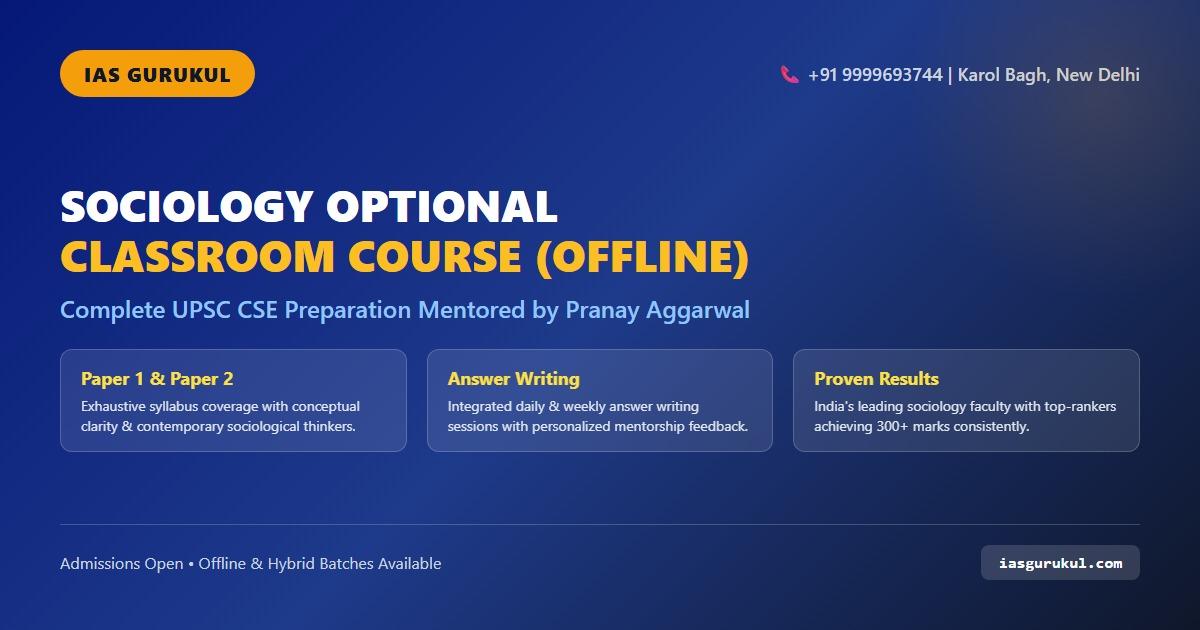
For candidates who prefer structured face-to-face teaching, IAS Gurukul offers the Sociology Optional Classroom Course (Offline).
The listed programme includes the following details:
| Course Detail | Information |
|---|---|
| Course Name | Sociology Optional Classroom Course |
| Faculty | Pranay Aggarwal |
| Listed Start Date | 10 August 2026 |
| Duration | 4.5 Months |
| Offline Fee | ₹54,000 |
| Class Timing | 10:00 AM – 12:30 PM |
| Delivery Mode | Classroom + Live Online Access |
| Validity | Till Mains 2027 |
The course highlights include conceptual clarity, beginner-friendly teaching, comprehensive syllabus coverage, current affairs linkages and regular doubt-clearing support.
The listed batch start date has passed. Candidates interested in joining should confirm current batch availability and admission details directly with the institute.
Explore the IAS Gurukul Sociology Optional Classroom Course for further information.
Conclusion
Sociology can be a suitable optional subject for UPSC CSE aspirants who are interested in understanding society, social institutions and contemporary transformations. Its theoretical foundations, connection with Indian society and relevance to several General Studies topics make it worth considering.
However, success requires dedicated syllabus coverage, an understanding of sociological thinkers, regular revision, contemporary examples and consistent answer-writing practice.
IAS Gurukul provides specialised Sociology Optional preparation under the guidance of Pranay Aggarwal, with an emphasis on conceptual clarity, structured learning and examination-oriented guidance.
Before selecting an optional subject, aspirants should examine the syllabus, understand the nature of questions and assess their personal interest.
For further information about Sociology Optional programmes and preparation resources, visit IAS Gurukul.
Frequently Asked Questions (FAQs)
1. Why should UPSC aspirants choose Sociology as an optional subject?
Sociology can be a suitable choice for aspirants interested in society, social institutions, human behaviour and contemporary social issues. It also has useful conceptual connections with General Studies Paper I, particularly Indian Society.
2. Is Sociology Optional suitable for engineering and science students?
Yes. Sociology does not require a specific graduation background. Engineering, science, commerce and other graduates can study the subject by developing an understanding of its basic concepts, theories and terminology.
3. How many papers are there in UPSC Sociology Optional?
There are two papers, Paper I and Paper II, carrying 250 marks each. Paper I covers the fundamentals of Sociology, while Paper II focuses on Indian society, its structure and transformation.
4. Who teaches Sociology Optional at IAS Gurukul?
Sociology Optional courses at IAS Gurukul are guided by Pranay Aggarwal, who has more than 15 years of experience mentoring civil services aspirants.
5. Does Sociology Optional overlap with General Studies?
Yes. Sociology has useful connections with General Studies Paper I, especially Indian Society. Topics such as caste, gender, urbanisation, migration, globalisation and social change are relevant to both areas, although their depth and examination requirements differ.
6. How can students improve their Sociology Optional answer writing?
Students should practise previous year questions, use relevant sociological thinkers, connect theories with contemporary examples, develop structured arguments and attempt sectional and full-length tests. Regular evaluation can help identify areas for improvement.
 Deutsch
 English
 Arabic
 French
 Spanish
 Portuguese
 Turkish
 Dutch
 Italiano
 Russian
 Romaian
 Portuguese (Brazil)
 Greek