


Why High Ranking Pages Lose Traffic Even When Nothing Looks Broken
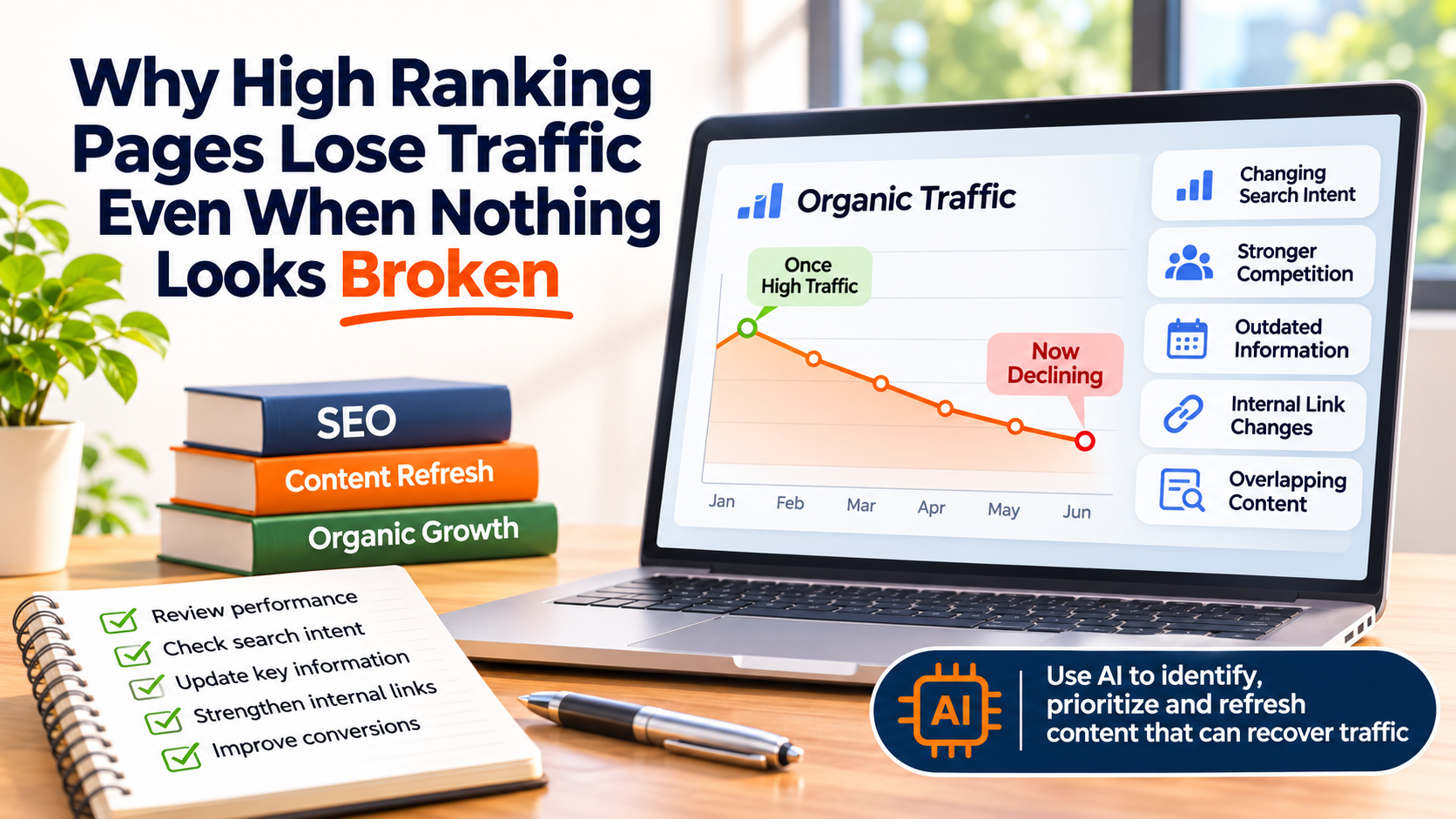
Why High Ranking Pages Lose Traffic Even When Nothing Looks Broken
A page can rank well for months and then slowly begin losing traffic.
No technical error appears.
The URL still works.
The content is still indexed.
The page may even look exactly the same as it did when performance was strong.
That does not mean nothing changed.
Search results move because competitors improve, search intent shifts, new questions appear, internal links change, and older information becomes less useful.
A structured approach to AI Powered SEO Services should therefore include regular review of existing pages, not only the production of new content.
The first question should be simple.
Is the page still the best answer for the searches bringing people to it?
Start With the Traffic Decline
Do not rewrite the page immediately.
First identify what changed.
Review:
-
Organic clicks
-
Impressions
-
Average position
-
Search queries
-
Conversion activity
A decline in clicks can have several causes.
Rankings may have fallen.
Search demand may have changed.
The page may still rank, but users may be choosing other results.
Each situation requires a different response.
Compare Current Queries With Older Queries
A page may start attracting searches that were not important when the content was created.
Search Console can reveal whether the query mix has changed.
For example, a page originally written around implementation may now receive impressions for migration, integration, pricing, or comparison terms.
If those topics are missing from the page, competitors may provide a more complete answer.
Updating the content around real search behavior can improve relevance.
Review the Search Results Again
Search intent is not permanent.
A keyword that once returned blog articles may now show:
-
Service pages
-
Product pages
-
Comparison pages
-
Videos
-
Forums
-
Local results
If the dominant result type changes, the existing page may no longer match what searchers expect.
Before refreshing content, review the current search results.
The page format may matter as much as the copy.
Check Whether Competitors Improved
Ranking losses can happen because another page became better.
Compare competing pages for:
-
Topic coverage
-
Original examples
-
Useful tools
-
Better structure
-
Stronger internal links
-
Updated information
-
Clearer commercial relevance
The goal is not to copy competitors.
The goal is to understand what users now receive elsewhere.
Look for Outdated Information
Older content can lose value gradually.
Review:
-
Statistics
-
Product features
-
Screenshots
-
Pricing references
-
Regulations
-
Recommendations
-
External links
-
Examples
Outdated information can weaken trust even when the main topic remains relevant.
Refresh only what genuinely needs updating.
Do Not Rewrite What Already Works
One common mistake is replacing the entire article.
That can remove sections already performing well.
Use search and analytics data to identify:
-
Strong sections
-
Weak sections
-
Missing topics
-
Declining queries
Preserve useful content.
Improve the parts that no longer match the search opportunity.
Check Internal Links
A page may lose support when website structure changes.
Perhaps older articles linking to it were removed.
Maybe new content was published without linking back.
Review which internal pages currently support the URL.
Add relevant contextual links from:
-
Related articles
-
Service pages
-
Resource pages
-
Case studies
-
Category pages
Internal linking helps both users and search engines understand which pages matter.
Look for Keyword Cannibalization
Sometimes the traffic did not disappear.
Another page began competing for the same searches.
Check whether several URLs target similar intent.
Possible solutions include:
-
Consolidating overlapping content
-
Repositioning one page
-
Improving internal links
-
Redirecting outdated pages
Publishing another similar article can make the problem worse.
Review Conversion Performance
A page may lose traffic while still generating valuable leads.
Another page may gain traffic without creating any business result.
Do not judge refresh priorities only by visits.
Track:
-
Forms
-
Calls
-
Demo requests
-
Purchases
-
Qualified leads
Commercial performance should influence which pages receive attention first.
Create a Content Decay Score
Large websites need a practical way to prioritize updates.
A simple score can include:
Traffic decline
How much organic traffic has fallen.
Ranking decline
How many important terms lost position.
Business value
How important the page is for leads or revenue.
Content age
How long since the last meaningful update.
Search opportunity
Whether the page still has realistic ranking potential.
Pages with strong commercial value and visible decline should usually receive attention first.
Use AI to Review Large Content Libraries
AI can help organize large sets of pages by:
-
Topic
-
Search intent
-
Content age
-
Similarity
-
Missing subtopics
-
Declining performance
This can help SEO teams find refresh opportunities faster.
Human review should still decide whether a page should be updated, merged, redirected, or left alone.
Refresh With a Clear Goal
Every content update should have a reason.
Examples include:
-
Recover lost rankings
-
Match changed search intent
-
Improve conversion
-
Add missing topics
-
Remove outdated information
-
Strengthen internal linking
-
Consolidate competing pages
A refresh should solve a specific problem.
Measure What Changed
After updating the page, track:
-
Search impressions
-
Clicks
-
Rankings
-
Organic sessions
-
Conversions
Compare performance over time.
Some pages recover quickly.
Others may require stronger internal links, better authority, or a different page format.
Content Maintenance Is Part of SEO
Publishing new content is only one part of organic growth.
Existing pages already have history, links, rankings, and search data.
That makes them valuable assets.
When those pages begin losing visibility, the answer is not always to create something new.
Sometimes the stronger move is to understand why performance changed and improve the page around current search behavior.
That is how content maintenance becomes an ongoing part of SEO growth rather than an occasional cleanup task.
 French
 English
 Arabic
 Spanish
 Portuguese
 Deutsch
 Turkish
 Dutch
 Italiano
 Russian
 Romaian
 Portuguese (Brazil)
 Greek