


Why Specifiers Are Choosing WPC Wall Panels for Moisture-Prone Interiors
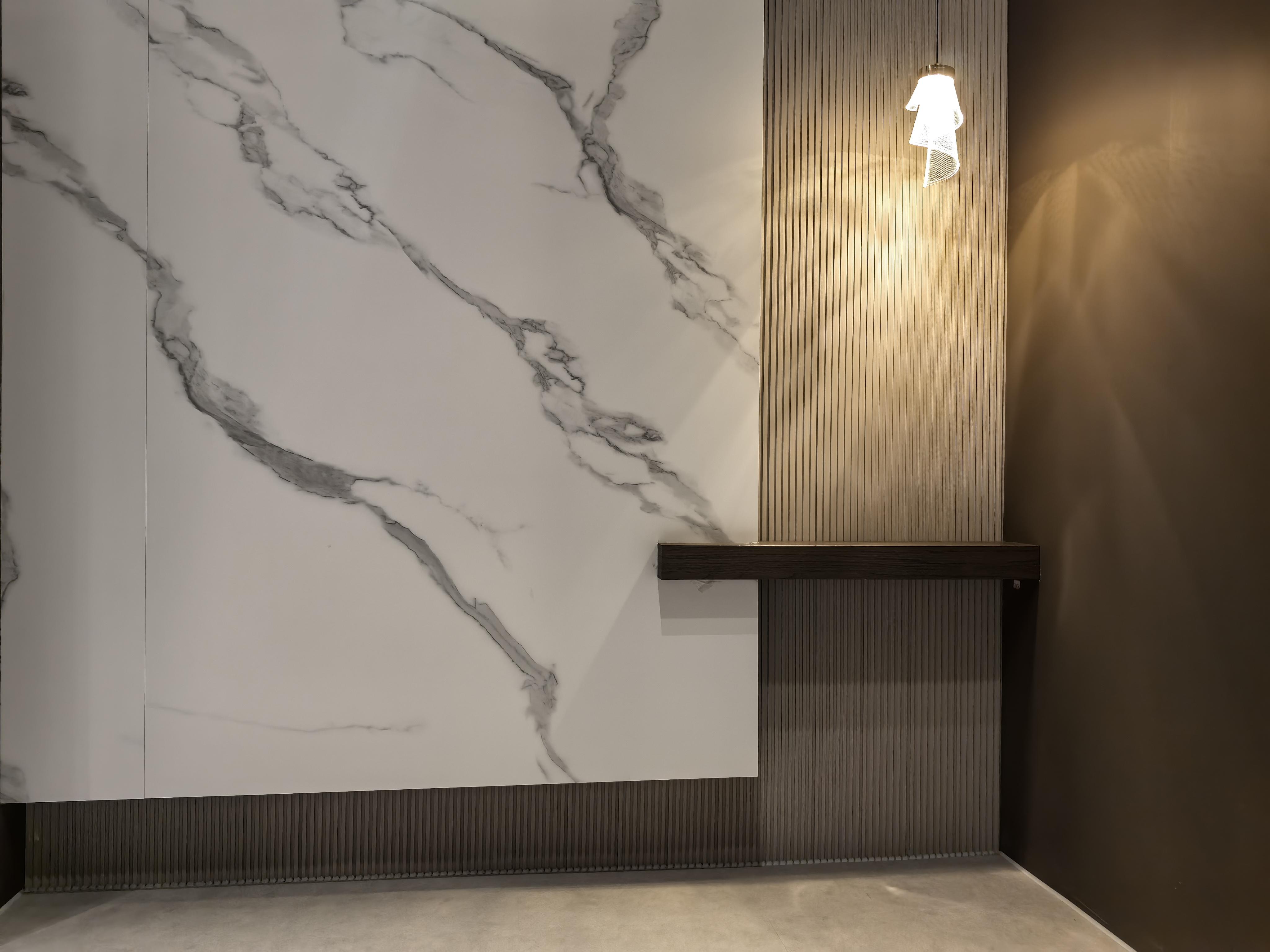
Anyone who has specified real timber cladding in a bathroom, kitchen, or busy hotel corridor knows the pattern: it looks superb on day one, then slowly reveals its weaknesses. Moisture creeps in, edges swell, boards cup and warp, and the maintenance schedule fills up. Interior WPC (wood-plastic composite) wall panels were developed to solve precisely that problem — delivering a natural wood appearance without the vulnerabilities that come with genuine wood.
What WPC Panels Are Made Of
WPC panels are a composite of wood fiber, PVC, and a coupling agent. That combination is the key to the category's appeal: the wood fiber contributes the warmth and texture of a timber finish, while the PVC matrix provides dimensional stability and moisture resistance, and the coupling agent bonds the two phases together so the panel performs as a single, coherent material.
The specification is straightforward. Panels are supplied 1.22 m wide and up to 3.6 m long, with thickness options of 5 mm, 7 mm, 8 mm, 11 mm, and 18 mm. Standard dimensions can be customized for OEM orders, which matters for contractors working to fixed module sizes. Formaldehyde emission is rated E0, and the fire performance is C-s3,d0 — equivalent to GB 8624 B1 — covering the requirements of most commercial and residential interior projects.
The Performance Case
The headline benefits are durability and low maintenance. The panels have passed flexural strength and impact resistance testing, which is meaningful in corridors, lobbies, and retail environments where walls take constant punishment. Thermal conductivity is low at 0.128 W/(m·K), and the material is waterproof and moisture resistant — the attribute that most directly separates WPC from natural timber cladding.
Wood appearance is the other half of the proposition. The surface range covers wood grain, fabric, marble, PET metal, PET mirror, 3D textures, and more, with over 1,000 finishes available. Every finish can be matched to a custom color code for OEM orders, and buyers can send a reference photo to confirm a match before committing. For designers coordinating a palette across a large project, that flexibility is often the deciding factor.
Where Interior WPC Panels Belong
The application list is broad and practical: living room feature walls, bedroom wall decoration, hotel interior wall cladding, office interior wall panels, and both residential and commercial interior wall cladding. In each case, the same logic applies — the panels deliver a wood-look finish in spaces where moisture, traffic, or maintenance access would make real timber a risky specification.
Two Installation Methods, Two Different Logics
WPC panels can be installed in two ways, and the choice should follow the project's priorities rather than installer habit.
The click-lock method is the faster route. Mark level lines on the wall or batten frame, fix the first panel, then slide each tongue into the previous groove. Check alignment every few panels and finish the edges with matching trims. This approach suits fast work and makes later replacement straightforward — a real advantage in commercial settings where individual panels may need to be swapped out.
Adhesive installation produces a more permanent, seamless wall. The wall must be clean, dry, and level; MS polymer or construction adhesive is applied evenly to the panel back, the panel is pressed firmly into place, and the adhesive is left to cure as the manufacturer instructs. This is the better choice where a continuous surface matters more than future access.
Sourcing from the Factory
For importers, distributors, and contractors, the supply details are as important as the product. Huigong has produced these panels in its own Chongqing factory since 2012. Free samples are available: send finish codes, thickness, and address, and the company confirms within 24 hours and ships by express within 7 business days, freight collect. Standard lead time is about 15 days, with custom colors and sizes confirmed against a production schedule at the quotation stage.
Packing is designed for ocean freight — wooden pallet, carton, and corner protectors, available for both FCL and LCL shipments — with DHL, FedEx, or UPS used for sample dispatch. The product carries ISO 9001, CE, SGS, E0, and B1 certifications, which simplifies compliance documentation on the buyer's side.
The Takeaway
WPC wall panels are not trying to be timber. They are trying to be better suited to the places timber struggles — wet rooms, high-traffic corridors, and commercial interiors where maintenance budgets are finite. With E0 emissions, B1 fire performance, a thousand-plus finishes, and two installation methods to match different project needs, they offer a rare combination: the look designers want, with the durability contractors and facility managers actually need.

 English
 Arabic
 French
 Spanish
 Portuguese
 Deutsch
 Dutch
 Italiano
 Russian
 Romaian
 Portuguese (Brazil)
 Greek