


Electrostrictive Materials Market Forecast 2026–2034: Ceramics Maintain Their Leading Position
The growing demand for precision motion control, advanced sensing, and intelligent electronic systems is increasing interest in electrostrictive materials. These smart materials change their shape or dimensions when exposed to an electric field, making them suitable for applications requiring controlled deformation and accurate positioning. Their electromechanical properties are creating opportunities across aerospace, defense, automotive, healthcare, consumer electronics, and industrial automation.
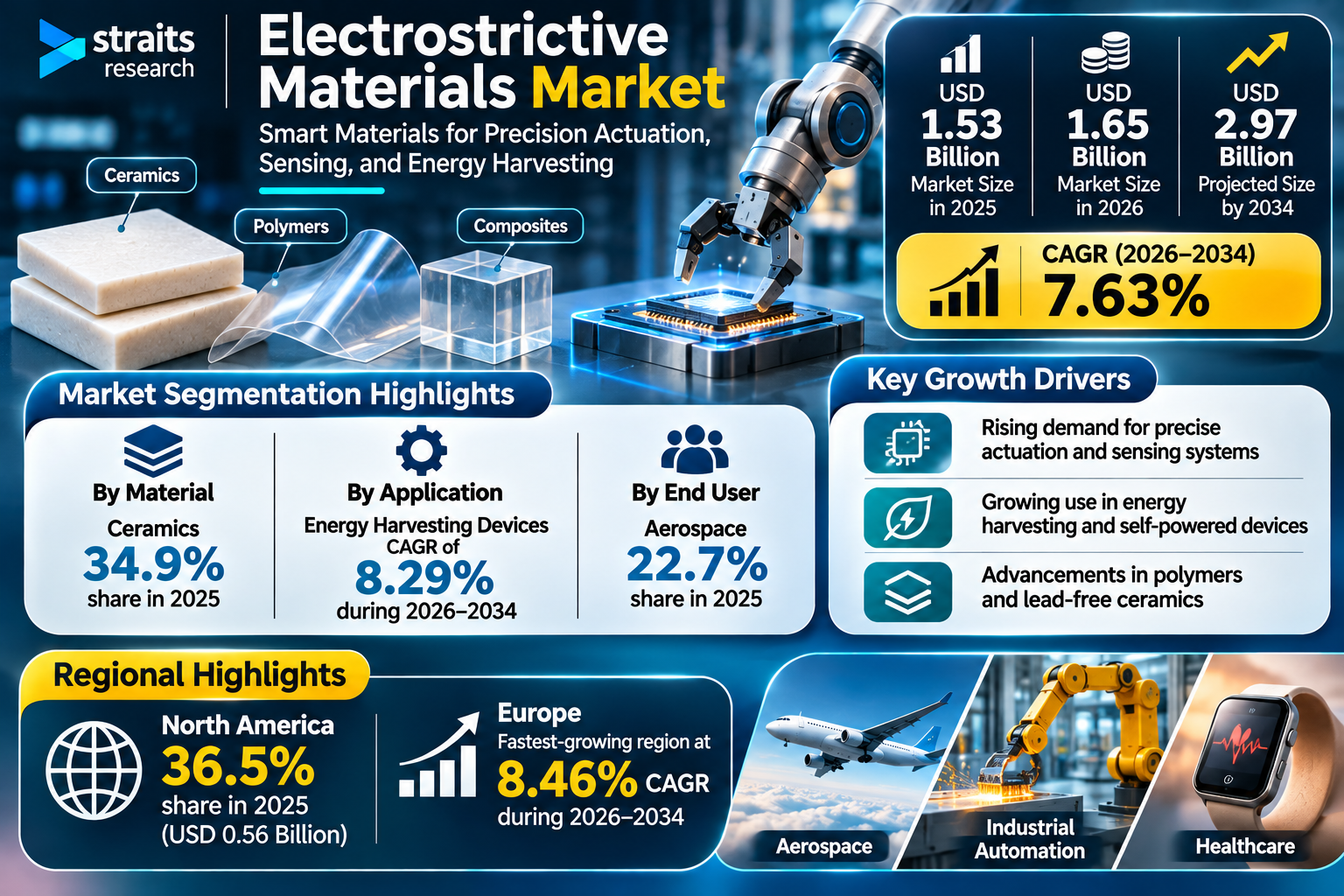
According to Straits Research, the global electrostrictive materials market was valued at USD 1.53 billion in 2025 and is projected to increase from USD 1.65 billion in 2026 to USD 2.97 billion by 2034, registering a CAGR of 7.63% during the forecast period 2026–2034. Increasing investments in advanced functional materials, precision actuators, sensors, and energy-efficient electronic devices are supporting market development.
Precision Actuation Strengthens Demand for Electrostrictive Materials
Electrostrictive materials are increasingly relevant to applications requiring precise movement, controlled deformation, and stable electromechanical responses. Their ability to generate deformation under an applied electric field makes them suitable for micro-positioning systems, optical equipment, sensors, transducers, and advanced actuators. The expansion of robotics, automated manufacturing, and precision electronics is creating additional opportunities for these materials.
The miniaturization of electronic components is also encouraging manufacturers to explore compact materials capable of delivering reliable motion control. Electrostrictive materials can support advanced device architectures where positioning accuracy and controlled movement are important performance requirements.
Advanced Polymers and Lead-Free Ceramics Expand Material Innovation
Material development is increasingly focused on improving electromechanical performance while addressing environmental and processing requirements. Researchers are exploring lead-free ceramic compositions, electroactive polymers, and engineered composites to improve strain response, flexibility, operating stability, and energy efficiency.
These developments are expanding potential applications in soft robotics, wearable electronics, medical devices, and precision actuation. Polymer-based materials offer lightweight construction and flexibility, while advanced ceramics provide strong electromechanical responses and thermal stability. Continued improvements in material composition and manufacturing techniques are expected to broaden commercial opportunities.
Ceramics Maintain Their Leading Position
The ceramics segment accounted for a dominant 34.9% share of the electrostrictive materials market in 2025. Ceramic electrostrictive materials are valued for their strong electromechanical response, thermal stability, and suitability for precision actuation and sensing applications. Their established use in aerospace, defense, industrial equipment, and advanced electronics supports their leading market position.
Research into lead-free ceramic formulations and engineered material compositions is further expanding the segment's potential. Manufacturers are focusing on improving material performance and developing alternatives that address environmental considerations while maintaining the required electromechanical properties.
Energy Harvesting Devices Create New Application Opportunities
Energy harvesting devices are projected to be the fastest-growing application segment, registering a CAGR of 8.29% during 2026–2034. Electrostrictive materials can convert mechanical deformation into electrical energy, creating opportunities for self-powered sensors, wearable electronics, and low-power devices.
The growing interest in autonomous electronic systems is encouraging research into technologies that can reduce dependence on conventional batteries. Electrostrictive materials may support energy harvesting applications in compact monitoring systems and connected devices, creating additional opportunities for material manufacturers.
Aerospace Leads End-User Adoption
The aerospace segment accounted for 22.7% of the market in 2025, making it the leading end-user category. Electrostrictive materials offer compact construction, rapid electromechanical response, and precision capabilities that can support advanced sensing, actuation, vibration control, and structural monitoring systems.
The industry's focus on lightweight components, advanced aircraft technologies, and reliable control systems is supporting demand for high-performance functional materials. Defense, automotive, healthcare, and consumer electronics also represent important application areas as manufacturers explore improved sensing and actuation capabilities.
North America Leads While Europe Records Faster Growth
North America dominated the electrostrictive materials market with a 36.5% share in 2025, representing a market value of USD 0.56 billion. The region benefits from established aerospace and defense industries, advanced electronics manufacturing, and substantial investment in materials science research. Demand for high-performance actuators, sensors, and precision manufacturing technologies is supporting regional market development.
Europe is projected to be the fastest-growing region, registering a CAGR of 8.46% during 2026–2034. Investments in advanced materials, aerospace technologies, industrial automation, automotive electronics, and energy-efficient devices are supporting demand. The region's emphasis on sustainable materials is also encouraging research into lead-free electrostrictive ceramics, polymers, and composites.
Asia Pacific accounted for 24.1% of the global market in 2025, supported by electronics manufacturing, robotics, industrial automation, and automotive electrification. Increasing investment in advanced materials research is creating further opportunities across the region.
Competitive Landscape and Future Outlook
The electrostrictive materials market includes advanced materials manufacturers and technology companies developing electroactive materials, precision actuators, transducers, and positioning systems. Key participants identified in the Straits Research report include Piezo Kinetics, Inc., Harris Corporation, Smart Materials Corp., Noliac A/S, APC International, Mad City Labs, Pi Ceramic, MSI Transducers Corporation, Morgan Technical Ceramics, and Sparkler Ceramics Pvt. Ltd.
Future market development will depend on improvements in material composition, lead-free alternatives, polymer-based electroactive technologies, and precision actuation systems. Growing applications in aerospace, robotics, healthcare, and energy harvesting are expected to create opportunities for specialized material suppliers.
With the market projected to reach USD 2.97 billion by 2034, electrostrictive materials are positioned to support the development of next-generation smart devices and advanced electromechanical systems.
Explore the full report: https://straitsresearch.com/report/electrostrictive-materials-market
About Straits Research
Straits Research is a market intelligence and consulting firm providing industry insights, market sizing, competitive analysis, and strategic research across multiple sectors. Its reports help businesses understand emerging trends, evaluate market opportunities, and make informed decisions.
 Russian
 English
 Arabic
 French
 Spanish
 Portuguese
 Deutsch
 Turkish
 Dutch
 Italiano
 Romaian
 Portuguese (Brazil)
 Greek