


Positive Train Control Market Forecast 2026–2034: High-Speed Rail and Metro Expansion Accelerate Adoption
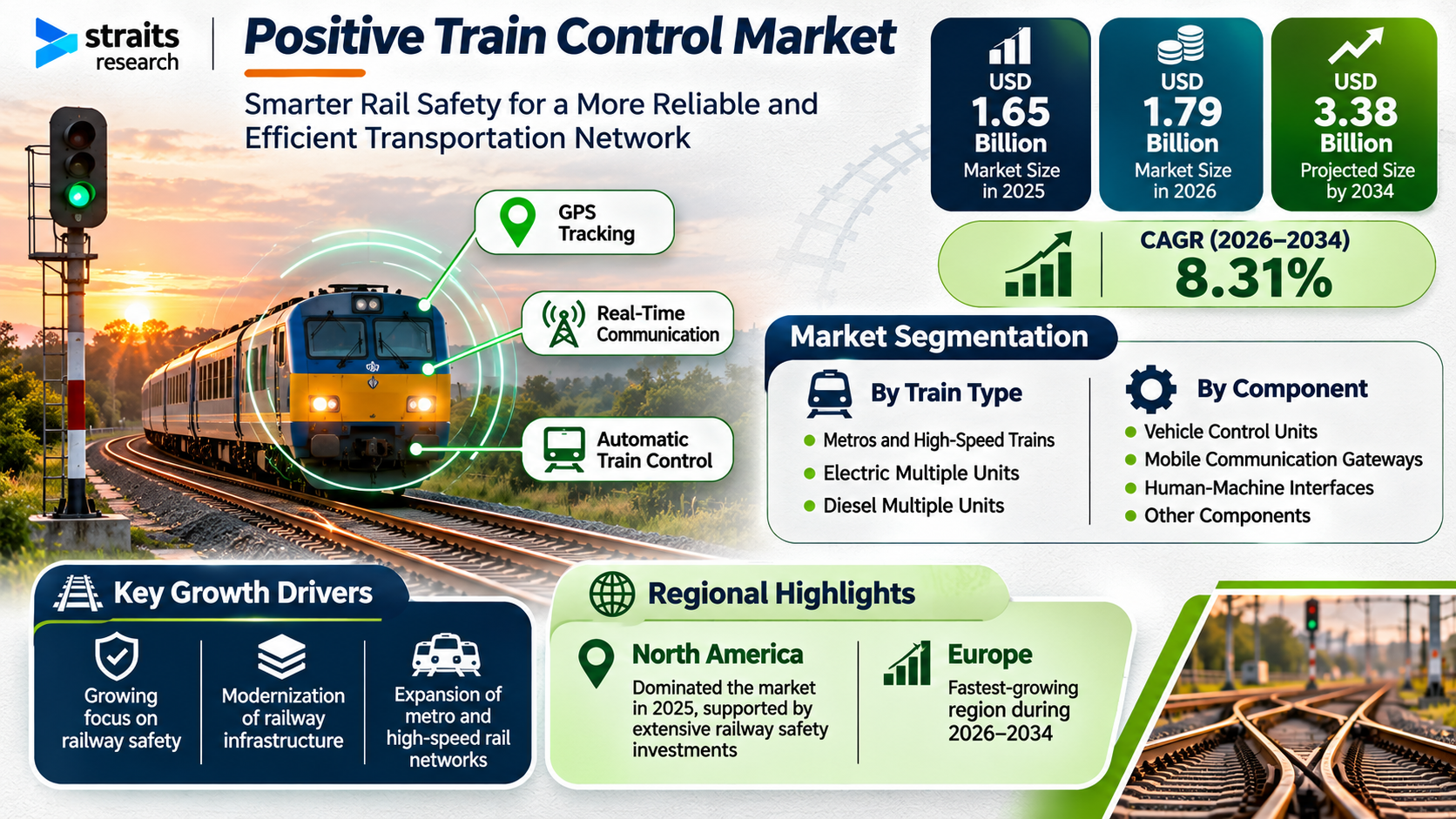
Railway operators are increasingly investing in advanced train control technologies to improve operational safety, prevent accidents, and optimize railway network performance. Positive Train Control (PTC) systems use GPS, wireless communication, and onboard computing technologies to monitor train movements and automatically intervene when necessary. These systems help prevent train collisions, derailments, unauthorized train movements, and speed-related incidents, making them an important component of modern railway safety infrastructure.
According to Straits Research, the global positive train control market was valued at USD 1.65 billion in 2025 and is projected to increase from USD 1.79 billion in 2026 to USD 3.38 billion by 2034, registering a CAGR of 8.31% during the forecast period 2026–2034. Increasing railway infrastructure investments, growing passenger and freight transportation requirements, and modernization of train management systems are supporting market expansion.
Railway Safety Modernization Strengthens Market Demand
The growing emphasis on railway safety is encouraging governments and railway operators to deploy advanced train control technologies. PTC systems continuously monitor train locations, operating speeds, and movement authorities, helping prevent dangerous operating conditions. Their ability to automatically initiate braking when trains exceed permitted speeds or approach restricted sections makes them valuable for reducing operational risks.
Railway modernization programs are also supporting adoption. Governments are investing in upgraded signaling infrastructure, communication networks, and automated safety systems to improve railway reliability. As passenger and freight networks become more complex, integrated train control solutions are gaining importance in railway operations.
Metro and High-Speed Rail Expansion Creates Opportunities
The development of metro and high-speed railway networks is increasing demand for advanced train management and safety technologies. Urbanization and population growth are encouraging governments to expand public transportation infrastructure, particularly in densely populated cities. These projects require reliable signaling and train control systems capable of supporting frequent services and safe operations.
Countries such as India, China, and Japan continue to invest in railway modernization and high-speed transportation. The expansion of electric multiple units and advanced passenger rail networks is creating opportunities for train control technology providers. Interoperability between railway networks is another important consideration as operators seek seamless train movement across different infrastructure systems.
Metros and High-Speed Trains Support Market Applications
The market is segmented by train type into metros and high-speed trains, electric multiple units, and diesel multiple units. Metros and high-speed trains represent an important application area because of their operational speed, passenger capacity, and requirement for reliable safety infrastructure. Advanced train control systems help manage movement authority, monitor speed restrictions, and improve operational coordination.
Electric multiple units also create opportunities as cities expand electrified commuter rail and regional transportation networks. Their increasing use in urban and suburban passenger transportation is strengthening demand for integrated train control technologies. Diesel multiple units remain relevant across regional railway networks where electrification infrastructure is limited.
Communication and Control Components Improve Railway Efficiency
The component segmentation includes vehicle control units, mobile communication gateways, human-machine interfaces, and other components. Vehicle control units process operational information and support onboard train monitoring and control functions. These systems are essential for implementing automatic intervention and maintaining compliance with railway operating restrictions.
Mobile communication gateways enable information exchange between trains and railway infrastructure, supporting real-time monitoring and operational coordination. Human-machine interfaces provide train crews with relevant operational information, alerts, and system notifications. The integration of these components supports reliable communication and coordinated railway safety management.
North America Leads While Europe Records Faster Growth
North America dominated the positive train control market in 2025, supported by established railway infrastructure and extensive investment in railway safety systems. The United States has been an important market for PTC deployment across freight and passenger railway networks. The region's focus on collision prevention, speed enforcement, and infrastructure modernization continues to support demand for train control technologies.
Europe is projected to be the fastest-growing regional market during 2026–2034. Investments in railway interoperability, advanced signaling infrastructure, and automated train control systems are creating opportunities for technology providers. The development and modernization of European railway networks are also supporting demand for integrated safety and communication solutions.
Asia Pacific represents another important market, driven by metro expansion, high-speed rail investments, and railway modernization initiatives across China, India, and Japan. Increasing demand for efficient public transportation and advanced railway infrastructure is creating additional opportunities for PTC suppliers.
Competitive Landscape and Future Outlook
The positive train control market includes railway technology manufacturers and signaling solution providers competing through advanced control systems, communication technologies, safety solutions, and integrated railway infrastructure. Key companies identified in the Straits Research report include Bombardier Inc., Siemens AG, Toshiba Corporation, Mitsubishi Electric Corporation, Wabtec Corporation, Hitachi Ltd., Knorr-Bremse AG, ALSTOM SA, CAF Group, ASELSAN A.Ş., China Railway Signal & Communication Corporation Limited (CRSC), ABB Group, Thales Group, and Quester Tangent.
Future market development will depend on railway safety modernization, high-speed rail expansion, communication infrastructure upgrades, and greater interoperability between railway networks. Improvements in automated train control and real-time monitoring are expected to create opportunities for manufacturers and technology providers.
With the market projected to reach USD 3.38 billion by 2034, positive train control systems will remain an important technology for improving railway safety, operational reliability, and transportation efficiency.
Explore the full report: https://straitsresearch.com/report/positive-train-control-market
About Straits Research
Straits Research is a market intelligence and consulting firm providing industry insights, market sizing, competitive analysis, and strategic research across multiple sectors. Its reports help businesses understand emerging trends, evaluate market opportunities, and make informed decisions.
 Russian
 English
 Arabic
 French
 Spanish
 Portuguese
 Deutsch
 Turkish
 Dutch
 Italiano
 Romaian
 Portuguese (Brazil)
 Greek