


How to Prepare for the C_THR85_2605 Exam Format: A Step-by-Step Strategy for 2027 Candidates
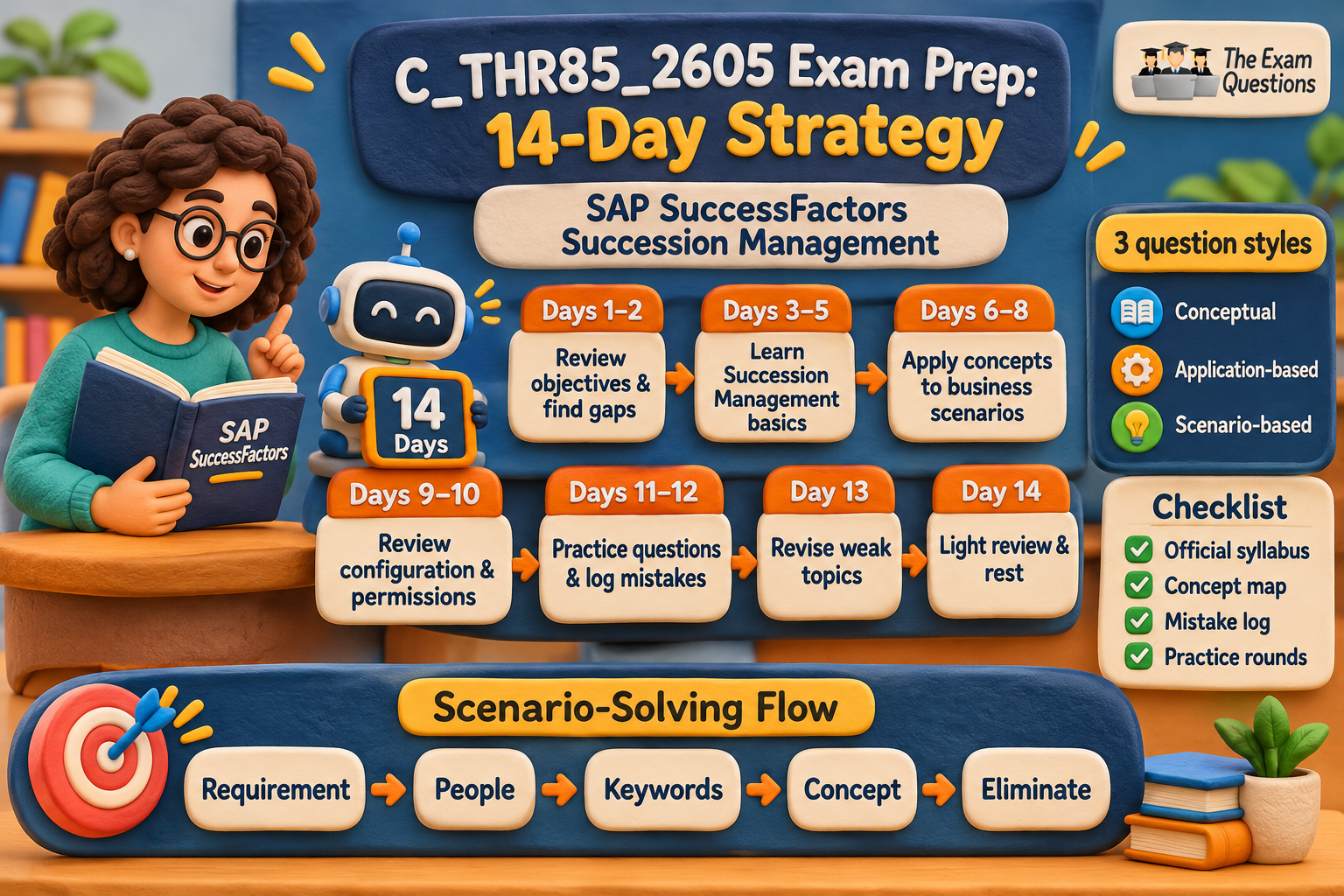
Most candidates open a study guide and start reading topics immediately. It feels productive, but it often wastes the first week. Before you memorize configuration paths, you need to know how the exam asks questions, because that decides how you should study. Understanding the C_THR85_2605 Exam Format is the foundation of a sound exam preparation strategy for the SAP SuccessFactors Succession Management exam. This playbook gives you a 14-day plan, a method for breaking down scenarios, and a way to use SAP practice questions without falling into the memorization trap.
TL;DR
- Check the official certification page first for current topics, structure, and policies. Don’t rely on forum rumors.
- Follow the 14-day suggested schedule below and adjust it to your own gaps.
- Practice three question styles: conceptual, application-based, and scenario-based.
- Use practice questions to find weaknesses, not to memorize answers.
- Finish with targeted SAP exam revision and the checklist at the end.
What Should Candidates Understand About C_THR85_2605 Before Beginning Preparation?
C_THR85_2605 is the code for the SAP Certified Associate certification in SAP SuccessFactors Succession Management. As an associate-level certification assessment, it checks whether you understand the solution and can apply it to realistic business situations. Reciting menu names is not enough.
Candidates are generally expected to know talent processes such as succession planning and talent reviews, and to understand how the solution is set up and used. The code’s suffix normally points to the release the exam content aligns with, so confirm the current version on the official page. This article deliberately does not state exam duration, question counts, or passing scores. Those details should come only from SAP, and you should check them before you book.
Why Review the Official Exam Structure, Syllabus, and SAP Learning Resources?
The official certification page is the only dependable source for topic areas, their weightings, and exam policies. Copy the topic list and treat it as your study contract: every study hour should map to a listed area. Heavier areas deserve more time, but lighter areas still need coverage, since a weak spot there can still cost you points.
Pair that topic list with SAP’s own learning content and product documentation, so your understanding comes from the source rather than second-hand summaries. Use third-party material only as a supplement, and verify any claim that sounds oddly specific.
Your 14-Day C_THR85_2605 Exam Format Preparation Plan
This is a suggested study schedule, not an official SAP preparation timeline. Stretch or compress it based on your experience and available hours.
Days 1–2: Understand the objectives and identify knowledge gaps. Read the official topic list and rate each area red, amber, or green based on honest confidence. Open the SAP certification resource and note the listed areas and any recommended learning. Write your weak spots in a notebook. That becomes your priority list.
Days 3–5: Study Succession Management fundamentals. Cover the purpose of succession management, key terms such as positions, successors, nominations, talent pools, and readiness, and how the module connects to other SuccessFactors talent processes. Finish by drawing a one-page map in your own words.
Days 6–8: Focus on important concepts and practical applications. Move from definitions to usage. For each concept, ask who uses it, what business problem it solves, and what goes wrong if it is used or set up incorrectly. Use any demos, learning journeys, or sandbox exercises available to you.
Days 9–10: Review configuration-related concepts and business scenarios. Study configuration at a conceptual level, such as how settings and permissions shape what users see and do. Pair each topic with a short business scenario and focus on cause and effect: if a requirement changes, which part of the setup is affected?
Days 11–12: Solve practice questions and analyze mistakes. Work through SAP practice questions in focused blocks. For every wrong answer, log the reason: knowledge gap, misread keyword, or weak reasoning. Group mistakes by topic and re-study them the same evening.
Day 13: Revise difficult topics. Spend the day on your weakest areas using the mistake log. Re-attempt missed questions without looking at the answers.
Day 14: Conduct a final knowledge review. Do a light pass through your one-page map, key terms, and mistake log. Don’t start new topics. Rest and exam logistics matter more today.
How to Approach Conceptual, Application-Based, and Scenario-Oriented Questions
Conceptual questions test definitions and purpose. Eliminate options that describe a different feature, and be cautious with absolute words such as “always” or “only.”
Application-based questions ask how a feature is used. Picture the user performing the task and choose the answer that matches the real workflow.
Scenario-oriented questions wrap a business need in a short story. This is where scenario-based learning pays off. Underline the requirement, identify the people involved, and match the requirement to a concept before you read the answer options. If you read the options first, plausible distractors can pull you off course.
A Realistic Succession Management Scenario, Broken Down
Here is an illustrative scenario I created for practice. It is not an actual exam question.
A manufacturing company wants HR and business leaders to identify who could take over key plant manager roles, understand how prepared each person is, and discuss them in a structured session. Leaders also want successor information visible only to the right people.
- Business goal: Identify and assess potential successors for critical roles.
- People involved: HR and business leaders, with restricted visibility.
- Keywords: “how prepared” points to readiness, “structured session” points to a talent review discussion, and “visible only to the right people” points to role-based permissions.
- Matching concepts: succession planning for key positions, readiness assessment, talent review, and permissions.
- Eliminate: Reject options about unrelated processes, such as recruiting or learning assignments.
The repeatable habit is requirement, then people, then keywords, then concept, then elimination. Practice it until it becomes automatic.
Common Preparation Mistakes and How to Avoid Them
- Skipping the official topic list. Build your plan from it.
- Memorizing answers. Explain the reasoning behind every option instead.
- Avoiding configuration topics. They feel technical, but they often decide scenario answers.
- Studying passively. Write summaries and teach concepts aloud.
- Using outdated material. Check that resources match the current release.
- Cramming the night before. Use that time for light review and sleep.
How to Use Practice Questions Effectively
Use practice questions in three passes: a diagnostic early on, topic-focused sets midway, and mixed sets near the end. After each question, explain in your own words why the correct answer is right and why each wrong option is wrong. Then rewrite the question as a new scenario to test whether you understand the concept rather than the wording.
If you start recognizing answers by position or phrasing instead of reasoning, retire that question set. Practice questions are a diagnostic tool, not a shortcut.
What Should You Do If You Struggle With a Particular Topic?
First, narrow the problem. Is it vocabulary, process flow, or configuration logic? Go back to the official learning material for that area, then explain it aloud as if teaching a colleague. If you can’t, you have found the gap. Build a small example, such as a mini scenario with a requirement and the concept that solves it. Ask specific questions in the SAP Community if you are stuck, and retest with fresh questions after 24 hours.
If a topic still resists, mark it, move on, and return on Day 13. One stubborn topic shouldn’t consume your whole schedule.
Frequently Asked Questions
How should beginners prepare for C_THR85_2605?
Start with the official topic list, then learn Succession Management fundamentals before touching practice questions. Follow the 14-day plan, and extend the fundamentals phase if the terminology is new to you.
Is understanding the exam format important?
Yes. Knowing how questions are framed shapes how you study, and the official page is the place to confirm current details. It helps you practice reasoning, not just recall.
Are practice questions enough for preparation?
No. They reveal gaps, but real understanding comes from official learning content, hands-on exposure where possible, and reviewing your mistakes.
How can candidates improve their scenario analysis?
Identify the requirement and the people involved, map keywords to concepts, and eliminate unrelated options. Rewrite practice questions as new scenarios to build flexibility.
What should candidates revise before exam day?
Your one-page concept map, key terminology, configuration cause-and-effect notes, and your mistake log. Don’t start new material.
Your Preparation Checklist
- Review the official certification page and topic list.
- Rate every topic red, amber, or green.
- Complete the fundamentals study (Days 3–5).
- Link each concept to a business problem.
- Review configuration and permissions concepts.
- Complete at least two rounds of practice questions.
- Log and re-study every mistake.
- Revise weak topics and rest before exam day.
Conclusion
Strong preparation is less about studying more and more about studying in the right order. Start with the official structure, build fundamentals, practice scenario thinking, and let your mistakes guide your revision. Follow the plan, adapt it to your gaps, and you will walk into the exam with a clear method. For additional exam-focused practice and guidance, visit The Exam Questions.
 Greek
 English
 Arabic
 French
 Spanish
 Portuguese
 Deutsch
 Turkish
 Dutch
 Italiano
 Russian
 Romaian
 Portuguese (Brazil)