


How Yongxing Thinks About Stretch Zones in Yoga S
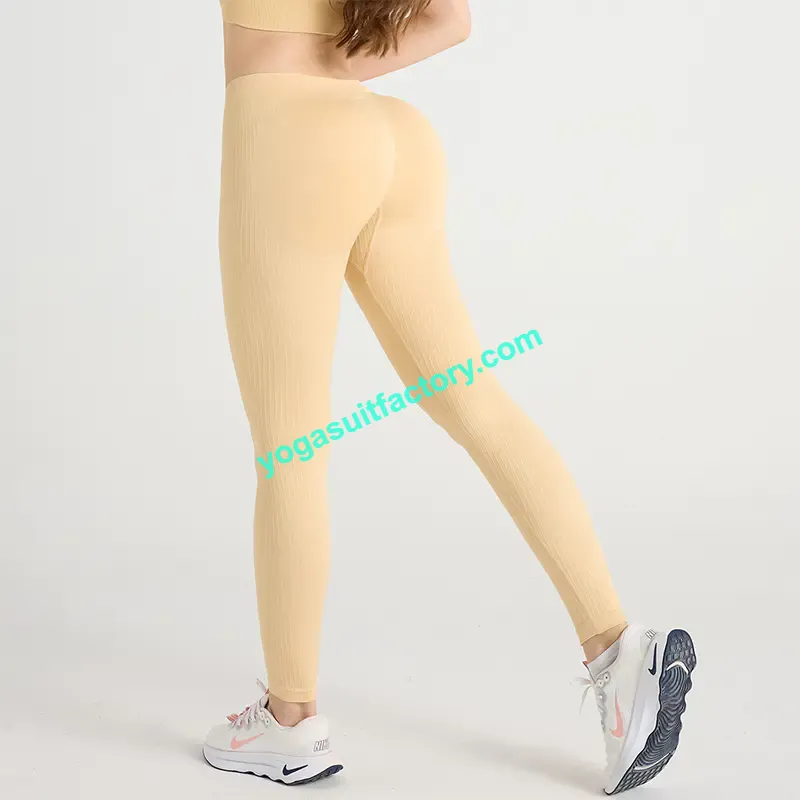
A common worry among people buying their first pieces of this kind is that a garment without the usual stitched joins must be flimsy, as though the missing seams were holding something up. On a pair of Seamless Yoga Sets the opposite is closer to the truth, since the body of the piece is formed by the knitting itself, and the work that joins would normally do is handed to the structure of the loops. I find it easier to judge such a thing once I understand how it comes off the machine, so what follows goes in order, from the loops to the waistband.
Many pieces of this type are knitted in tubular form on circular machines, so the shape is built while the cloth is made instead of being cut from flat yardage and sewn afterward. I am describing the general method, since details differ between makers and I have no specification sheet for any particular product in front of me. What matters to a wearer is that the loops can be pulled tighter or left looser at chosen points along the tube, which gives one continuous body some areas that grip firmly and others that stay relaxed.
That variation in loop tightness is the core function, and it is easy to feel with your hands. Tug a section across the waist and then across the ribs, and a tight area resists and returns with a quiet, even pull, while a loose area opens readily and shows its stitch pattern plainly. Many designs place a firm band at the waist, a lighter structure across the back for airflow, and a denser section around the hips and seat where the material has to cover and hold, though the exact layout depends on the pattern a maker chooses.
Elasticity comes from a springy fiber carried inside the main yarn, and how well a piece recovers depends on how that fiber sits in the loops. My own test is simple: I pull a sample sideways close to its limit, hold it for a few seconds, and let go. The cloth should return to its original outline without a baggy patch or a rippled edge, and a pair that stays slightly slack at the knees after such a test is showing fatigue early.
Thin spots are the other thing worth hunting for. I once watched a friend drop into a deep squat on a studio mat in a pair of light leggings, and the panel behind the knee turned faintly see-through, which no flat photograph had hinted at. Holding the cloth up to a window while pulling it gently shows the same thing in advance, because evenly spaced loops give a steady grain of light and uneven ones open into sheer patches that only widen with wear.
Since there are no seams, the edges are finished as part of the construction as well. Hems, cuffs and waistbands are usually formed within the tube, often as a folded or doubled band that stops the edge from curling. Slide a finger along the inside of the waistband and feel for ridges, since a flat, smooth interior sits against the skin without leaving a line. Where an opening does need closing, such as the crotch of a legging or the underarm of a bodysuit, there may be a small joined area, and pressing it between finger and thumb tells you whether it feels flat or lumpy.
Fiber content decides how the item handles sweat and washing, and the care label is the only reliable source for what the yarn actually is, so I read it instead of the product description. Synthetic blends commonly dry quickly while natural fibers tend to hold moisture longer, but I would not assume either without seeing the tag. Washing in a mesh bag is a common way to avoid catching loops on zips and hooks, and a gentle cycle is usually printed on the label for the same reason.
Where a factory describes its own process, it is reasonable to ask which machines and yarns it uses, how tightness is set at each zone, and how finished pieces are checked for thin spots before cartons are packed. A maker that works with this kind of product regularly can usually answer in plain terms, and a vague reply is useful information in itself.
A listing like the one at https://www.yogasuitfactory.com/ can name the cut and the colors, but the tightness of the loops at the waist and the thinness of the cloth behind the knee only show up in the hand. Seamless Yoga Sets are generally made in tubular form, with the elastic fiber carried through the same loops that form the body, and the hems and edges are finished as part of that same construction.
 Romaian
 English
 Arabic
 French
 Spanish
 Portuguese
 Deutsch
 Turkish
 Dutch
 Italiano
 Russian
 Portuguese (Brazil)
 Greek