


UAE Market Entry Guide: Regulatory Requirements for Pharmaceuticals, Food Supplements and Cosmetics
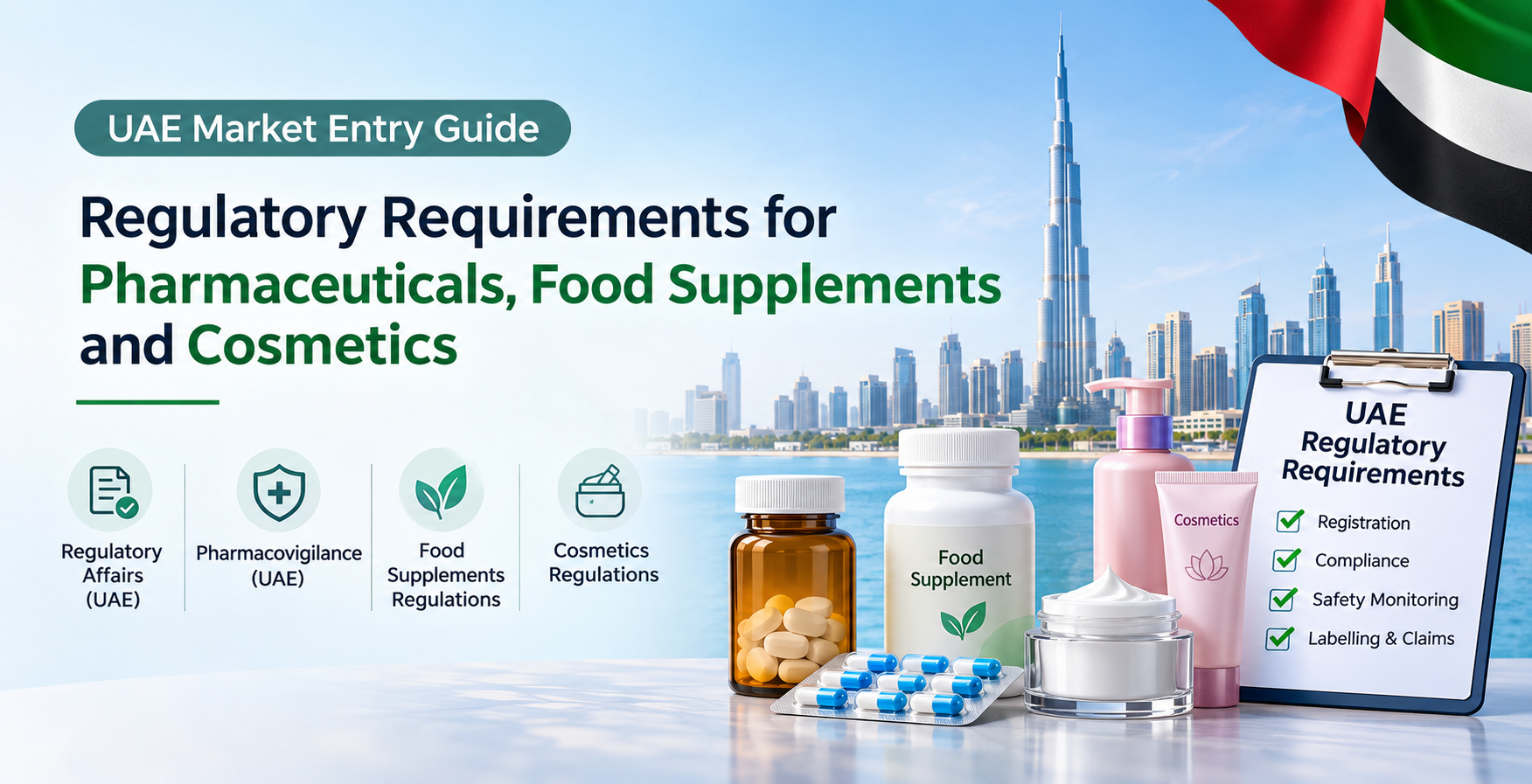
The United Arab Emirates (UAE) has become an important destination for pharmaceutical, healthcare, nutraceutical and cosmetics companies looking to expand their presence in the Middle East. Its growing healthcare infrastructure, expanding consumer market and strategic position as a regional distribution hub make it an attractive market for international manufacturers.
However, entering the UAE market involves more than identifying distributors and establishing commercial partnerships. Companies must understand the regulatory framework governing product classification, registration, marketing authorisation, labelling, safety monitoring and post-market compliance.
One of the most important considerations is that different product categories may follow different regulatory pathways. Pharmaceutical products, food supplements and cosmetics are not necessarily subject to identical registration procedures or regulatory oversight.
For manufacturers planning to introduce products in the UAE, understanding these distinctions early can help reduce regulatory delays, prevent documentation gaps and support a smoother market-entry strategy.
This guide explores the key regulatory considerations for pharmaceutical products, pharmacovigilance, food supplements and cosmetics in the UAE.
1. Understanding the UAE Regulatory Landscape
The UAE has a structured regulatory framework designed to ensure the quality, safety and appropriate marketing of healthcare and consumer products.
The Emirates Drug Establishment (EDE) plays a central role in regulating medical products, including pharmaceutical products, healthcare products, biological products, food supplements and certain cosmetics. Other competent authorities, including municipal authorities, have responsibilities for consumer products within their respective jurisdictions.
The applicable authority and registration route depend on factors such as:
- Product composition and intended use.
- Therapeutic or health-related claims.
- Product presentation and labelling.
- Classification as a pharmaceutical, healthcare, food or cosmetic product.
- Importation and distribution arrangements.
- The emirate and applicable local registration requirements.
An important regulatory consideration is Federal Decree-Law No. 38 of 2024, governing medical products, pharmacists and pharmaceutical establishments, which entered into force on 2 January 2025.
Companies should therefore evaluate the applicable regulatory framework before initiating product registration or commercialisation activities.
2. Pharmaceutical Product Registration in the UAE
Pharmaceutical product registration is a critical step for companies intending to import, distribute or market medicines in the UAE.
The registration process involves demonstrating that a product meets applicable requirements for quality, safety and efficacy. Manufacturers must prepare the appropriate technical documentation and ensure that the proposed marketing authorisation arrangements comply with local requirements.
Key Regulatory Considerations
Product and manufacturing site registration
Companies must evaluate the applicable requirements for registering the marketing authorisation holder and manufacturing facilities before proceeding with product applications.
Technical documentation and dossier preparation
Pharmaceutical applications require comprehensive technical documentation. Depending on the product and applicable pathway, this may involve an electronic Common Technical Document (eCTD), covering:
- Administrative and regional information.
- Quality and Chemistry, Manufacturing and Controls (CMC) documentation.
- Non-clinical study information, where applicable.
- Clinical study data.
- Product labelling and prescribing information.
Product quality and safety requirements
Regulatory authorities may evaluate product quality, stability, bioequivalence where applicable, and other supporting information before granting marketing authorisation.
Labelling and packaging compliance
Product packaging, patient information leaflets and prescribing information must comply with applicable UAE requirements. Companies should review the proposed artwork and product information before submission.
Why Regulatory Planning Matters
A well-defined regulatory strategy helps companies identify documentation gaps, understand submission expectations and anticipate potential regulatory questions.
Manufacturers planning to enter the UAE should consider professional Regulatory Affairs Services in UAE to support product registration, regulatory strategy, submission preparation, lifecycle management and ongoing compliance.
3. Pharmacovigilance Requirements in the UAE: Maintaining Product Safety After Approval
Obtaining marketing authorisation is not the end of a pharmaceutical company’s regulatory responsibilities.
Once a medicinal product enters the market, its safety profile must continue to be monitored through an effective pharmacovigilance system.
Pharmacovigilance (PV) involves identifying, assessing, understanding and preventing adverse reactions and other medicine-related safety concerns.
In the UAE, marketing authorisation holders and relevant pharmaceutical establishments must meet applicable pharmacovigilance obligations under the EDE framework and associated guidelines.
Important Pharmacovigilance Considerations
1. Pharmacovigilance System and Responsibilities
Companies must establish an appropriate pharmacovigilance system with clearly defined responsibilities, documented procedures and mechanisms for managing safety information.
2. Qualified Pharmacovigilance Personnel
Companies should assess the applicable requirements for pharmacovigilance personnel, including the appointment and approval of the responsible pharmacovigilance officer, as required by the competent authority.
3. Individual Case Safety Reports (ICSRs)
Adverse event reports must be collected, assessed, documented and submitted in accordance with applicable reporting requirements and timelines.
4. Risk Management Plans (RMPs)
Risk Management Plans help identify important potential and identified risks associated with a medicinal product and establish appropriate risk-minimisation measures.
5. Periodic Safety Reporting
Depending on the product and applicable requirements, companies may need to prepare and submit Periodic Safety Update Reports (PSURs), Periodic Benefit-Risk Evaluation Reports (PBRERs) and other safety documentation.
6. Signal Detection and Safety Monitoring
Continuous monitoring of safety information helps companies identify emerging risks and take appropriate regulatory or safety actions.
The Importance of a Strong Local PV Framework
International pharmaceutical companies must ensure that their global pharmacovigilance systems address UAE-specific regulatory expectations.
This includes appropriate local responsibilities, safety information exchange, reporting procedures, documentation and communication with the relevant regulatory authority.
Companies looking to strengthen their local safety compliance can explore Pharmacovigilance Services in UAE for support with ICSR management, safety reporting, risk management, signal detection, pharmacovigilance system oversight and related activities.
4. Food Supplement Regulations in the UAE
The UAE food supplement market offers opportunities for manufacturers of vitamins, minerals, herbal products, nutritional supplements and other products intended to support general health.
However, companies should not assume that all food supplements follow the same regulatory pathway.
Product classification is particularly important because the applicable regulatory route may depend on the ingredients, composition, intended use, presentation and claims made on the packaging or in marketing materials.
Some products may be regulated through food and consumer-product registration pathways, while others may fall within EDE’s healthcare product framework.
Key Requirements for Food Supplement Compliance
Ingredient and Composition Assessment
Manufacturers should review all active and inactive ingredients, their quantities, permitted use and any applicable restrictions. Particular attention should be given to ingredients that may trigger additional regulatory scrutiny.
Product Classification
The product’s intended purpose, composition and claims should be assessed to establish whether it is regulated as a food supplement, healthcare product or another category.
Labelling and Claims Compliance
Labels and marketing materials should be reviewed for:
- Ingredient declarations.
- Nutritional information, where applicable.
- Recommended daily intake and directions for use.
- Warnings and precautionary statements.
- Country of origin and manufacturer information.
- Applicable Arabic and English labelling requirements.
- Health and nutritional claims.
Companies should avoid presenting food supplements as products intended to diagnose, treat, cure or prevent diseases unless the product is appropriately classified and authorised for such use.
Product Registration and Supporting Documents
Depending on the classification and registration route, companies may need product specifications, certificates of analysis, ingredient information, product artwork, free sale documentation and supporting safety or conformity evidence.
Why Early Classification Is Important
A product marketed as a nutritional supplement in one country may not automatically receive the same classification in the UAE.
For example, a supplement containing ingredients associated with medicinal use or making therapeutic claims may require a different regulatory assessment from a conventional food supplement.
Manufacturers should therefore evaluate product composition and claims before finalising labels or submitting registration applications.
For companies managing multiple supplement products across international markets, specialised Food Supplements Regulatory Services can support product classification, ingredient assessment, regulatory submissions, labelling reviews and claims compliance.
5. Cosmetics Regulatory Requirements in the UAE
The UAE cosmetics and personal care market includes skincare, haircare, fragrances, makeup, personal hygiene products and other consumer beauty products.
Although cosmetics generally follow a different regulatory route from medicinal products, they are still subject to product safety, ingredient, labelling and registration requirements.
Companies must determine the appropriate registration pathway based on product characteristics and intended claims.
For example, conventional cosmetics and personal care products may fall under municipal consumer-product registration systems, such as Dubai Municipality’s Montaji system. Products with medical or therapeutic characteristics may require a different assessment and potentially fall under EDE oversight.
Key Areas of Cosmetics Regulatory Compliance
1. Ingredient Compliance
Manufacturers should evaluate product formulations against applicable ingredient restrictions, permitted substances and safety requirements.
2. Product Registration
Applicable product registration requirements should be identified before importation and commercial distribution. The responsible importer or local entity should also assess the relevant registration obligations.
3. Cosmetics Labelling
Product labels should be reviewed for the applicable requirements, which may include:
- Product name and function.
- Ingredient list using appropriate nomenclature.
- Manufacturer and country of origin.
- Batch identification.
- Net content.
- Production and expiry information, where applicable.
- Directions for use and relevant warnings.
- Arabic language requirements, where applicable.
4. Product Safety and Supporting Documentation
Companies should prepare appropriate supporting documents, such as product formulation details, certificates of analysis, conformity documents, safety information and product artwork, depending on the applicable registration route.
5. Claims and Product Presentation
Cosmetic claims should accurately represent the product’s intended function and be supported by appropriate evidence.
Claims suggesting the diagnosis, treatment or prevention of medical conditions may affect the product’s classification and regulatory pathway.
Preparing Cosmetics for the UAE Market
A product approved for sale in another international market is not automatically compliant with UAE requirements.
Manufacturers should review the formulation, product artwork, ingredient declarations and marketing claims before introducing cosmetics into the UAE.
Companies can explore specialised Cosmetics Regulatory Services for assistance with ingredient reviews, safety assessments, labelling compliance, regulatory strategy and product documentation.
6. Common Regulatory Challenges When Entering the UAE Market
Despite the opportunities available, companies may encounter several regulatory challenges when planning their UAE market entry.
| Regulatory challenge | Potential impact | Recommended approach |
|---|---|---|
| Incorrect product classification | Application delays or incorrect registration pathway | Conduct a regulatory classification assessment before submission |
| Incomplete technical documentation | Regulatory queries and additional review cycles | Perform a dossier gap assessment |
| Non-compliant product labels | Labelling revisions and market-entry delays | Conduct an early artwork and claims review |
| Unclear local responsibilities | Regulatory and operational compliance gaps | Define the roles of the manufacturer, local entity and marketing authorisation holder |
| Inadequate pharmacovigilance arrangements | Potential safety reporting and compliance issues | Establish an appropriate local PV system |
| Unsupported product claims | Reclassification or regulatory scrutiny | Review claims against the product’s authorised category and intended use |
| Changes in regulatory requirements | Post-approval compliance risks | Monitor applicable regulatory updates continuously |
Addressing these issues before filing can help organisations establish a more predictable regulatory pathway.
Building a Sustainable Regulatory Strategy for the UAE
Successful market entry requires more than obtaining an initial product approval. Companies must establish a regulatory strategy that supports the entire product lifecycle, from classification and documentation to registration, market surveillance and ongoing compliance.
For international manufacturers, this means understanding the differences between pharmaceutical, food supplement and cosmetics regulations while ensuring that local regulatory responsibilities are clearly defined.
A coordinated regulatory approach can help organisations:
- Reduce avoidable documentation gaps.
- Identify the correct registration pathway.
- Improve submission readiness.
- Maintain product safety and regulatory compliance.
- Manage post-approval changes effectively.
- Support expansion across the UAE and wider Middle Eastern markets.
Working with experienced regulatory professionals can help companies navigate these requirements with greater clarity and confidence.
Conclusion
The UAE offers significant opportunities for pharmaceutical, nutraceutical and cosmetics companies. However, successful commercialisation depends on understanding the regulatory requirements applicable to each product category.
From pharmaceutical registration and pharmacovigilance to food supplement classification and cosmetics compliance, every stage requires careful regulatory planning.
Companies that invest in early classification, robust documentation, appropriate safety systems and continuous regulatory monitoring can establish a stronger foundation for sustainable market access.
Planning to enter the UAE market?
Connect with DDReg Pharma to understand the regulatory considerations for your products and develop a market-entry strategy aligned with applicable UAE requirements.
Explore our regulatory expertise:
 Italiano
 English
 Arabic
 French
 Spanish
 Portuguese
 Deutsch
 Turkish
 Dutch
 Russian
 Romaian
 Portuguese (Brazil)
 Greek