


How Pole Count Influences Vibration Motor Operation
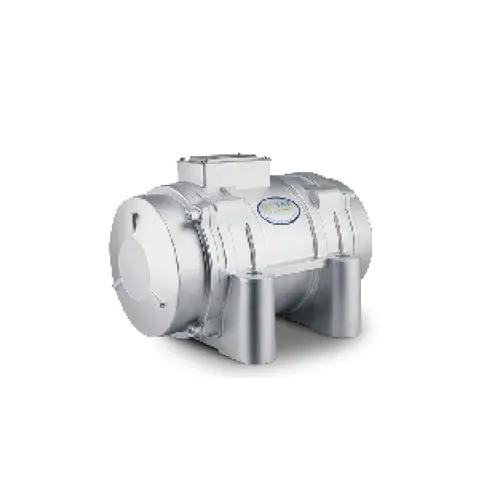
A Vibration Motor generates mechanical vibration through rotating eccentric weights attached to its shaft. As the motor rotates, the offset weights create a centrifugal force that is transferred to the equipment frame. This movement can help transport, screen, settle or discharge materials, depending on the machine's structure and operating conditions.
One of the main factors affecting motor speed is pole count. In an AC induction motor, synchronous speed is determined by the supply frequency and the number of magnetic poles. The formula is 120 multiplied by frequency, divided by pole count. At 50 Hz, the theoretical synchronous speeds are approximately 3,000 rpm for a 2-pole motor, 1,500 rpm for a 4-pole motor, 1,000 rpm for a 6-pole motor and 750 rpm for an 8-pole motor. Actual induction motor speeds are generally slightly lower because of slip.
This relationship explains why pole count is an important specification when comparing industrial vibration equipment. A 2-pole motor produces faster rotation, while motors with more poles operate at lower speeds under the same supply frequency. At 60 Hz, the corresponding synchronous speeds increase, so the selected motor must match the electrical conditions at the installation site.
Speed also influences the excitation force generated by eccentric weights. When the weight and offset remain unchanged, centrifugal force increases approximately with the square of rotational speed. This means that increasing speed can produce a substantial change in the force applied to the machine. However, actual vibration amplitude also depends on the equipment's mass, stiffness, mounting arrangement and operating load. RPM alone does not determine how far the machine will move.
Material characteristics are another part of the selection process. Fine powders and small particles may respond well to relatively rapid vibration, particularly in screening or spreading applications. Coarser or heavier materials may require a different combination of frequency and force to move through a hopper or along a conveying surface. Materials that tend to stick together or form bridges can also place different demands on the vibration system.
These differences can be seen across industrial applications. Mining equipment uses vibration to separate and move bulk materials, while chemical processing machinery may need controlled movement for powder handling. Bin activators use vibration to encourage material discharge, and construction equipment may use it for compaction or other processing tasks. Each application has its own requirements, so motor speed should be considered alongside material behavior and machine design.
The power supply further narrows the available choices. Industrial installations commonly use three-phase electricity, while smaller equipment may operate with single-phase power. Voltage and frequency need to match the motor's rated specifications. Some specialized applications use DC motors, particularly where battery-powered or mobile equipment is involved. Checking the available supply before selecting a motor helps avoid compatibility problems during installation.
Another consideration is the adjustment of eccentric weights. Many vibration motors allow the excitation force to be changed by adjusting the weight arrangement. This provides a way to adapt the vibration output to the connected equipment, within the motor's permitted operating range. The adjustment should follow the manufacturer's instructions because an unsuitable setting can increase mechanical stress on the motor and machine structure.
A suitable Vibration Motor is therefore selected through more than a comparison of rated speeds. Pole count establishes the basic speed range, while eccentric weight settings, electrical supply, material properties and equipment design determine how that speed translates into useful movement. Considering these factors together helps create a vibration system that matches the actual requirements of an industrial process.
 Portuguese
 English
 Arabic
 French
 Spanish
 Deutsch
 Turkish
 Dutch
 Italiano
 Russian
 Romaian
 Portuguese (Brazil)
 Greek