


Semiconductor Rectifier Market Size, Share, Growth & Industry Outlook 2026-2034
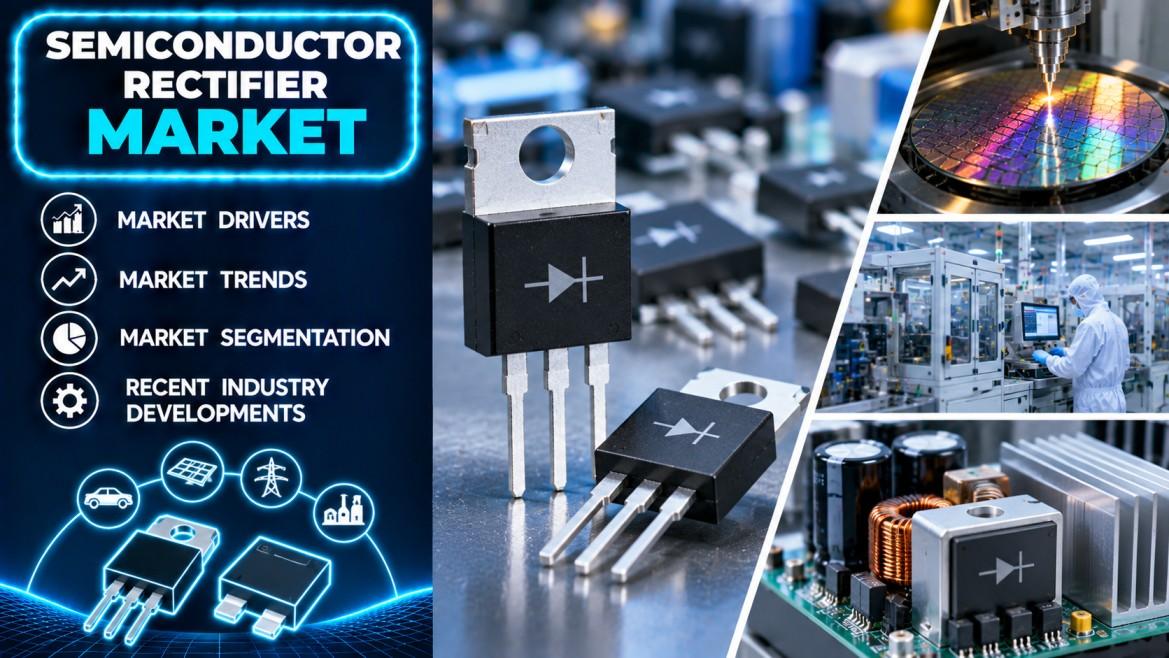
IMARC Group, a leading global market research and management consulting firm, has published its latest market intelligence report on the semiconductor rectifier market. The global semiconductor rectifier market size was valued at USD 5.3 Billion in 2025. Looking forward, IMARC Group estimates the market to reach USD 8.7 Billion by 2034, exhibiting a CAGR of 5.48% from 2026-2034, driven by rising demand for energy-efficient power management in renewable energy, automotive and electronics applications, rapid adoption of electric vehicles, advancements in silicon carbide and gallium nitride technologies, and growing investments in smart grids and industrial automation worldwide. Asia Pacific currently dominates the market with a share of over 45.8%.
The market is experiencing strong growth momentum as electrification spreads across transportation, buildings, factories and digital infrastructure. Every one of these systems needs to convert alternating current into stable direct current, and semiconductor rectifiers sit at the heart of that conversion in chargers, power supplies, inverters, telecom towers, server racks and household appliances. Electric vehicles, solar and wind installations, and fast-charging networks are pushing demand toward rectifiers that handle higher voltages and currents with lower losses. At the same time, miniaturization in consumer electronics is rewarding compact, thermally stable devices, while cloud computing and 5G rollouts are lifting the need for dependable power conversion in data centers and telecom networks. Wide-bandgap materials are widening the performance envelope, which is encouraging manufacturers to build new fabs and form partnerships across the value chain.
How AI is Reshaping the Future of the Semiconductor Rectifier Market
-
AI Data Center Power Architectures Driving Demand for High-Efficiency Rectification: AI server racks are moving from roughly 120 kW toward 500 kW and eventually 1 MW per rack, which is pushing operators from legacy 54 V distribution to 800 VDC architectures. Infineon, working alongside NVIDIA, has introduced a 12 kW reference design that combines gallium nitride and silicon carbide devices to reach about 98% efficiency, while Navitas has shown an 8.5 kW power supply targeting the same efficiency level. NVIDIA has indicated that the architecture can lift end-to-end power efficiency by up to 5% compared with 54 VDC systems, creating a fast-growing use case for advanced rectification stages.
-
Digitalized and Data-Driven Fabs Raising Output and Shortening Qualification Cycles: Manufacturers are embedding automation and digital tools into power semiconductor production. Infineon's new Smart Power Fab in Dresden uses digitization to run production up to twice as fast as before, and its link to the Villach plant as a "One Virtual Fab" makes process and product qualification significantly faster. STMicroelectronics is likewise deploying additional AI and automation across technology R&D, manufacturing, reliability and qualification as it concentrates investment on 300mm silicon and 200mm silicon carbide wafer fabs.
-
AI-Enabled Predictive Maintenance Protecting Power Conversion Assets: Industrial operators are applying machine learning and sensor data to detect equipment drift before failure in drives, chargers, grids and other converter-based systems. ABB's AI-enabled predictive maintenance solutions target unplanned downtime, which the company notes can cost anywhere from USD 10,000 to USD 500,000 per hour. As rectifier-based power stages become mission critical in EV charging networks, telecom sites and data centers, condition monitoring is turning reliability into a purchasing criterion for high-quality devices.
Grab a sample PDF of this report: https://www.imarcgroup.com/semiconductor-rectifier-market/requestsample
Semiconductor Rectifier Market Trends and Drivers
The global semiconductor rectifier market is expanding on the back of electrification, smart grid investment and the steady rise of connected devices. Rectifiers ensure stable power flow and prevent voltage reversals, which makes them indispensable in modern grids that must integrate variable solar and wind output. According to the International Energy Agency, the U.S. Department of Energy allocated USD 3 Billion for smart grids as part of a USD 10.5 Billion program to strengthen the national electricity grid, and similar investments in other regions are amplifying demand for advanced rectifiers. Demand on the grid itself keeps climbing, with U.S. electricity consumption reaching a record 4.07 Trillion kWh, a 14-fold increase over several decades, which is increasing the need for efficient conversion across residential, industrial and renewable installations.
Consumer electronics and automotive electronics form the second major pillar of growth. Laptops, smartphones and gaming consoles depend on rectifiers for high-frequency rectification and efficient charging, and according to GSMA, over half of the global population now owns a smartphone, with rectifiers supporting connectivity for nearly 4 Billion users. In Europe, Germany's smartphone penetration has climbed to 90.1%, reflecting how deeply connected devices are embedded in daily life. In vehicles, rectifiers support battery management systems, electric drivetrains and onboard charging, and automotive already accounts for the largest end use share at 27.8% of the market. Partnerships such as the collaboration between Valeo and ROHM Semiconductor to optimize power modules for electric motor inverters show how automakers and chipmakers are co-developing more efficient power stages.
A third driver is the rapid shift toward wide-bandgap materials and regionalized supply chains. Silicon carbide and gallium nitride rectifiers switch faster, run hotter and waste less energy, which allows smaller and lighter designs in chargers, telecom power systems and solar inverters. Governments are responding with large incentive programs to localize production of power semiconductors, a trend that is attracting fresh capital into fabs, packaging lines and wafer plants across Asia, Europe and North America. The IT and telecom segment is benefiting as well, with the UAE data center market alone attracting close to USD 1 Billion of investment and demand for compact, high-capacity rectifiers rising alongside 5G deployment.
Ask an analyst for customized report: https://www.imarcgroup.com/request?type=report&id=5066&flag=E
Key Government Schemes and Policy Programs Supporting the Industry
-
India, Semicon India Programme: The programme carries a total outlay of Rs 76,000 crore to build a domestic semiconductor and display manufacturing ecosystem. Ten projects covering 2 fabs and 8 packaging units have been approved with planned investments of about Rs 1.6 lakh crore. A silicon carbide facility by SiCsem in Bhubaneswar, with an investment of Rs 2,066 crore and annual capacity of 60,000 wafers and 96 Million packaged units, directly supports power device supply, while the CG Power and Renesas OSAT unit at Sanand, valued at Rs 7,600 crore, targets power management chips.
-
United States, CHIPS and Science Act: The Act provides USD 52.7 Billion for semiconductor research, manufacturing and workforce development, including USD 39 Billion for manufacturing incentives and USD 2 Billion reserved for mature-node chips used in automobiles and defense systems. The advanced manufacturing investment tax credit has been raised from 25% to 35% for qualifying property, improving project economics for new fabs. The Department of Energy's Office of Electricity separately announced USD 20 Million for nine projects to modernize power grid transformers and USD 2.25 Million for advanced semiconductor packaging.
-
European Union, European Chips Act: The Act aims to mobilize up to EUR 43 Billion in public and private investment and double Europe's share of global chip production from about 10% to 20%. The European Commission approved state aid of up to EUR 920 Million for Infineon's EUR 5 Billion Smart Power Fab in Dresden, and Italy is supporting STMicroelectronics' EUR 5 Billion silicon carbide campus in Catania with about EUR 2 Billion under the Chips Act framework.
-
Japan, METI Power Semiconductor Supply Assurance Subsidy: Under the Economic Security Promotion Act, the Ministry of Economy, Trade and Industry approved a subsidy of up to JPY 129.4 Billion, equal to one third of a JPY 388.3 Billion joint investment by ROHM and Toshiba Electronic Devices and Storage. ROHM concentrates on silicon carbide devices and wafers, Toshiba on silicon power devices, and both must keep producing for at least 10 years after supply begins.
Semiconductor Rectifier Industry Segmentation
The report has segmented the market into the following categories:
Breakup By Product
- Single Phase
- Three Phase
Single phase leads the product segment, accounting for 58.3% of the market share. Single-phase rectifiers convert AC to DC in low-power applications such as household appliances, lighting systems and small-scale industrial equipment, and their compact size, simple installation and affordability make them popular across residential, commercial and industrial settings. Rising solar adoption, electrification in emerging economies and advances in consumer electronics are reinforcing the segment's dominance.
Breakup By Type
- Low Current Rectifier
- Medium Current Rectifier
- High Current Rectifier
Low current rectifiers serve consumer electronics, household appliances and small industrial devices, supporting battery charging and power regulation, while medium current rectifiers power automotive systems, EV charging, solar arrays and telecom infrastructure where a balance of capacity and efficiency is needed. High current rectifiers handle heavy industrial processes, electric vehicles and large wind and solar installations, ensuring stable energy flow and minimal downtime in power-intensive operations. Together, the three tiers map directly onto the electrification of everyday devices, mobility and utility-scale energy.
Breakup By End Use Industry
- Automotive
- Consumer Electronics
- Power and Utility
- IT and Telecom
- Others
Automotive leads the end use industry segment, accounting for 27.8% of the market share. Rectifiers are integral to battery management systems, electric drivetrains and onboard charging, and the transition to electric and hybrid vehicles, together with tighter emission standards and growing demand for safety and infotainment electronics, continues to lift demand for efficient power conversion across vehicle platforms.
Breakup By Region
- North America (United States, Canada)
- Asia Pacific (China, Japan, India, South Korea, Australia, Indonesia, Others)
- Europe (Germany, France, United Kingdom, Italy, Spain, Russia, Others)
- Latin America (Brazil, Mexico, Others)
- Middle East and Africa
Asia Pacific dominates the global semiconductor rectifier market with a share of over 45.8%, supported by a large electronics manufacturing base, expanding consumer electronics and automotive production, rapid growth in solar and wind capacity, and EV charging and smart grid investment. Favorable government policies and the presence of major semiconductor manufacturers further strengthen the region's production capacity and innovation. In North America, the United States accounts for 83.30% of the regional market, driven by record electricity demand, renewable energy projects and the rollout of EV charging stations.
Competitive Landscape
The report provides a comprehensive analysis of the competitive landscape in the semiconductor rectifier market with detailed profiles of all major companies, including:
- ABB Ltd.
- Infineon Technologies AG
- Mitsubishi Electric Corporation
- NXP Semiconductors
- ROHM Co., Ltd
- Semiconductor Components Industries, LLC
- STMicroelectronics
- Taiwan Semiconductor Co., Ltd.
- Toshiba Electronic Devices & Storage Corporation
Competition is intense and increasingly capital intensive, with leading players racing to expand silicon carbide and gallium nitride capacity while localizing production close to customers. Infineon holds the largest position in power discretes and modules with a share of about 17.7% in an Omdia-based ranking, while the next tier, including onsemi, STMicroelectronics, Mitsubishi Electric, Toshiba, Vishay and ROHM, is far more fragmented, and Chinese challengers such as BYD have already reached roughly 3.1% share. The scale of capital commitments is notable: Infineon invested EUR 5 Billion in its Dresden fab, STMicroelectronics plans up to 15,000 silicon carbide wafers per week at full build-out in Catania, and ROHM and Toshiba are jointly investing JPY 388.3 Billion to strengthen domestic power device supply.
What Does The Full Report Cover?
If you are tracking the semiconductor rectifier market for investment decisions, market entry planning, competitive benchmarking, or strategic advisory, IMARC Group's report gives you everything in one place:
- Complete market sizing with revenue forecasts covering the full projection period
- Quantified growth driver analysis with impact scoring across product, type, end use industry and regional markets
- Sub-segment breakdowns for single phase, three phase, low current, medium current and high current rectifiers, and automotive, consumer electronics, power and utility, and IT and telecom end uses, with individual share data
- Country-level data for the United States, Canada, Germany, France, the United Kingdom, Italy, Spain, Russia, China, Japan, India, South Korea, Australia, Indonesia, Brazil, and Mexico
- Competitive profiles of leading companies including ABB, Infineon, Mitsubishi Electric, NXP, ROHM, onsemi, STMicroelectronics, Taiwan Semiconductor and Toshiba
- Porter's Five Forces analysis, value chain insights and market dynamics covering drivers, challenges and opportunities
- Latest technology trends covering silicon carbide and gallium nitride adoption, smart grid integration, EV power electronics and miniaturization shaping competition across key regional markets
Recent News and Developments in Semiconductor Rectifier Market
-
July: Infineon opened its Smart Power Fab in Dresden several months ahead of schedule, an EUR 5 Billion investment that is the largest in the company's history. The fab creates 1,000 direct jobs, doubles Infineon's capacity at the Dresden site, recycles about 90% of the water it uses and recovers up to 45% of the energy consumed.
-
October: Mitsubishi Electric celebrated completion of a new silicon carbide power semiconductor plant at its Kumamoto site, an investment of about JPY 100 Billion across a 42,000 square meter facility. The plant supports EV and energy-efficient electronics demand, with operations starting the following month.
-
October: Infineon unveiled an 800 VDC power architecture for AI data centers in alignment with NVIDIA's vision, targeting racks that rise from 120 kW to 500 kW and up to 1 MW. Its GaN and SiC based reference design reaches about 98% efficiency per conversion stage and supports live hot-swapping of server boards without downtime.
-
December: Delta Electronics India signed an MoU with ThunderPlus to supply high-efficiency 4 kW rectifier modules for fast chargers designed for low-voltage 2W and 3W EVs. The rectifiers will be manufactured at Delta's new facility in Krishnagiri, Tamil Nadu, supporting local EV supply chains.
-
November: Vishay introduced new 1 A and 2 A, 1200 V Gen 7 Hyperfast rectifiers in SMF packages, featuring reduced recovery times for high-frequency power conversion in industrial and automotive systems.
-
February: Taiwan Semiconductor launched its TSD Series of automotive rectifiers with ESD protection above 10,000 V and repetitive peak reverse voltage of up to 600 V. Available in 1 A, 2 A and 3 A ratings, the devices operate from -40°C to 175°C.
Note: If you require specific details, data, or insights that are not currently included in the scope of this report, we are happy to accommodate your request. As part of our customization service, we will gather and provide the additional information you need, tailored to your specific requirements. Please let us know your exact needs, and we will ensure the report is updated accordingly to meet your expectations.
Key Questions This Report Answers
- What is the current global semiconductor rectifier market size and what is its projected value?
- Which product segment holds the largest share in the global semiconductor rectifier market?
- What are the key drivers of global semiconductor rectifier market growth?
- Which region dominates the global semiconductor rectifier market and why?
- How are silicon carbide and gallium nitride technologies, EV adoption and smart grid investments reshaping product development and competitive strategies in the semiconductor rectifier industry?
- Who are the top companies in the global semiconductor rectifier market and what are their competitive strategies?
- What are the investment and market entry opportunities across automotive, consumer electronics, power and utility, and IT and telecom applications?
About Us
IMARC Group is a global management consulting firm that helps the world's most ambitious changemakers to create a lasting impact. The company provides a comprehensive suite of market entry and expansion services. IMARC offerings include thorough market assessment, feasibility studies, company incorporation assistance, factory setup support, regulatory approvals and licensing navigation, branding, marketing and sales strategies, competitive landscape and benchmarking analyses, pricing and cost research, and procurement research.
Media and Sales Contact
IMARC Group
Email: sales@imarcgroup.com
United States: +1-201-971-6302
India: +91-120-433-0800
United Kingdom: +44-753-714-6104
 Portuguese
 English
 Arabic
 French
 Spanish
 Deutsch
 Turkish
 Dutch
 Italiano
 Russian
 Romaian
 Portuguese (Brazil)
 Greek