


Why Expansion Joints Fail First and How Commercial Caulking Keeps Them Moving
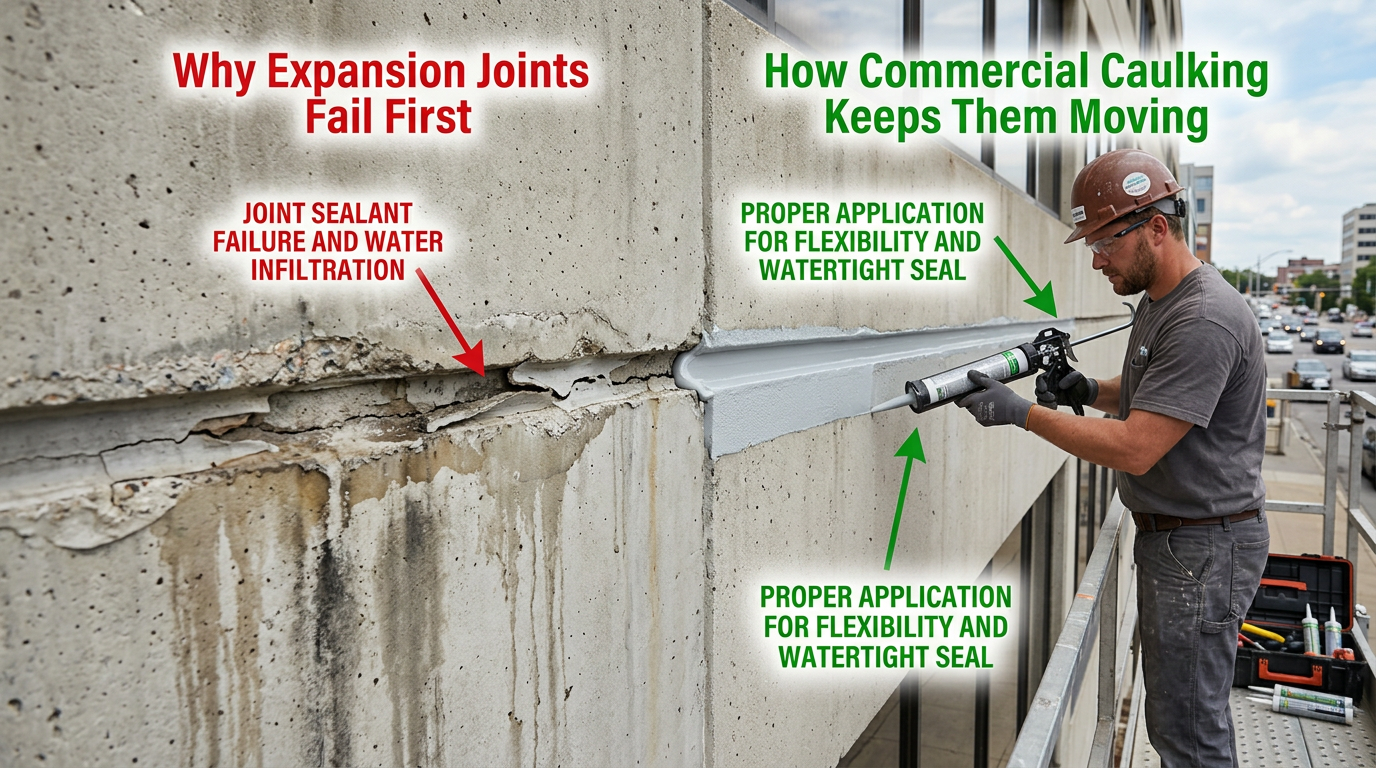
Every commercial building moves. Brick grows as it absorbs moisture. Concrete shrinks as it cures. Steel and aluminum expand on hot afternoons and contract on cold nights. Designers plan for that movement by building gaps into the structure, and those gaps are called expansion joints.
An expansion joint is only as good as the seal that closes it. That's why expansion joints are one of the most important parts of any commercial caulking program and often the first to fail. The sealant in these joints works harder than anywhere else on the building, stretching and compressing through every season.
When an expansion joint seal fails, water and air move straight into the wall or slab. This article explains why these joints break down first, what good joint design looks like and how commercial caulking done correctly keeps them sealed and moving for years.
What expansion joints do
Building materials change size with temperature and moisture. A long brick wall can grow by a noticeable fraction of an inch over a year. A precast concrete panel moves with the sun. A parking deck slab can move far more than that between a January night and a July afternoon.
If a building had no joints, that movement would crack the materials themselves. Expansion joints give the movement somewhere to go. They divide walls, slabs and facades into sections that can shift without damage.
Control joints are a close relative. They're placed to guide where shrinkage cracks form in concrete and masonry, so cracking happens in a straight line inside a sealed joint rather than randomly across a wall.
Both types need sealant, and both fail in similar ways when that sealant ages. The sealant keeps water, air and debris out of the gap while letting the sections on either side move freely.
Why expansion joints fail before other joints
A window perimeter joint might move a small amount through the year. An expansion joint may be designed to take far more. That extra movement puts the sealant under constant stress. Several factors make expansion joints especially vulnerable.
They move the most. The sealant must stretch on cold days when the joint opens and compress on hot days when it closes. Every cycle wears on the material. In the Mid-Atlantic, with hot, humid summers and freezing winters, that adds up to a wide swing each year.
They often face the harshest exposure. Expansion joints run along roof edges, parapets, plaza decks and long facade elevations that take full sun, driving rain and standing water.
They're often undersized. A joint that's too narrow for the movement it sees forces the sealant past its limits. No product can make up for a joint that's too small.
They're easy to install wrong. Sealant depth, backer rod size and surface preparation all matter more in a joint that moves a lot.
How sealant fails in a moving joint
When an expansion joint seal fails, it usually shows one of a few patterns. Knowing which one you're looking at helps identify the cause:
- Adhesive failure, where the sealant pulls cleanly away from one side of the joint
- Cohesive failure, where the sealant tears apart down the middle
- Substrate failure, where the sealant holds but pulls off a layer of the concrete or masonry behind it
- Hardening and cracking from years of sun exposure, leaving the sealant brittle
- Splitting at corners and intersections, where movement concentrates
Adhesive failure often points to poor surface preparation, a missing primer or a contaminated joint face. Cohesive failure often points to a sealant that couldn't handle the movement or was installed too deep. Substrate failure suggests the joint edges were weak or deteriorated before the sealant went in.
What good joint design looks like
Most early failures trace back to the joint itself, not the sealant. A well-designed joint gives the sealant a fair chance.
Width matters first. The joint must be wide enough that the expected movement stays within the sealant's rated movement capability. Sealants are rated by how much they can stretch and compress as a percentage of joint width. A sealant rated for plus or minus 25% movement in a joint that moves 40% will fail.
Depth matters too. For most joints, the sealant should be about half as deep as it is wide, within limits set by the manufacturer. A sealant bead shaped like an hourglass, thin in the middle and wider where it bonds to each side, flexes best.
The sealant should bond only to the two sides of the joint, never to the back. That's the job of the backer rod or bond breaker tape. When sealant sticks to the back of the joint as well, it can't stretch freely. Installers call this three-sided adhesion, and it's a leading cause of tearing in commercial caulking on moving joints.
Choosing the right sealant
Sealant choice depends on the substrate, the movement and the exposure. Common options include:
- Silicone sealants, which handle high movement and resist sunlight well, often used on facades and precast panels.
- Polyurethane sealants, which resist abrasion and are often used on horizontal joints that see foot or vehicle traffic.
- Hybrid sealants, which combine some properties of both and can be painted in some cases.
- Preformed compression seals or foam seals, used in larger joints where a gun-applied sealant can't span the gap.
The highest-movement joints may need a sealant rated for plus or minus 50% or more. Traffic-bearing joints need a product that resists wear and won't pick up dirt and grit. Joints against porous stone may need a non-staining formula.
Compatibility matters when replacing sealant. Some old sealants leave residues that new products won't bond to. A contractor should identify the existing material and remove it fully before installing anything new.
Color is a practical choice as well. Expansion joints often run the full height of a facade, so a sealant that clashes with the brick or panel color stands out from the street. Matching the color keeps the joint from becoming a visible stripe on the building.
Installation details that decide the outcome
A good sealant in a well-designed joint can still fail if it's installed poorly. These steps make the difference:
Remove all old sealant and backer rod, then clean the joint faces down to sound material. Grind or wire brush surfaces as needed.
Apply primer where the manufacturer calls for it. Porous masonry and some metals need primer for reliable adhesion.
Install backer rod sized slightly larger than the joint width so it stays in place, set at the correct depth.
Apply sealant in steady conditions. Temperature at installation affects how the joint behaves. Sealant installed on a very cold day goes in when the joint is near its widest, and it will spend summer under compression. Installing at moderate temperatures keeps the sealant near the middle of its movement range.
Tool the sealant to press it against the joint faces and form the proper profile. Tooling removes air pockets and improves adhesion. It also gives the finished joint a clean, consistent look.
Inspecting expansion joints
Because expansion joints fail first, they should be inspected more often than other joints. A walk-around every year or two catches most problems early. Pay closest attention to roof-level joints, parapets, joints on south and west elevations and any horizontal joints that hold water.
Look for gaps along the edges, splits in the middle, missing sections and sealant that's hard to the touch. Probe suspect areas gently. If the sealant pulls away easily, it's no longer protecting the joint. Take photos and note the location of each problem so repairs can be planned and tracked over time.
Interior signs matter too. Water stains near vertical joint lines, efflorescence on interior masonry and drafts near joint locations often point to failed expansion joint seals.
When to repair and when to replace
Small areas of damage can sometimes be cut out and replaced locally. If failures show up along much of a joint run, full removal and replacement makes more sense. Patching a joint that's failing in many places usually just moves the problem a few feet down the wall.
Budget planning helps here. Expansion joint replacement often requires lifts, swing stages or scaffolding, and those access costs can match the cost of the sealant work itself. Grouping joint replacement with window or facade work spreads that access cost across more of the building.
If joints keep failing within a few years of replacement, the joint design itself may be the issue. In that case, a contractor may recommend widening the joint, switching to a higher-movement sealant or using a preformed seal.
Conclusion
Expansion joints carry more movement than any other seal on a building, so they need the right width, the right sealant and careful installation to last. Waterproof Caulking & Restoration LLC inspects and replaces expansion and control joint sealants on commercial buildings throughout eastern Pennsylvania, Delaware and New Jersey, matching each joint with a product and method that fits how it actually moves.

 Arabic
 French
 Spanish
 Portuguese
 Deutsch
 Turkish
 Dutch
 Italiano
 Russian
 Romaian
 Portuguese (Brazil)
 Greek