


How Thales Key Management Helps Enterprises Strengthen Encryption Governance Across Complex IT Environments
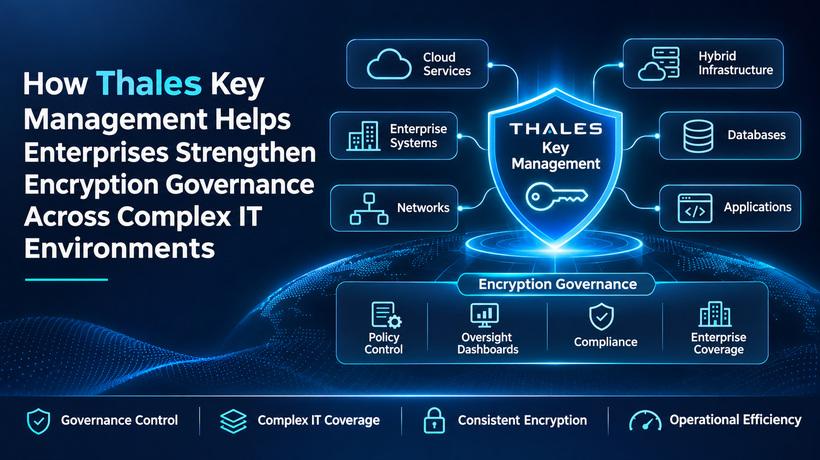
Excerpt:
Complex enterprise IT environments require consistent policies for managing encryption keys across cloud platforms, applications, databases, and on-premises infrastructure.
Thales key management can support centralized control and help security teams establish stronger governance over cryptographic assets.
Effective Key management improves visibility, access control, lifecycle management, monitoring, and accountability across enterprise environments.
Introduction
Enterprise IT environments have become increasingly distributed.
Organizations may operate multiple cloud platforms, on-premises data centers, enterprise applications, databases, SaaS services, APIs, backup systems, and digital services.
Each environment may use encryption to protect sensitive information.
As the number of systems increases, organizations also accumulate more cryptographic keys.
Managing these keys individually can make it difficult to maintain consistent policies and governance.
Security teams need to know which keys exist, who owns them, what they protect, which applications use them, and when they should rotate or retire.
This makes centralized Key management an important component of enterprise encryption governance.
Thales key management can support organizations seeking centralized control over cryptographic keys across complex IT environments.
What Is Encryption Governance?
Encryption governance refers to the policies, processes, responsibilities, and controls an organization establishes to manage encryption consistently.
A governance framework can define:
-
Approved encryption practices
-
Key ownership
-
Key access
-
Key storage
-
Rotation requirements
-
Backup procedures
-
Recovery processes
-
Revocation
-
Retirement
-
Monitoring
The goal is to ensure that encryption remains consistent with enterprise security requirements.
Why Complex IT Environments Need Strong Governance
Large organizations often have many technology teams.
Different teams may manage applications, databases, cloud infrastructure, security systems, and business platforms.
Without centralized governance, these teams may create different Key management practices.
This can result in:
-
Key sprawl
-
Inconsistent access controls
-
Unclear ownership
-
Missed rotation requirements
-
Poor visibility
Centralized governance can help address these challenges.
The Role of Key Management in Cryptography
Key management in cryptography provides the lifecycle framework for managing cryptographic keys.
The lifecycle generally includes:
-
Generation
-
Storage
-
Distribution
-
Access
-
Usage
-
Rotation
-
Backup
-
Recovery
-
Revocation
-
Retirement
-
Destruction
Encryption governance should address every stage.
Thales Key Management
Thales key management can support centralized control of cryptographic keys across enterprise environments.
Organizations can use centralized management capabilities to support:
-
Key lifecycle management
-
Access control
-
Key rotation
-
Key ownership
-
Monitoring
-
Recovery
-
Governance
The appropriate implementation should reflect the organization's infrastructure and security requirements.
Establishing Key Ownership
Every critical cryptographic key should have a clear owner.
Ownership helps organizations determine who is responsible for:
-
Key purpose
-
Access
-
Rotation
-
Recovery
-
Revocation
-
Retirement
Clear accountability can improve response times when organizations identify security issues.
Centralized Key Inventory
A centralized inventory can provide greater visibility into cryptographic assets.
Security teams should track:
-
Key identifier
-
Key purpose
-
Owner
-
Associated system
-
Protected data
-
Lifecycle status
-
Rotation schedule
This can help organizations identify unknown or obsolete keys.
Enforcing Least Privilege
Organizations should restrict access to cryptographic keys.
Users and applications should receive only the permissions required for their approved functions.
For example, an application responsible for customer records should not automatically receive access to keys used by financial systems.
Centralized policies can help organizations apply these principles consistently.
Managing Key Rotation
Key rotation represents an important governance requirement.
Organizations should define when keys should rotate based on:
-
Key age
-
Data sensitivity
-
Risk
-
Internal policy
-
Application requirements
-
Suspected compromise
Security teams should document the process and test it before applying it to production systems.
Managing Key Revocation
Governance should also address key revocation.
Organizations need clear procedures for responding when keys become compromised or no longer serve a valid purpose.
A revocation policy should define:
-
Who can revoke keys
-
How dependent systems are identified
-
How replacement keys are generated
-
How applications are updated
-
How the event is documented
Protecting Database Encryption Keys
Databases often contain sensitive business information.
Organizations may encrypt:
-
Customer data
-
Financial information
-
Employee records
-
Transaction information
-
Business documents
The associated keys should follow enterprise Key management policies.
Protecting Cloud Workloads
Cloud environments introduce additional governance challenges.
Organizations may operate workloads across multiple cloud platforms.
Security teams should maintain visibility into cloud encryption keys and ensure that they follow enterprise policies.
Centralized Key management can help provide a consistent governance model.
Managing Hybrid Infrastructure
Hybrid infrastructure combines cloud and on-premises systems.
Organizations should establish common encryption governance across both environments.
Technical implementation may differ, but the organization can maintain consistent principles for:
-
Ownership
-
Access
-
Rotation
-
Monitoring
-
Recovery
-
Retirement
Monitoring Cryptographic Activity
Governance requires visibility.
Security teams should monitor:
-
Key creation
-
Key access
-
Key rotation
-
Key revocation
-
Administrative changes
-
Failed access attempts
-
Key retirement
Monitoring can help identify policy violations and suspicious activity.
Supporting Compliance and Audits
Organizations may need to demonstrate that they maintain appropriate controls over sensitive information.
Centralized Key management can help maintain records related to:
-
Key ownership
-
Access permissions
-
Rotation history
-
Lifecycle status
-
Administrative activity
These records can support internal reviews and security assessments.
Automation and Governance
Automation can help organizations apply policies consistently.
Businesses can automate appropriate processes such as:
-
Rotation notifications
-
Expiration alerts
-
Inventory updates
-
Access workflows
-
Lifecycle actions
However, automation should remain subject to appropriate authorization and monitoring.
Common Governance Challenges
Fragmented Key Management
Different teams may manage keys independently.
Incomplete Inventory
Security teams may not know every cryptographic asset.
Excessive Permissions
Applications may receive unnecessary key access.
Manual Processes
Manual lifecycle management can create errors.
Legacy Systems
Older applications may not integrate easily with centralized governance.
Best Practices
Organizations should:
-
Establish enterprise-wide encryption policies
-
Maintain a centralized key inventory
-
Assign key ownership
-
Apply least privilege
-
Separate keys from protected data
-
Define rotation requirements
-
Establish revocation procedures
-
Protect backups
-
Monitor key activity
-
Automate suitable lifecycle processes
-
Test recovery procedures
-
Retire obsolete keys
Building a Strong Encryption Governance Framework
A practical governance model can follow:
Identify → Classify → Assign → Protect → Monitor → Rotate → Review → Retire
This creates a continuous process rather than a one-time implementation.
Organizations should periodically review their Key management policies as infrastructure and business requirements change.
Conclusion
Complex IT environments make encryption governance increasingly important.
Organizations need consistent control over cryptographic keys across cloud platforms, databases, applications, and on-premises infrastructure.
Thales key management can support centralized administration and help enterprises establish stronger control over cryptographic assets.
Key management in cryptography provides the lifecycle framework for generating, storing, accessing, rotating, revoking, recovering, and retiring keys.
Effective Key management combines centralized visibility, least-privilege access, lifecycle policies, monitoring, automation, and governance.
By establishing consistent encryption policies across complex IT environments, enterprises can strengthen accountability, reduce cryptographic risk, and build a more resilient framework for protecting sensitive digital information.

 Arabic
 French
 Spanish
 Portuguese
 Deutsch
 Turkish
 Dutch
 Italiano
 Russian
 Romaian
 Portuguese (Brazil)
 Greek