


Mechanical and Electromechanical Locks Market To produce $30,816.2 Million by 2030
When people need to unlock a mechanical safe lock, they turn a dial and input a key, much as they would for an old-school locker. The lock tumblers are correctly aligned by that combination, enabling the door to be opened. It is a straightforward yet efficient manual lock method.
Moreover, a bit more sophisticated locks are electronic locks or e-locks. You enter a four- to the six-digit number on a battery-operated keypad instead of turning a dial, and the combination is stored even if the battery runs out. The lock engages the mechanism and permits the handle to revolve so you may open the door when the proper combination is entered.
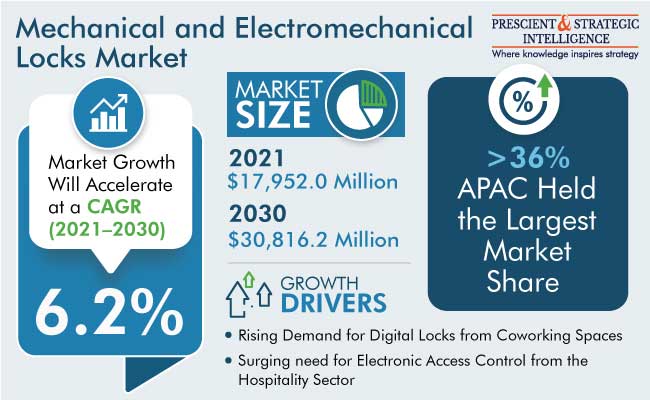
The mechanical and electromechanical locks market is on the track to hitting a $30,816.2 million value by 2030. This is owing to the surging need for digital locks from coworking spaces, growing demand for electronic access control from the hospitality industry, and snowballing concentration on convenience and safety.
A high degree of unpredictability has resulted in a huge increase in the demand for efficient, effective, and safe solutions. As theft and burglary instances rise, people's concerns about their safety are growing.
Smart electromechanical locks may be accessed through mobile applications, and they alert homeowners if the physical or virtual security of the doors is jeopardized. Some locks permit code changes following each entrance. Because of the high degree of security, smart electromechanical locks are in great demand worldwide.
Similar to digital locks and locking systems, mechanical locks are also seeing developments in terms of jimmy and drill proofing, tougher materials, and protection against fault factors. Additionally, in the event of a system breakdown or power outage, mechanical locks will remain to be used instead of electromechanical locks.
Replacement doors are utilized more frequently in restoration and retrofit projects and are more in demand than replacement locks. Replacement locks are a direct result of the necessity to replace doors and the growing pressure to increase property security.
The improvement in energy efficiency, which highlights the overall fenestration of buildings, is also a factor driving the mechanical and electromechanical locks industry.
Large hotel chains have adopted digital access or electronic control systems and products at a rate never before seen in commercial settings. A very big percentage of residences still use mechanical locks, and the use of electronic locks in apartments and single-family homes is still pretty recent.
But as IoT becomes more widely accepted and digital locks are made available from well-known suppliers throughout the world, smart digital locks with access controls and wireless locking are becoming more common in all industries.
Geographically, the APAC mechanical and electromechanical locks market is predicted to register the highest rate in the coming years.
This is due to the region's accelerated infrastructural development, rising urban population, soaring awareness, and widespread distribution of disposable cash. Furthermore, the biggest markets in APAC are Australia, India, South Korea, China, and Japan.
Read More: https://www.psmarketresearch.com/market-analysis/mechanical-electromechanical-locks-market
When people need to unlock a mechanical safe lock, they turn a dial and input a key, much as they would for an old-school locker. The lock tumblers are correctly aligned by that combination, enabling the door to be opened. It is a straightforward yet efficient manual lock method.
Moreover, a bit more sophisticated locks are electronic locks or e-locks. You enter a four- to the six-digit number on a battery-operated keypad instead of turning a dial, and the combination is stored even if the battery runs out. The lock engages the mechanism and permits the handle to revolve so you may open the door when the proper combination is entered.
The mechanical and electromechanical locks market is on the track to hitting a $30,816.2 million value by 2030. This is owing to the surging need for digital locks from coworking spaces, growing demand for electronic access control from the hospitality industry, and snowballing concentration on convenience and safety.
A high degree of unpredictability has resulted in a huge increase in the demand for efficient, effective, and safe solutions. As theft and burglary instances rise, people's concerns about their safety are growing.
Smart electromechanical locks may be accessed through mobile applications, and they alert homeowners if the physical or virtual security of the doors is jeopardized. Some locks permit code changes following each entrance. Because of the high degree of security, smart electromechanical locks are in great demand worldwide.
Similar to digital locks and locking systems, mechanical locks are also seeing developments in terms of jimmy and drill proofing, tougher materials, and protection against fault factors. Additionally, in the event of a system breakdown or power outage, mechanical locks will remain to be used instead of electromechanical locks.
Replacement doors are utilized more frequently in restoration and retrofit projects and are more in demand than replacement locks. Replacement locks are a direct result of the necessity to replace doors and the growing pressure to increase property security.
The improvement in energy efficiency, which highlights the overall fenestration of buildings, is also a factor driving the mechanical and electromechanical locks industry.
Large hotel chains have adopted digital access or electronic control systems and products at a rate never before seen in commercial settings. A very big percentage of residences still use mechanical locks, and the use of electronic locks in apartments and single-family homes is still pretty recent.
But as IoT becomes more widely accepted and digital locks are made available from well-known suppliers throughout the world, smart digital locks with access controls and wireless locking are becoming more common in all industries.
Geographically, the APAC mechanical and electromechanical locks market is predicted to register the highest rate in the coming years.
This is due to the region's accelerated infrastructural development, rising urban population, soaring awareness, and widespread distribution of disposable cash. Furthermore, the biggest markets in APAC are Australia, India, South Korea, China, and Japan.
Read More: https://www.psmarketresearch.com/market-analysis/mechanical-electromechanical-locks-market
Mechanical and Electromechanical Locks Market To produce $30,816.2 Million by 2030
When people need to unlock a mechanical safe lock, they turn a dial and input a key, much as they would for an old-school locker. The lock tumblers are correctly aligned by that combination, enabling the door to be opened. It is a straightforward yet efficient manual lock method.
Moreover, a bit more sophisticated locks are electronic locks or e-locks. You enter a four- to the six-digit number on a battery-operated keypad instead of turning a dial, and the combination is stored even if the battery runs out. The lock engages the mechanism and permits the handle to revolve so you may open the door when the proper combination is entered.
The mechanical and electromechanical locks market is on the track to hitting a $30,816.2 million value by 2030. This is owing to the surging need for digital locks from coworking spaces, growing demand for electronic access control from the hospitality industry, and snowballing concentration on convenience and safety.
A high degree of unpredictability has resulted in a huge increase in the demand for efficient, effective, and safe solutions. As theft and burglary instances rise, people's concerns about their safety are growing.
Smart electromechanical locks may be accessed through mobile applications, and they alert homeowners if the physical or virtual security of the doors is jeopardized. Some locks permit code changes following each entrance. Because of the high degree of security, smart electromechanical locks are in great demand worldwide.
Similar to digital locks and locking systems, mechanical locks are also seeing developments in terms of jimmy and drill proofing, tougher materials, and protection against fault factors. Additionally, in the event of a system breakdown or power outage, mechanical locks will remain to be used instead of electromechanical locks.
Replacement doors are utilized more frequently in restoration and retrofit projects and are more in demand than replacement locks. Replacement locks are a direct result of the necessity to replace doors and the growing pressure to increase property security.
The improvement in energy efficiency, which highlights the overall fenestration of buildings, is also a factor driving the mechanical and electromechanical locks industry.
Large hotel chains have adopted digital access or electronic control systems and products at a rate never before seen in commercial settings. A very big percentage of residences still use mechanical locks, and the use of electronic locks in apartments and single-family homes is still pretty recent.
But as IoT becomes more widely accepted and digital locks are made available from well-known suppliers throughout the world, smart digital locks with access controls and wireless locking are becoming more common in all industries.
Geographically, the APAC mechanical and electromechanical locks market is predicted to register the highest rate in the coming years.
This is due to the region's accelerated infrastructural development, rising urban population, soaring awareness, and widespread distribution of disposable cash. Furthermore, the biggest markets in APAC are Australia, India, South Korea, China, and Japan.
Read More: https://www.psmarketresearch.com/market-analysis/mechanical-electromechanical-locks-market



 Arabic
 French
 Spanish
 Portuguese
 Deutsch
 Turkish
 Dutch
Dutch
 Italiano
 Russian
 Romaian
 Portuguese (Brazil)
 Greek
Greek